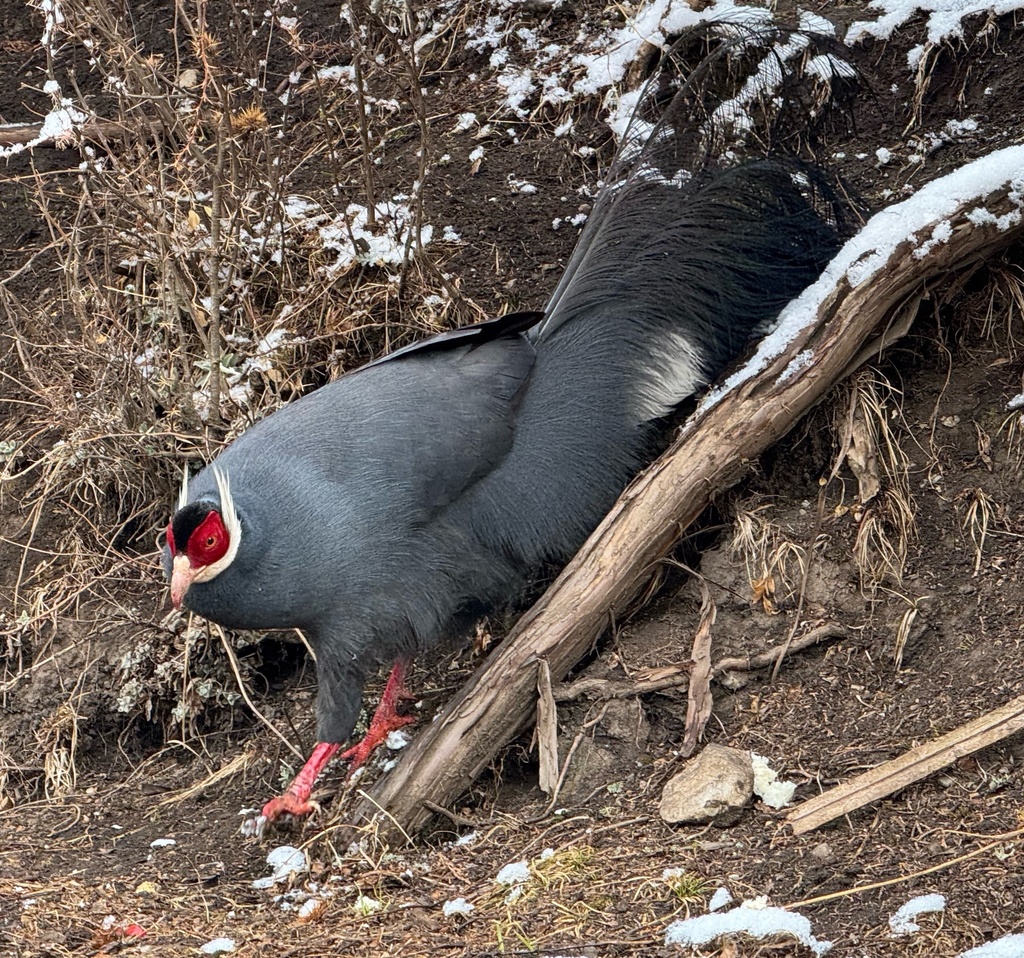
Blue Eared Pheasant
Photo © chrisdt
Photo © chrisdt — CC BY 4.0 — Source: iNaturalist #346984795Identification
The blue eared pheasant is a large, distinctive pheasant measuring around 96 cm in length, including a notably long tail of 49–56 cm. Males are slightly larger and heavier than females, weighing 1700–2110 g compared to females' 1450–1880 g. The species is immediately recognizable by its striking plumage: dark blue-grey feathers with a striking velvet black crown, bright red facial wattles of bare skin surrounding the eyes, and a pale pink bill. Perhaps most notably, it possesses long white ear coverts that extend below and behind the eyes, giving the species its common name. The iris is yellow, and the legs are a vivid crimson. The tail, comprising 24 elongated bluish-grey feathers, is notably curved, loose, and dark-tipped, with the outer five pairs of tail feathers displaying a distinctive white base. Both sexes share similar plumage patterns, though males possess short spurs on their legs.
Range & Habitat
Endemic to China, the blue eared pheasant inhabits the mountain forests of central China, with a distribution positioned geographically to the northeast of the closely related white eared pheasant and southwest of the brown eared pheasant. The species shows a marked preference for juniper scrub within alpine meadows, occurring at high altitudes between 2700–4400 m. This specialized alpine habitat preference makes the species dependent on the specific conditions of central China's mountainous regions.
Behaviour & Diet
The blue eared pheasant is primarily herbivorous, with its diet consisting mainly of berries and vegetable matter, which account for approximately 80% of its food intake. The remaining 20% of its diet comprises insects, particularly beetles, making it an opportunistic forager that supplements its plant-based diet with available invertebrates.
Best Time & Places to See It
As an endemic species found only in central China's mountain forests, the blue eared pheasant can be observed in its specialized alpine meadow and juniper scrub habitat within the 2700–4400 m altitude zone. Although the species is considered rare, it maintains a conservation status of least concern, suggesting populations remain stable. Birdwatchers and wildlife travelers should focus their efforts on the high-altitude mountain regions of central China where juniper scrub habitat is present.
Photography Tips
The blue eared pheasant's striking coloration and distinctive features make it a compelling photographic subject. The contrast between the dark plumage, white ear coverts, red facial wattles, and crimson legs provides excellent opportunities for vibrant wildlife photography. The bird's large size and the characteristic curved tail feathers present opportunities to capture its elegant form. Photographers should be prepared for the high-altitude alpine conditions of its habitat and should exercise patience, as the species' rarity and preference for juniper scrub environments may require dedication to locate and photograph.
Giant Panda National Park
Mianyang, China
+447 birds+47 mammals
Where the eastern slopes of China's Sichuan plateau descend into cloud-wrapped valleys, one of Asia's most biodiverse landscapes unfolds across more than 350,000 square kilometres. This…
VIEW NATIONAL PARKJiuzhai Valley
Jiuzhaigou County, China
+226 birds+7 mammals
Where crystalline alpine streams cascade through limestone gorges and karst terrain rises in dramatic vertical walls, Jiuzhai Valley unfolds across nearly 1,300 square kilometers of southwestern…
VIEW NATURAL MONUMENTHuanglong Scenic and Historic Interest Area
Ngawa Tibetan and Qiang Autonomous Prefecture, China
+194 birds+7 mammals
Across the high plateau of northwestern Sichuan, a geological wonder unfolds where limestone terraces and mineral-rich springs have sculpted one of China's most distinctive natural monuments.…
VIEW NATURAL MONUMENTWolong National Nature Reserve
Wenchuan County, China
+333 birds+17 mammals
Where the Qingyi River cuts through the eastern flanks of the Minshan Range, a temperate montane forest cloaks steep valleys in dense canopy that thins dramatically…
VIEW NATURE RESERVENo community photos yet. Log in to add the first one.
No community observations of this species yet.