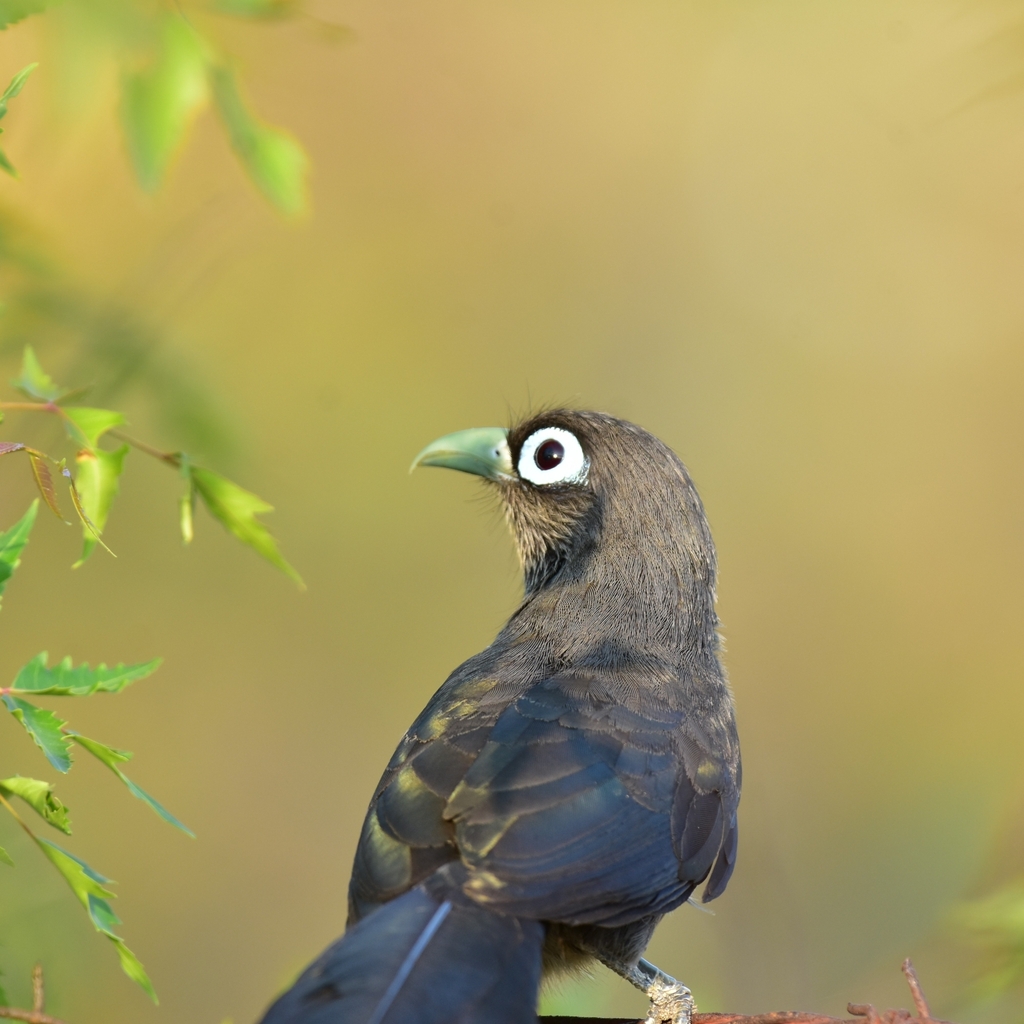
Blue-faced Malkoha
Photo © Renjith Jacob Mathews
Photo © Renjith Jacob Mathews — CC BY 4.0 — Source: iNaturalist #169949831Identification
The blue-faced malkoha is a largish cuckoo at 39 cm in length, unmistakable in its plumage and facial features. Its back and head are dark grey with an oily green or blue gloss, while the long, graduated tail is dark with white tips—notably broader in Sri Lankan birds. The most distinctive feature is the large bare patch of bright blue skin surrounding the eye, which contains a white-fringed red iris. The bill is apple green, contrasting sharply with the dark head. The throat and chin are particularly striking, covered in branched feathers with pointed, slightly yellowish tips that create a streaked, spiny appearance. The lower belly is pale ochre to grey. Males and females are indistinguishable by external appearance, though young birds lack the glossy sheen of adults and retain some brown feathers in their wings.
Range & Habitat
This non-parasitic cuckoo is endemic to peninsular India and Sri Lanka. In India, it is found south of Baroda and Cuttack, occurring in a variety of habitats including semi-evergreen, dry deciduous, and open scrub forests. The species has been recorded in Trichy district of Tamil Nadu. In Sri Lanka, its range is restricted to the plains. The blue-faced malkoha is a bird of open forests and scrub jungle, preferring areas with suitable undergrowth for foraging.
Behaviour & Diet
Despite being a cuckoo, the blue-faced malkoha is non-parasitic and raises its own young. It nests within thorny bushes, constructing a thick platform of twigs lined with green leaves. A typical clutch consists of two eggs, rarely three, which are chalky white in colour. The breeding season is extended and somewhat unclear, though nests have been recorded from March to August. The bird is generally very silent, though it occasionally produces a low, croaky "kraa" call when flushed. For food, it takes a variety of insects, caterpillars, and small vertebrates, usually foraging in the undergrowth rather than in open areas.
Best Time & Places to See It
The best opportunity to encounter this species is during the extended breeding season from March to August, when birds are more active and nesting. Look for them in open forests and scrub jungle habitats across peninsular India south of Baroda and Cuttack, and in the plains of Sri Lanka. They are most likely to be found by scanning the undergrowth of suitable scrub and deciduous forest areas, particularly in areas like Trichy district and other suitable habitat within their range.
Photography Tips
The blue-faced malkoha's striking facial features—the brilliant blue eye patch and apple-green bill—are key photographic subjects worth capturing in detail. Focus on the head to showcase these distinctive markings against the dark plumage. The graduated, white-tipped tail is also photogenic when the bird is perched. Since this species typically forages in the undergrowth, patience and careful stalking in scrub jungle habitat will be necessary. The bird's generally quiet behaviour means it may be easily overlooked, so scan low vegetation carefully. Early morning light will best reveal the oily blue-green gloss on the back and head, enhancing the bird's subtle but beautiful colouration.
Lunugamvehera National Park
Sri Lanka
+204 birds+14 mammals
Dry scrubland and shallow wetlands converge in Sri Lanka's southeastern lowlands, where Lunugamvehera National Park anchors one of the island's most ecologically vital landscapes. The park's…
VIEW NATIONAL PARKMinneriya National Park
Sri Lanka
+158 birds+9 mammals
Across the dry zone of Sri Lanka's North Central Province spreads a landscape of shallow tanks, grassland margins, and scattered dry forest—a mosaic of water and…
VIEW NATIONAL PARKNo community photos yet. Log in to add the first one.
No community observations of this species yet.