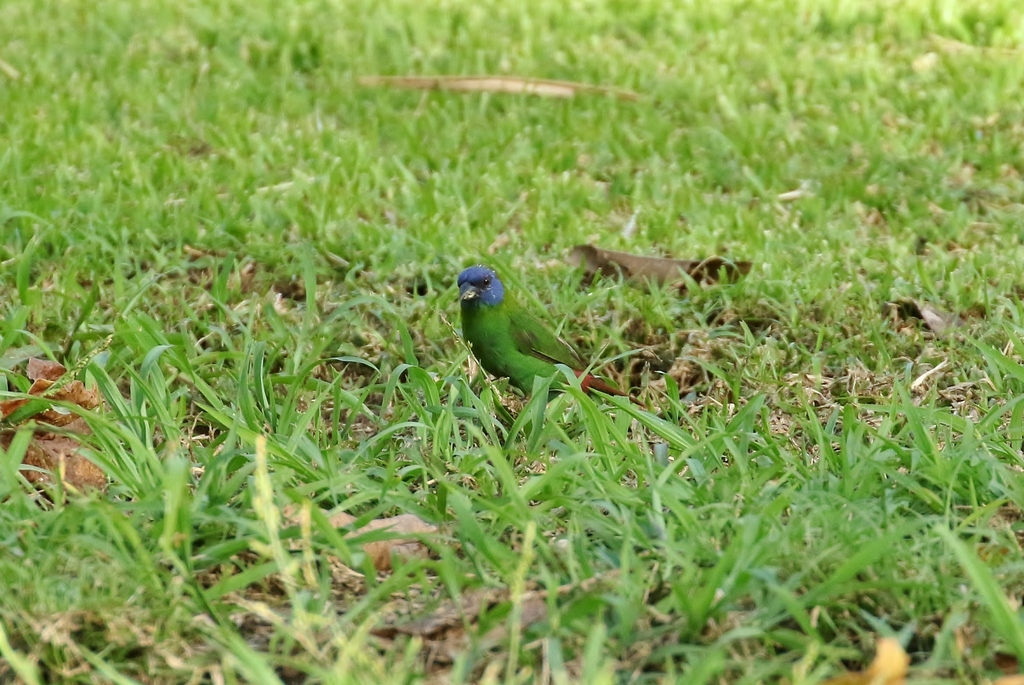
Blue-faced Parrotfinch
Photo © Thibaud Aronson
Photo © Thibaud Aronson — CC BY-SA 4.0 — Source: iNaturalist #22506984The blue-faced parrotfinch (Erythrura trichroa) is a locally common species of estrildid finch found in north-eastern Australia, eastern Indonesia, Papua New Guinea, the Solomon Islands, Vanuatu and New Caledonia, with disjunct populations in Micronesia and Palau. It has an estimated global extent of occurrence of 10,000,000 km2. It is found in subtropical and tropical zones in both montane and lowland moist forest areas, where it is most often associated with forest edges and disturbed habitat. It feeds largely on seeds of grasses, including in Australia several exotic genera especially Brachiaria. The IUCN has classified the species as being of least concern. == Taxonomy == The blue-faced parrotfinch was formally described and illustrated in 1833 by German naturalist Heinrich von Kittlitz based on a specimen collected on the island of Ualan (now Kosrae), one of the Caroline Islands which lie to the north of New Guinea. Kittlitz coined the binomial name Fringilla trichroa where the specific epithet combines the Ancient Greek ρι-/tri- meaning "three-" with χροα/khroa, χροας/khroas meaning "colour" or "appearance". The blue-faced parrotfinch is now one of the 12 species placed in the genus Erythrura that was introduced in 1837 by the English naturalist William Swainson. In the past, due…
Herberton Range National Park
Australia
+115 birds+10 mammals
Rainforest-clad ridges and rocky outcrops define this 324-square-kilometre reserve in far north Queensland, where the mountainous terrain of the Herberton Range rises through layered eucalypt woodland…
VIEW NATIONAL PARKLore Lindu National Park
Indonesia
+177 birds+4 mammals
Across the mountainous spine of Central Sulawesi spreads a wilderness of montane forest, rolling ridges, and deep valleys that rises from the island's volcanic bedrock to…
VIEW NATIONAL PARKNo community photos yet. Log in to add the first one.
No community observations of this species yet.