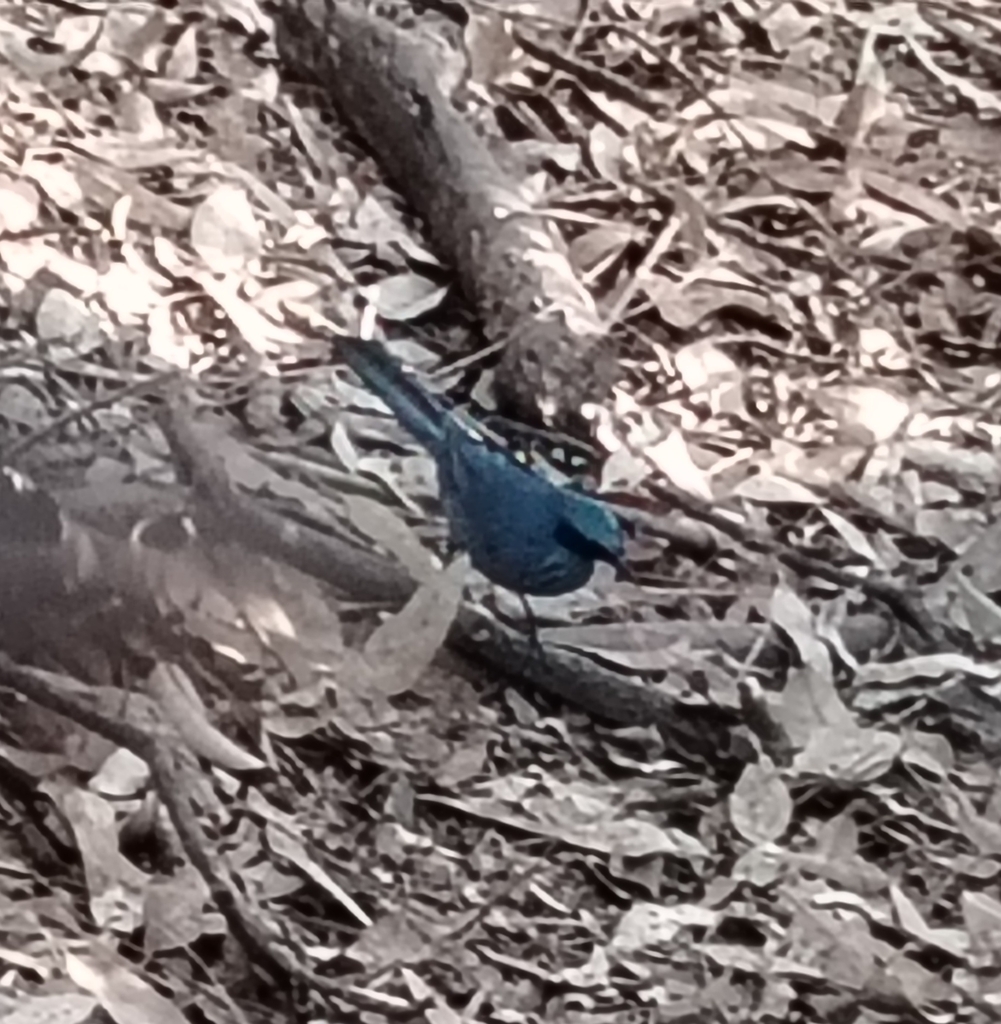
Blue Mockingbird
Photo © Carlos Martínez
Photo © Carlos Martínez — CC BY 4.0 — Source: iNaturalist #256550478Identification
The blue mockingbird is a medium-sized member of the Mimidae family, measuring 9.5–10.5 inches (24–27 cm) in length. Its most distinctive feature is its uniform blue plumage covering the back, tail, wings, head, and underparts—a coloration produced by feather structure rather than pigment, which can appear grayish in shade. The species sports a striking black facial mask surrounding reddish-brown eyes, and dark blue streaks pattern its breast. Its long, thin, slightly curved bill, black legs, and feet complete the portrait of this elegant mockingbird.
Range & Habitat
Endemic to Mexico, the blue mockingbird inhabits a variety of woodland settings including humid forests, riparian thickets, scrub, pine-oak forests, and second growth. It occurs from lowland areas up to elevations of 2,450 meters (8,040 feet). The nominate subspecies (M. c. caerulescens) ranges through the pine-oak zone of western Mexico from southern Sonora south to the Isthmus of Tehuantepec, while the subspecies longirostris is found exclusively on the Tres Marías Islands off the western Mexican coast. The species has occasionally appeared as a vagrant in the southern United States.
Behaviour & Diet
The blue mockingbird is an omnivore with a preference for invertebrates, though it also consumes vegetable matter. During breeding season, pairs construct cup nests from twigs and rootlets. With an estimated population of 500,000 to nearly 5 million individuals across its very large range, this species maintains healthy numbers, though recent evidence suggests populations are declining due to habitat fragmentation and loss.
Best Time & Places to See It
Observers seeking this striking blue bird should focus on the pine-oak woodlands and subtropical montane forests of western Mexico. The species' preference for varied woodland habitats means it can be encountered in degraded former forest areas as well as intact montane forest. Its relatively large population and wide elevation range (from lowlands to 2,450 meters) make it an achievable target for dedicated birders exploring Mexican woodlands.
Photography Tips
The blue mockingbird's brilliant blue plumage presents both opportunities and challenges for photographers. The structural color of its feathers can appear gray in shaded forest conditions, so seek open perches or early morning light to capture its true blue tones. The contrasting black facial mask and reddish-brown eyes provide excellent focal points. The bird's long, slightly graduated tail and slender profile offer distinctive silhouettes. Patient observation in pine-oak zones during active foraging periods will yield the best opportunities for quality images.
Parque Nacional Cerro de la Estrella
Mexico
+126 birds+4 mammals
Where volcanic peaks rise sharply above Mexico City's sprawling metropolis, Parque Nacional Cerro de la Estrella offers a rare glimpse of high-altitude terrain within one of…
VIEW NATIONAL PARKParque Nacional Benito Juárez
San Andrés Huayápam, Mexico
+128 birds+4 mammals
High in the Sierra Madre del Sur of Oaxaca, where cloud forest mingles with pine woodland and the terrain climbs steeply through ravines carved by mountain…
VIEW NATIONAL PARKNo community photos yet. Log in to add the first one.
No community observations of this species yet.