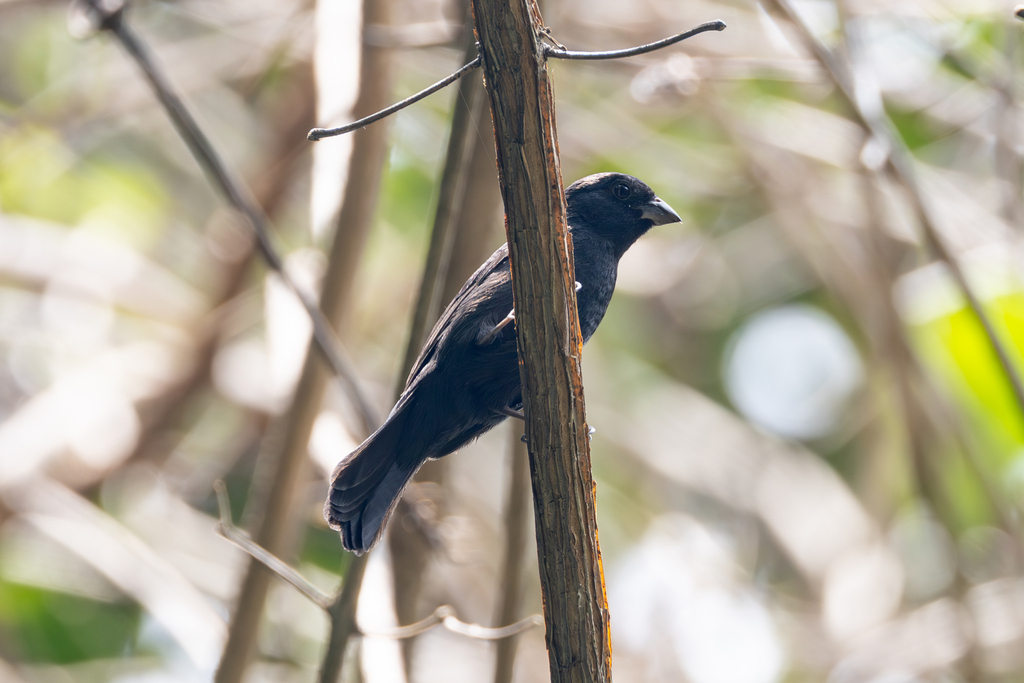
Blue Seedeater
Photo © Ryan F. Mandelbaum
Photo © Ryan F. Mandelbaum — CC BY 4.0 — Source: iNaturalist #180757302The blue seedeater (Amaurospiza concolor) or Cabanis's seedeater is a species of bird in the cardinal family that is found in southern Mexico and Central America. The Ecuadorian seedeater (Amaurospiza aequatorialis) was formerly considered a subspecies of the blue seedeater. == Taxonomy and systematics == The blue seedeater was formally described in 1861 by the German ornithologist Jean Cabanis based on a specimen that had been collected in Costa Rica. Cabanis placed the species in a new genus Amaurospiza and coined the binomial name Amaurospiza concolor. The specific epithet is Latin meaning "uniform", "similar in colour" or "plain". The blue seedeater was formerly considered to be conspecific with the Ecuadorian seedeater. Most authorities now treat the Ecuadorian seedeateras a separate species. This is based largely on the results of molecular phylogenetic studies that were published in 2014 and 2023. Confusingly, as of January 2024, BirdLife International uses the scientific name A. moesta for blue seedeater. The BirdLife account encompasses what are now the blue, Ecuadorian, and blackish-blue seedeaters. Two subspecies are recognised: A. c. relicta (Griscom, 1934) – southwest Mexico A. c. concolor Cabanis, 1861 – south Mexico, Belize, Honduras to Panama == Description == The blue seedeater is 11.5…
Chirripó National Park
Rivas, Costa Rica
+274 birds+6 mammals
Where the volcanic spine of Costa Rica's Central Cordillera reaches its apex, Chirripó National Park encompasses a landscape that shifts dramatically with elevation, from montane cloud…
VIEW NATIONAL PARKBraulio Carrillo National Park
Las Horquetas, Costa Rica
+547 birds+18 mammals
Where the Caribbean slope descends from the central volcanic cordillera toward the humid lowlands of Heredia, Braulio Carrillo National Park preserves one of Costa Rica's most…
VIEW NATIONAL PARKVolcán Poás National Park
Toro Amarillo, Costa Rica
+237 birds+4 mammals
Where volcanic slopes rise sharply from the Central Valley floor, Volcán Poás National Park protects one of Costa Rica's most active and accessible volcanic systems. The…
VIEW NATIONAL PARKBaru Volcano National Park
Cerro Punta, Panama
+402 birds+6 mammals
Where the land rises sharply toward the Caribbean's western spine, Baru Volcano National Park sprawls across roughly 220 square kilometres of southwestern Panama, anchored by the…
VIEW NATIONAL PARKParque Internacional la Amistad
Teribe, Panama
+325 birds+11 mammals
Where the continental divide rises between the Caribbean and Pacific watersheds, a wilderness of extraordinary biological richness unfolds across the Talamanca Range and into lowland rainforest—a…
VIEW NATIONAL PARKSierra del Lacandón National Park
Petén, Guatemala
+348 birds+7 mammals
Where the Petén rainforest rises into limestone ridges and deep ravines, Sierra del Lacandón National Park protects one of Central America's most intact tropical wilderness zones.…
VIEW NATIONAL PARKLa Amistad International Park
Crorina, Costa Rica
+532 birds+20 mammals
Where the Caribbean slopes of Costa Rica's Talamanca Mountains rise steeply inland from Limón, the boundary between two nations dissolves into an unbroken expanse of rainforest.…
VIEW NATIONAL PARKNo community photos yet. Log in to add the first one.
No community observations of this species yet.