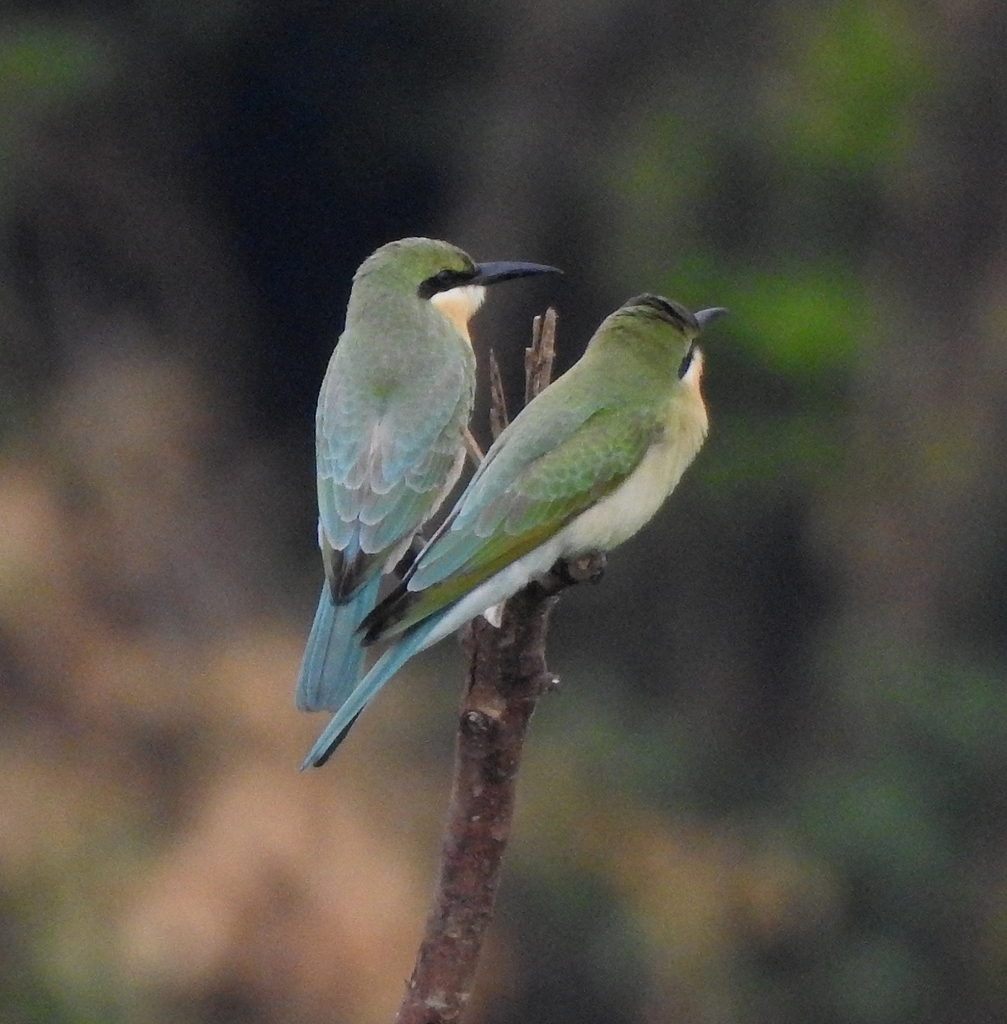
Blue-tailed Bee-eater
Photo © Afsar Nayakkan
Photo © Afsar Nayakkan — CC BY 4.0 — Source: iNaturalist #132246538Identification
The blue-tailed bee-eater is a richly coloured, slender bird around 29 cm long, with elongated central tail feathers adding an extra 7 cm. Its predominantly green plumage is distinctive: the face features a narrow blue patch with a black eye stripe, a yellow and brown throat, and a striking blue tail. The beak is black, and the three outer toes are united around their bases. Weighing 29–43 grams, both sexes appear alike to the human eye, though subtle differences exist—males tend to have longer central tail feather extensions and darker chestnut throats with brighter green plumage, while females show brighter blue rumps and yellow chins. Juveniles are drabber and lack the elongated central tail feathers.
Within its range, the only potentially confusable species is the blue-cheeked bee-eater, which favours drier habitats. The blue-tailed differs distinctly in having blue rather than green and black on the rump and tail, bluish rather than green undertail feathers, a much smaller blue cheek patch, and darker, more extensive chestnut on the throat and breast.
Range & Habitat
The blue-tailed bee-eater is widely distributed across South and Southeast Asia with a patchy breeding distribution spanning India, Myanmar, and parts of Southeast Asia. In India, they breed in several river valleys including the Godavari, Kaveri, Tunga Badra, and Krishna rivers, as well as in the eastern parts of Sri Lanka. The species is strongly migratory across much of its range, with populations seen seasonally in many areas and known to migrate diurnally en masse at locations such as Tanjung Tuan in West Malaysia and Promsri Hill in southern Thailand. They are winter visitors in parts of Malaysia and peninsular India.
This species is characteristically found in open habitats close to water. They breed colonially in small areas, mostly in river valleys, nesting by tunneling into loamy sand banks. They prefer sandy and sandy clay loams while avoiding heavier clay loams, and favour clear mud banks without vegetation cover. Notably, in Sri Lanka they have been recorded breeding in artificial sand dunes created by dredging of sea sand.
Behaviour & Diet
Like other bee-eaters, the blue-tailed bee-eater predominantly eats flying insects, especially bees (including large Xylocopa species), wasps, and hornets, which are caught in the air during sorties from an open perch. They probably take bees and dragonflies in roughly equal numbers. The species may also forage in flight over estuaries, backwaters, and even over the sea, though not far from the coast. Insects are beaten on the perch to kill them and break the exoskeleton—a habit common throughout the order Coraciiformes. These birds call mainly in flight with a rolling chirping whistling "teerp" sound, and they feed and roost communally.
Breeding occurs from April to May, with birds nesting colonially in closely placed nest holes in vertical mudbanks or gently sloping land. Nest tunnels can run nearly 2 metres deep. About 5 to 7 near-spherical eggs are laid, with both parents incubating and caring for the eggs. Parents actively guard the nest to prevent intraspecific brood parasitism and extra-pair copulation. One or two helpers may join the breeding pair after incubation begins.
Best Time & Places to See It
The blue-tailed bee-eater's strong migratory patterns make seasonal timing crucial for observation. Prime locations for viewing include the river valleys of India where they breed colonially—particularly the Godavari, Kaveri, Tunga Badra, and Krishna river systems during the April to May breeding season. In Sri Lanka, eastern regions offer breeding-season opportunities. For witnessing spectacular diurnal mass migrations, Tanjung Tuan in West Malaysia and Promsri Hill in southern Thailand are renowned hotspots. During non-breeding seasons, they can be found as winter visitors in parts of Malaysia and peninsular India, with overlapping ranges with blue-cheeked bee-eaters in Gujarat and western peninsular India.
Photography Tips
Photographing blue-tailed bee-eaters requires patience and positioning near water and open habitats where they hunt. The species' habit of catching insects from an open perch makes action photography possible—position yourself with clear sight lines to their favourite hunting posts. The striking blue tail and green plumage photograph best in strong, natural light. During breeding season, colonial nesting sites offer opportunities for behavioural shots, though exercise caution to avoid disturbing nesting birds. For migration photography, locations like Tanjung Tuan and Promsri Hill offer chances to capture birds in flight during mass movements. The elongated central tail feathers are a key identifying feature worth emphasizing in images.
Lunugamvehera National Park
Sri Lanka
+204 birds+14 mammals
Dry scrubland and shallow wetlands converge in Sri Lanka's southeastern lowlands, where Lunugamvehera National Park anchors one of the island's most ecologically vital landscapes. The park's…
VIEW NATIONAL PARKMinneriya National Park
Sri Lanka
+158 birds+9 mammals
Across the dry zone of Sri Lanka's North Central Province spreads a landscape of shallow tanks, grassland margins, and scattered dry forest—a mosaic of water and…
VIEW NATIONAL PARKWasgamuwa National Park
Sri Lanka
+156 birds+8 mammals
Dry deciduous forest and open grassland sweep across the North Central lowlands where Wasgamuwa National Park protects one of Sri Lanka's largest remaining tracts of this…
VIEW NATIONAL PARKAngamedilla National Park
Polonnaruwa, Sri Lanka
+40 birds+2 mammals
Ancient tanks and sal forests define this water-rich sanctuary in Sri Lanka's North Central heartland, where seasonal wetlands and dry deciduous woodland create a mosaic of…
VIEW NATIONAL PARKOrang National Park
Rangagarapathar, India
+298 birds+1 mammals
Where the Brahmaputra's floodplains meet the foothills of Assam, Orang National Park unfolds across a mosaic of riverine grasslands, forests and wetlands that pulse with the…
VIEW NATIONAL PARKRanthambhore National Park
Sawai Madhopur, India
+294 birds+20 mammals
Granite ridges and ravines carved through the Aravalli Range frame this protected landscape in eastern Rajasthan, where deciduous forest mingles with open scrubland and seasonal water…
VIEW NATIONAL PARKEravikulam National Park
Devikulam, India
+192 birds+7 mammals
High in the Western Ghats of Kerala, where monsoon mists cling to slopes that rise above 2,000 metres, Eravikulam National Park preserves one of South India's…
VIEW NATIONAL PARKMu Ko Ang Thong National Park
Thailand
+47 birds+1 mammals
Forty-two limestone islands rise from the Gulf of Thailand, their weathered karst peaks piercing emerald waters in a landscape of stunning geological drama. Mu Ko Ang…
VIEW NATIONAL PARKHat Noppharat Thara-Mu Ko Phi Phi National Park
Ao Nang, Thailand
+253 birds+9 mammals
Where limestone karsts rise dramatically from turquoise waters, Hat Noppharat Thara-Mu Ko Phi Phi National Park unfolds across a mosaic of beach, mangrove forest, and island…
VIEW NATIONAL PARKKhao Yai National Park
Prachantakham District, Thailand
+377 birds+46 mammals
Evergreen dipterocarp forest blankets the rolling terrain of this national park in eastern Thailand, where limestone hills rise abruptly from the forest floor and seasonal streams…
VIEW NATIONAL PARKKhao Laem Ya-Mu Ko Samet National Park
Mueang Rayong District, Thailand
+159 birds+3 mammals
Where limestone hills meet the Gulf of Thailand, Khao Laem Ya–Mu Ko Samet National Park stitches together a mosaic of terrestrial and marine worlds that few…
VIEW NATIONAL PARKKhao Laem National Park
Sangkhla Buri District, Thailand
+197 birds
Where the Vajiralongkorn Reservoir sprawls across the forested valleys of Kanchanaburi's northern borderlands, Khao Laem National Park protects a landscape where limestone ridges rise dramatically from…
VIEW NATIONAL PARKKanha Tiger Reserve
Kanha Kisli F.V., India
+321 birds+23 mammals
Where sal forests give way to emerald meadows and crystalline streams carve through ancient valleys, one of India's finest wilderness reserves unfolds across the Maikal Range.…
VIEW NATIONAL PARKTadoba National Park
Palasgaon Singru, India
+270 birds+20 mammals
Where sal forests meet open grasslands and rocky outcrops rise from red laterite soil, central India's landscape unfolds in raw, untamed beauty. Ancient teak woodlands and…
VIEW NATIONAL PARKBandhavgarh National Park
Garhpuri, India
+285 birds+17 mammals
Where granite ridges rise dramatically above sal and bamboo forests, one of India's most pristine tiger reserves unfolds across the Vindhyan plateau. Ancient rock formations tower…
VIEW NATIONAL PARKPanna National Park
Badgadi Kalan, India
+271 birds+17 mammals
Where granite gorges slice through central India's Vindhyan plateau, a landscape of stark beauty unfolds across nearly six hundred square kilometers. The Ken River carves through…
VIEW NATIONAL PARKKaziranga National Park
Kohora, India
+422 birds+26 mammals
Dawn breaks over the floodplains of the Brahmaputra, where tall grasslands stretch endlessly beneath monsoon-heavy skies. This sprawling wilderness of northeastern Assam is a mosaic of…
VIEW NATIONAL PARKKeoladeo National Park
Shreenagar Rural, India
+326 birds+14 mammals
Where shallow wetlands shimmer beneath vast Rajasthani skies, one of Asia's finest bird sanctuaries pulses with extraordinary life. This former maharaja's hunting reserve, now spanning 29…
VIEW NATIONAL PARKPeriyar National Park
Mlappara, India
+232 birds+4 mammals
Dawn breaks over mist-shrouded ridges where the Western Ghats tumble toward Kerala's spice-scented lowlands. Here, ancient tropical forests envelope a glittering artificial lake, creating a mosaic…
VIEW NATIONAL PARKPampadum Shola National Park
Vattavada, India
+258 birds+14 mammals
Where misty shola forests cling to the high plateaus of the Nilgiri Mountains, ancient evergreen remnants create a world apart. This 2,316-hectare reserve protects one of…
VIEW NATIONAL PARKBandipur National Park
Hirehalli, India
+302 birds+19 mammals
Where the Western Ghats descend into the Deccan plateau, ancient deciduous forests blanket a landscape carved by the Nugu River. Bandipur unfolds across 880 square kilometres…
VIEW NATIONAL PARKNagarahole Tiger Reserve
Nalkeri Forest, India
+323 birds+23 mammals
Where granite escarpments rise above dense deciduous forests and the Kabini River carves through pristine wilderness, one of India's most biodiverse landscapes unfolds across the Western…
VIEW NATIONAL PARKTaman Negara National Park
Kampong Samas, Malaysia
+393 birds+48 mammals
Where ancient rainforest meets limestone peaks, one of Southeast Asia's oldest protected wilderness preserves sprawls across 4,343 square kilometers of primordial landscape. Dipterocarp giants tower overhead,…
VIEW NATIONAL PARKPenang National Park
Balik Pulau, Malaysia
+107 birds+2 mammals
Granite peaks rise abruptly from the Andaman Sea where tropical rainforest clings to steep slopes in one of Malaysia's oldest protected landscapes. Mangrove forests fringe the…
VIEW NATIONAL PARKTaman Nasional Baluran
Situbondo, Indonesia
+189 birds+9 mammals
Across the northeastern tip of East Java, where monsoon winds sweep down from the Bali Strait, a landscape of contrasts unfolds within 374 square kilometres of…
VIEW NATIONAL PARKWest Bali National Park
Gerokgak, Indonesia
+240 birds+8 mammals
Across West Bali's northwestern reaches, where the Indian Ocean meets volcanic slopes and limestone cliffs plunge toward turquoise shallows, sprawls a protected realm of roughly 325…
VIEW NATIONAL PARKBogani Nani Wartabone National Park
Bolaang Mongondow, Indonesia
+154 birds+4 mammals
Across North Sulawesi's rugged interior, where tectonic uplift has carved steep ridges and deep valleys through ancient volcanic terrain, Bogani Nani Wartabone National Park sprawls across…
VIEW NATIONAL PARKGunung Ciremai National Park
Majalengka, Indonesia
+116 birds+1 mammals
Volcanic slopes rise sharply from West Java's interior, where Gunung Ciremai's 3,078-metre summit dominates a landscape carved by geological upheaval and shaped by equatorial monsoon rainfall.…
VIEW NATIONAL PARKLore Lindu National Park
Indonesia
+177 birds+4 mammals
Across the mountainous spine of Central Sulawesi spreads a wilderness of montane forest, rolling ridges, and deep valleys that rises from the island's volcanic bedrock to…
VIEW NATIONAL PARKSembilang National Park
Banyuasin, Indonesia
+56 birds+3 mammals
Where tidal mangroves grade into freshwater swamp forest and the Musi River delta spreads across more than 7,000 square kilometres, Sembilang National Park represents one of…
VIEW NATIONAL PARKBerbak National Park
Tanjung Jabung Timur, Indonesia
+24 birds
Across the lowland peatswamps and tidal forests of eastern Sumatra's coast, Berbak National Park sprawls over more than 3,000 square kilometres of one of Southeast Asia's…
VIEW NATIONAL PARKWay Kambas National Park
Lampung Timur, Indonesia
+237 birds+20 mammals
Across the low swamplands of eastern Lampung, where freshwater wetlands merge into tidal mangrove forests along the Sunda Strait, sprawls one of Sumatra's most vital sanctuaries.…
VIEW NATIONAL PARKKomodo National Park
Komodo, Indonesia
+155 birds+14 mammals
Where volcanic peaks rise dramatically from turquoise waters, a primordial landscape unfolds across three main islands and countless smaller ones scattered throughout the Lesser Sunda archipelago.…
VIEW NATIONAL PARKGir National Park
Asundrali, India
+258 birds+13 mammals
Dry deciduous forests cloak the rolling hills of western Gujarat where the Gir landscape rises as a final sanctuary for one of the world's rarest felids:…
VIEW NATIONAL PARKGaoligong Mountain National Nature Reserve
Nujiang Lisu Autonomous Prefecture, China
+443 birds+13 mammals
VIEW NATURE RESERVENo community photos yet. Log in to add the first one.
No community observations of this species yet.