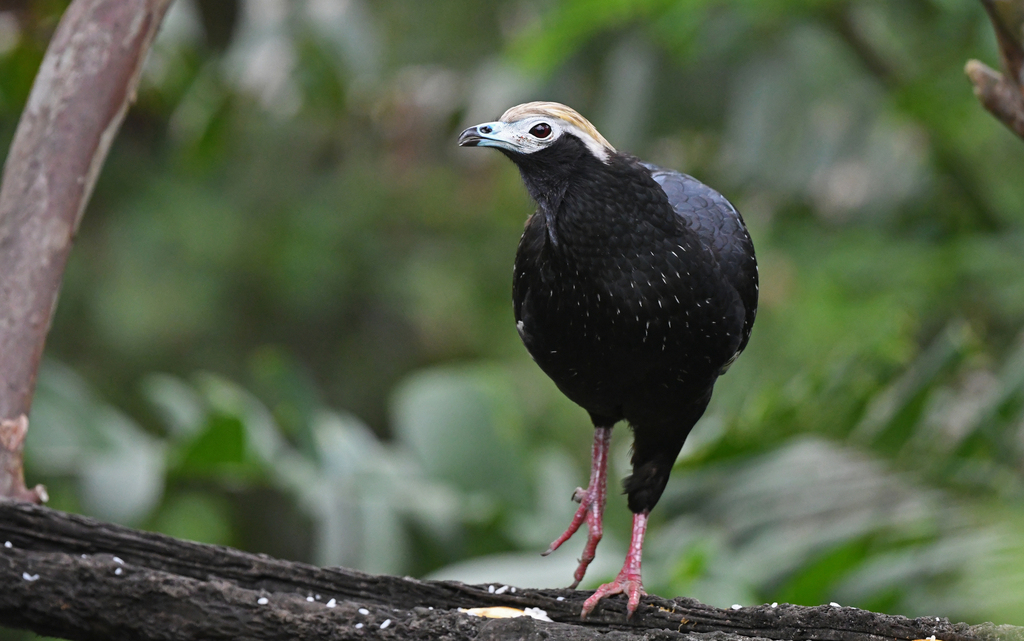
Blue-throated Piping Guan
Photo © Christoph Moning
Photo © Christoph Moning — CC BY 4.0 — Source: iNaturalist photo #329415473Identification
The blue-throated piping guan is a striking and unusual member of the guan family, measuring 60 to 69 cm long and weighing approximately 970 to 1,350 grams. Its most distinctive feature is its disproportionate anatomy: a long tail and particularly long, slender neck supporting a small head that has been described as looking oddly prehistoric or reptilian. The plumage is predominantly blackish with a greenish-blue gloss that is strongest on the shoulders, wings, and tail. The white forehead, crown, and nape contrast sharply with the dark body, and white outer wing coverts form a prominent patch visible on the folded wing. The most variable feature is the bare skin around the eye and forming a distinctive dewlap beneath the chin, which ranges from white to cobalt blue, slaty purple, dark purplish gray, or black. The reddish to brownish-red legs complete this handsome, if oddly proportioned, bird.
Range & Habitat
The blue-throated piping guan inhabits the Amazon Basin across a vast range that extends from northwestern Bolivia through Peru and Ecuador to Colombia, Venezuela, the Guianas, and northwestern Brazil. Within this distribution, the species shows a strong preference for humid tropical forests, including terra firme, várzea, gallery, and semi-deciduous forest types. In the Guianas, it also frequents less forested coastal areas. The species exhibits a remarkable fidelity to waterways, occurring almost always within 100 meters of rivers. Elevation varies across its range, reaching 300 meters in Bolivia, 400 meters in Ecuador, 500 meters in Colombia, 1,000 meters in Venezuela, and 1,100 meters in Peru.
Behaviour & Diet
The blue-throated piping guan is primarily frugivorous, with figs being its favored food, though it consumes fruits from many plant families and also eats leaves. Outside the breeding season, these birds may gather in flocks of up to 30 individuals, especially at salt licks. They typically forage in the canopy or just below it, though they will descend to feed on the ground beneath fruiting trees. The species also practices geophagy, consuming mineral-rich soil. The species is mostly sedentary, though it may make local or elevational movements in response to fruit availability.
Best Time & Places to See It
The breeding season, spanning from August to possibly April during the local wet season, is when the blue-throated piping guan is most vocal and conspicuous. The species' preference for areas near rivers and its relatively conspicuous habits make it more visible than many other forest guans, though it varies from rare in some locations to common in others. Early morning and dusk are the optimal times to encounter this species, as it performs its spectacular displays during these periods. The bird's very large range across the Amazon Basin means it can be found in appropriate habitat throughout Bolivia, Peru, Ecuador, Colombia, Venezuela, the Guianas, and northwestern Brazil.
Photography Tips
Photographers seeking the blue-throated piping guan should position themselves near rivers within humid tropical forests, where the species is most likely to be encountered. The bird's distinctive white markings on the head and wings offer excellent contrast against its dark plumage, making for striking photographs. During breeding season, arrive at promising locations before dawn to witness the bird's remarkable flight display accompanied by its distinctive song of slow, clear whistles. The dramatic vocal performance is usually accompanied by wing-claps or wing-whirring sounds, providing multiple opportunities for both audio and visual documentation. The long tail and slender neck create an unmistakable silhouette that should be easily recognizable in flight against the forest canopy.
Yasuní National Park
Aguarico, Ecuador
+601 birds+43 mammals
Where the western Amazon basin converges with Ecuador's Orellana Province, lowland rainforest reaches toward the horizon in an unbroken canopy of staggering botanical density. Yasuní National…
VIEW NATIONAL PARKSumaco Napo-Galeras National Park
Loreto, Ecuador
+563 birds+4 mammals
Where Ecuador's Amazon transitions into cloud forest, a massive shield volcano rises from the emerald lowlands of Orellana Province, anchoring one of the continent's most biodiverse…
VIEW NATIONAL PARKManu National Park
Manu, Peru
+892 birds+26 mammals
Across the eastern slopes of the Peruvian Andes, tropical rainforest descends into the Amazon basin with a complexity that few terrestrial ecosystems match. Manu National Park…
VIEW NATIONAL PARKSierra del Divisor National Park
Alto Tapiche, Peru
+298 birds+2 mammals
Where the western Amazon meets the Andes foothills, nearly 41,000 square kilometres of pristine rainforest rise across Peru's Alto Tapiche region in a landscape of extraordinary…
VIEW NATIONAL PARKBahuaja Sonene National Park
San Pedro de Putina Punco, Peru
+602 birds+8 mammals
Where the Madre de Dios and Heath rivers converge in southeastern Peru rises one of South America's most biodiverse wilderness regions: a vast protected realm of…
VIEW NATIONAL PARKNo community photos yet. Log in to add the first one.
No community observations of this species yet.