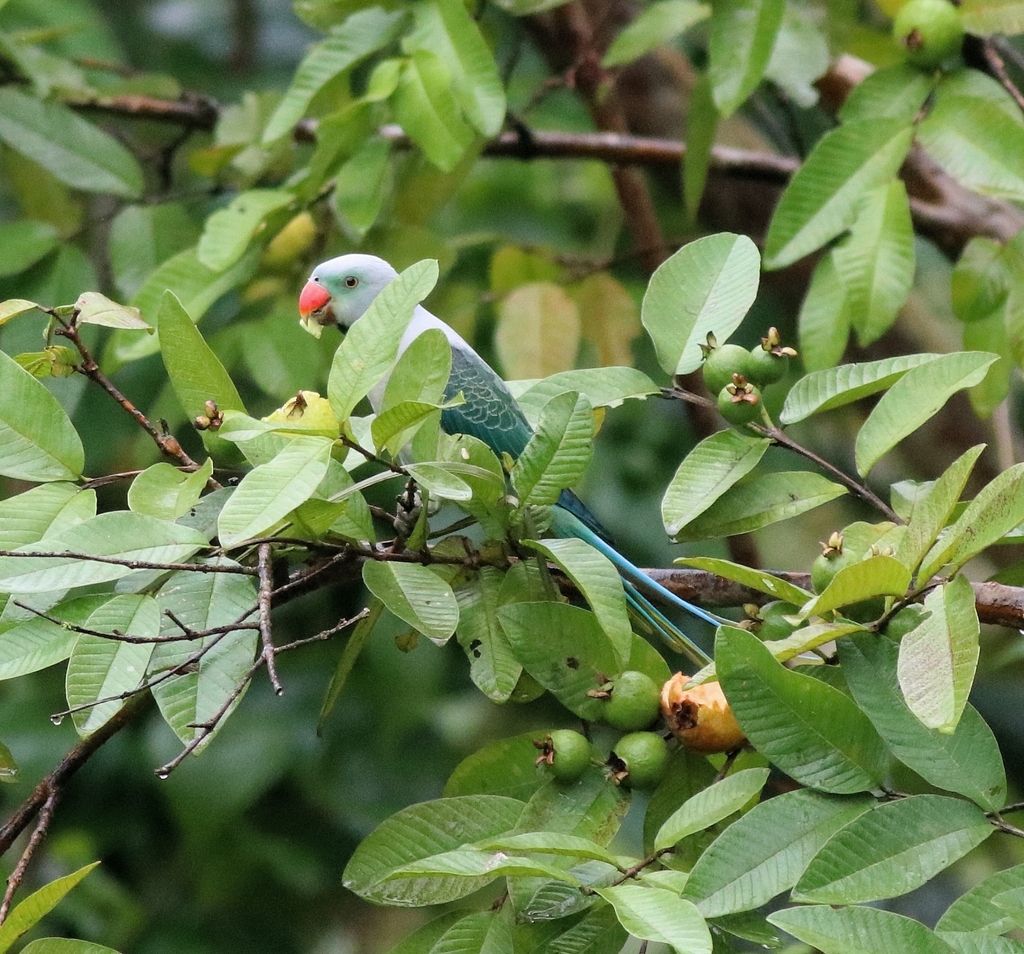
Blue-winged Parakeet
Photo © Afsar Nayakkan
Photo © Afsar Nayakkan — CC BY 4.0 — Source: iNaturalist #179563761Identification
The blue-winged parakeet is a striking small parrot characterized by its bluish-grey plumage contrasted with distinctive long blue tail feathers tipped in yellow and dark wings. Both males and females display a complete black neck ring, making this feature a reliable identifying mark. The most useful field distinction between the sexes lies in the beak: males have a red upper mandible with a white tip, while females possess an entirely black bill. Females can be confused with the similar plum-headed parakeet, but the latter species shows a broad yellow collar absent in the blue-winged parakeet. When in flight through forest clearings, flocks produce distinctive screeching calls—a rapid series of "keek-keek-keek"—that differ noticeably from other parakeet species sharing their range.
Range & Habitat
The blue-winged parakeet is endemic to the Western Ghats of southern India, where it inhabits forested regions from approximately 19°N (near Bombay) southward to Kerala. The species also extends into the hills of the Palnis and Nilgiris, with populations occurring in adjoining Eastern Ghats including the Biligirirangan range and possibly the Kolli Hills. These parakeets are found in small flocks moving through the forest canopy, preferring areas with suitable nesting cavities and flowering or fruiting trees that provide food resources.
Behaviour & Diet
Blue-winged parakeets are social birds that move through forests in coordinated flocks, flying with rapid wingbeats while maintaining constant vocal contact through their characteristic screeching calls. They breed during the dry season following the northeast monsoon, with chicks fledging before the southwest monsoon arrives in June. Breeding season commences in December, with eggs laid in December and January; clutches typically contain four eggs that hatch after approximately 23 days. During incubation, females initially brood while males provision food, though males later take over brooding duties. Chicks remain in the nest for about a month before fledging. The species feeds on vegetation, with documented observations of birds consuming the leaves of Loranthus longiflorus. They nest in tree cavities, showing a preference for tall Mesua ferrea trees and frequently utilizing abandoned woodpecker and barbet nests.
Best Time & Places to See It
The best viewing opportunities occur during the breeding season from December through June, when birds are most active and vocal. The Western Ghats, particularly in Kerala and the Nilgiris region, offer the most reliable locations for encountering this species. Early morning hours are ideal for observing parakeets as they move through the forest canopy and produce their distinctive calls.
Photography Tips
The blue-winged parakeet's rapid flight and active behavior in forest clearings present a challenging photography subject. Focus on capturing birds perched on prominent branches where their distinctive blue tails, dark wings, and grey plumage create strong visual contrast. The sexual dimorphism in bill color provides excellent compositional opportunities for identifying and separating males from females in photographs. Patience and positioning near known roosting or feeding areas during early morning will increase your chances of obtaining quality flight shots as flocks move through the canopy.
Eravikulam National Park
Devikulam, India
+192 birds+7 mammals
High in the Western Ghats of Kerala, where monsoon mists cling to slopes that rise above 2,000 metres, Eravikulam National Park preserves one of South India's…
VIEW NATIONAL PARKPeriyar National Park
Mlappara, India
+232 birds+4 mammals
Dawn breaks over mist-shrouded ridges where the Western Ghats tumble toward Kerala's spice-scented lowlands. Here, ancient tropical forests envelope a glittering artificial lake, creating a mosaic…
VIEW NATIONAL PARKPampadum Shola National Park
Vattavada, India
+258 birds+14 mammals
Where misty shola forests cling to the high plateaus of the Nilgiri Mountains, ancient evergreen remnants create a world apart. This 2,316-hectare reserve protects one of…
VIEW NATIONAL PARKBandipur National Park
Hirehalli, India
+302 birds+19 mammals
Where the Western Ghats descend into the Deccan plateau, ancient deciduous forests blanket a landscape carved by the Nugu River. Bandipur unfolds across 880 square kilometres…
VIEW NATIONAL PARKNagarahole Tiger Reserve
Nalkeri Forest, India
+323 birds+23 mammals
Where granite escarpments rise above dense deciduous forests and the Kabini River carves through pristine wilderness, one of India's most biodiverse landscapes unfolds across the Western…
VIEW NATIONAL PARKNo community photos yet. Log in to add the first one.
No community observations of this species yet.