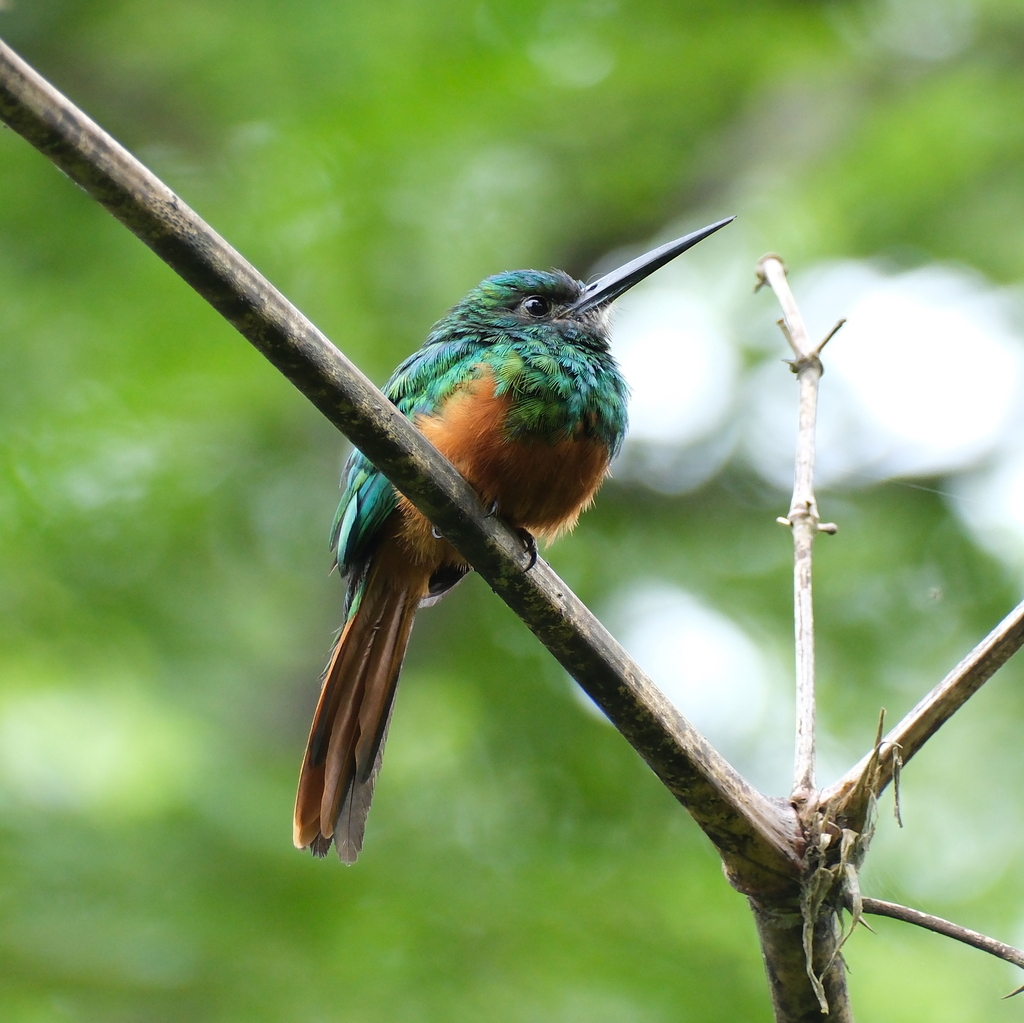
Bluish-fronted Jacamar
Photo © agujaceratops
Photo © agujaceratops — CC BY 4.0 — Source: iNaturalist #148330650Identification
The bluish-fronted jacamar is a small bird measuring 20 to 23 cm in length and weighing 22 to 26 grams. Males are particularly striking, with a metallic green to bluish crown and forehead that gives the species its name, complemented by metallic green upperparts with a bluish gloss. The chin and upper throat are blackish, while the lower throat and chest are green, and the remaining underparts are distinctly rufous. Females are similar to males but differ subtly in having ochraceous (warm buff-brown) lower breast and belly plumage rather than pure rufous.
Range & Habitat
The bluish-fronted jacamar is found in western South America, east of the Andes and south of the Amazon River. Its range encompasses eastern Peru, western Brazil as far east as the Madeira River, and extends south into Bolivia's La Paz Department. This species inhabits humid primary forest, gallery forest, and secondary forest, typically at elevations up to 1,000 meters.
The bird shows a preference for mid-stage succession vegetation along forest edges, with a particular affinity for areas near watercourses and lakesides. This habitat preference makes it most likely to be encountered in riparian zones and transitional forest areas rather than in dense primary forest interiors.
Behaviour & Diet
The bluish-fronted jacamar is an insectivorous species that hunts by sallying—a technique wherein it perches on exposed branches or scrub vegetation and makes quick aerial forays to snatch flying insects from the air. While the precise composition of its diet has not been thoroughly documented, it is believed to consume many kinds of flying insects. The species is sometimes observed joining mixed-species foraging flocks, a behaviour that may enhance foraging efficiency.
The bird's vocalizations are distinctive and complex, rendered as "kip kip-kip-kipkikikrkrkrrr-kree-kree-kree-kip-kip-kikikrrrrreeuw." Unfortunately, detailed information about its breeding phenology remains undocumented.
Best Time & Places to See It
The bluish-fronted jacamar appears to be common throughout its range and occurs in several protected areas, making it a reliable target for birders and naturalists visiting the appropriate regions. The species is best sought in Peru, Brazil, and Bolivia, particularly in areas with suitable riparian and forest-edge habitats. Its preference for edges and watercourses means that birders should focus their efforts on gallery forests, lakesides, and areas of secondary forest regeneration rather than attempting to locate it in deep primary forest.
Photography Tips
Photographing the bluish-fronted jacamar presents both challenges and rewards. The species' habit of perching on exposed branches offers opportunities for clean, well-lit shots, though patience is essential. The iridescent metallic plumage—particularly the bluish-green crown—is best captured in bright, natural light that brings out the subtle colour variations. Since the bird hunts by sallying from exposed perches, photographers should position themselves with clear sight lines to these hunting vantage points and anticipate the bird's quick movements to capture it in flight or mid-strike.
Serra do Divisor National Park
Brazil
+448 birds+10 mammals
Where the western Amazon meets the Andes foothills, Serra do Divisor National Park sprawls across one of South America's most biodiverse and least accessible frontiers. Spanning…
VIEW NATIONAL PARKOtishi National Park
Río Tambo, Peru
+108 birds
Where the Andes descend toward the Amazon basin, vast cloud forests cloak the ridges and valleys of Peru's Río Tambo watershed, and this is where Otishi…
VIEW NATIONAL PARKYanachaga–chemillén National Park
Palcazu, Peru
+639 birds+6 mammals
Where the eastern slopes of Peru's central cordillera plunge into cloud forest, Yanachaga–Chemillén National Park protects nearly three thousand square kilometres of montane wilderness that few…
VIEW NATIONAL PARKManu National Park
Manu, Peru
+892 birds+26 mammals
Across the eastern slopes of the Peruvian Andes, tropical rainforest descends into the Amazon basin with a complexity that few terrestrial ecosystems match. Manu National Park…
VIEW NATIONAL PARKSierra del Divisor National Park
Alto Tapiche, Peru
+298 birds+2 mammals
Where the western Amazon meets the Andes foothills, nearly 41,000 square kilometres of pristine rainforest rise across Peru's Alto Tapiche region in a landscape of extraordinary…
VIEW NATIONAL PARKBahuaja Sonene National Park
San Pedro de Putina Punco, Peru
+602 birds+8 mammals
Where the Madre de Dios and Heath rivers converge in southeastern Peru rises one of South America's most biodiverse wilderness regions: a vast protected realm of…
VIEW NATIONAL PARKTingo Maria National Park
Mariano Dámaso Beraún, Peru
+423 birds
Where the eastern slopes of the Peruvian Andes descend toward the Amazon basin, the landscape fractures into a maze of limestone ridges, humid gorges, and cloud-wrapped…
VIEW NATIONAL PARKNo community photos yet. Log in to add the first one.
No community observations of this species yet.