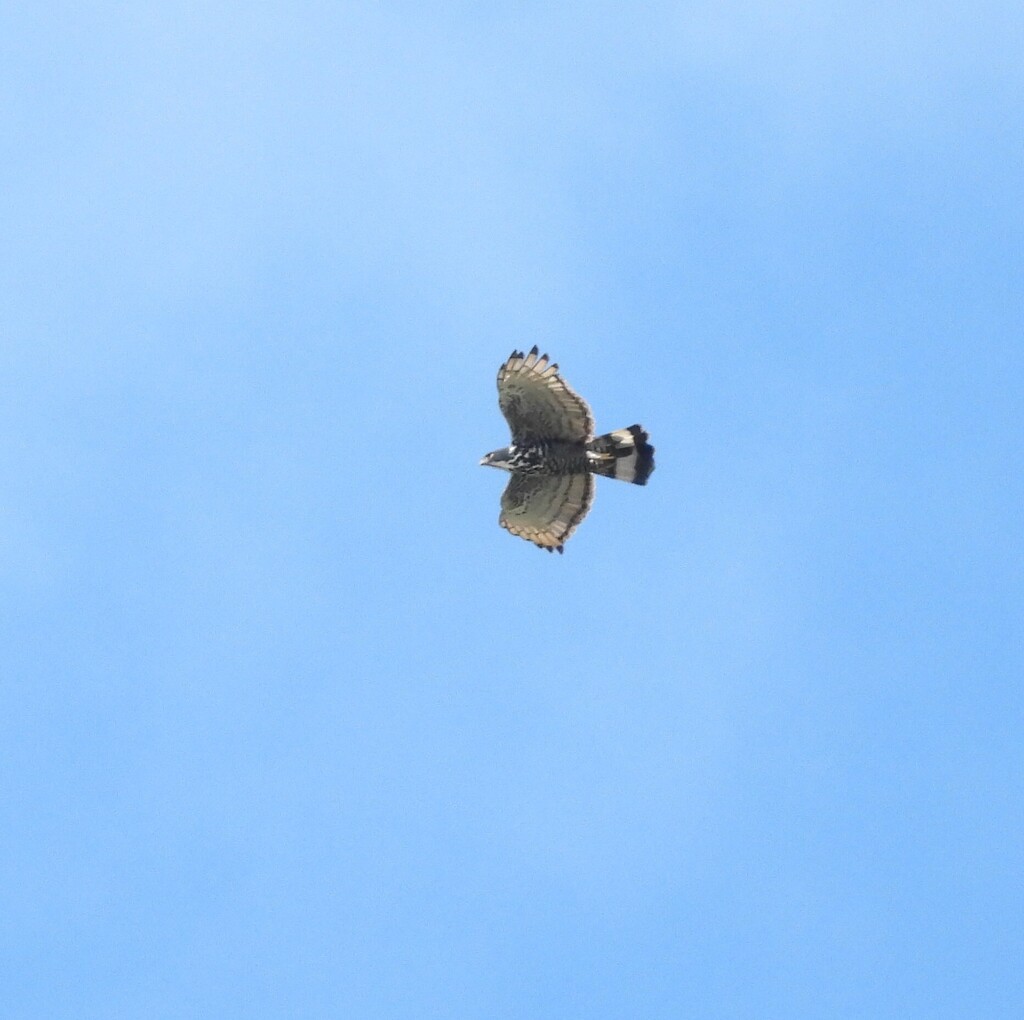
Blyth’s Hawk-Eagle
Photo © Mark Clarke
Photo © Mark Clarke — CC BY 4.0 — Source: iNaturalist #330562693Blyth's hawk-eagle (Nisaetus alboniger) (earlier treated as Spizaetus) is a medium-sized bird of prey. Like all eagles, it is in the family Accipitridae. It can be found in the Malay Peninsula, Singapore, Sumatra and Borneo. It is a bird of open woodland, although island forms prefer a higher tree density. It builds a stick nest in a tree and lays a single egg. It is a fairly small eagle at about 50–60 cm (20–24 in) in length. The adult has a thick white band on uppertail and undertail, all black above, black spotted breast, barred below. It has a prominent crest like the bazas. Juvenile is dark brown above, and has a light brown head and underparts. The common name commemorates Edward Blyth (1810–1873), English zoologist and Curator of the Museum of the Asiatic Society of Bengal.
Bako National Park
Kuching, Malaysia
+210 birds+17 mammals
Weathered sandstone cliffs rise dramatically from the South China Sea, their ochre faces sculpted by millennia of wind and tide into a landscape of extraordinary geological…
VIEW NATIONAL PARKTaman Negara National Park
Kampong Samas, Malaysia
+393 birds+48 mammals
Where ancient rainforest meets limestone peaks, one of Southeast Asia's oldest protected wilderness preserves sprawls across 4,343 square kilometers of primordial landscape. Dipterocarp giants tower overhead,…
VIEW NATIONAL PARKGunung Mulu National Park
Long Seridan, Malaysia
+280 birds+39 mammals
Where granite monoliths pierce the rainforest canopy of Sarawak, an ancient limestone karst landscape reveals one of Southeast Asia's most biodiverse strongholds. Soaring peaks cloaked in…
VIEW NATIONAL PARKKerinci Seblat National Park
Kerinci, Indonesia
+228 birds+16 mammals
Across nearly 67,000 square kilometres of Sumatra's spine, a mountainous realm of equatorial rainforest rises from steaming lowlands to volcanic peaks shrouded in cloud. Kerinci Seblat…
VIEW NATIONAL PARKNo community photos yet. Log in to add the first one.
No community observations of this species yet.