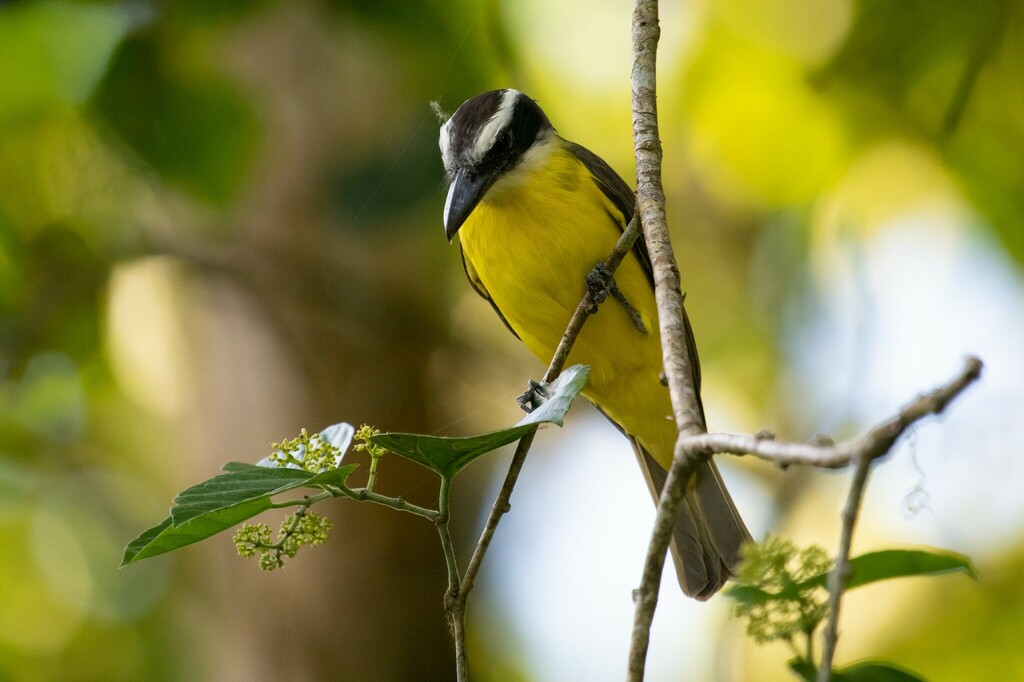
Boat-billed Flycatcher
Photo © Adam Jackson
Photo © Adam Jackson — CC0 1.0 — Source: iNaturalist photo #339596543Identification
The boat-billed flycatcher is a large tyrant flycatcher measuring 21.5 to 24 cm in length. Its most distinctive feature is the characteristic long, wide, heavy, and arched bill—much heavier than related species. Adults of the nominate subspecies display a blackish-brown crown with a mostly hidden yellow to orange-rufous central patch, a prominent white supercilium beginning at the forehead and extending around the nape, and a wide black band from the lores to ear coverts. The cheeks are white, contrasting with bright yellow underparts. Upperparts are olive to dull brownish-olive, with dusky wings and tail showing thin pale cinnamon or rufous edges. Subspecies vary notably: M. p. mexicanus has brighter, more greenish olive upperparts without rufous on tail feathers; M. p. chrysogaster displays a tawny-orange crown patch with richer yellow underparts and prominent rufous wing markings. Juveniles lack the crown patch and have yellower supercilia with darker, more brownish upperparts. The boat-billed flycatcher is larger and heavier-billed than the superficially similar great kiskadee and social flycatcher, with more olivaceous upperparts and browner wings and tail.
Range & Habitat
The boat-billed flycatcher is found from western Mexico through Central America, Trinidad, and throughout mainland South America south to Argentina, with vagrant records from Chile. Six subspecies are recognized, each occupying distinct ranges from southwestern Mexico (M. p. tardiusculus and caniceps) through Central America (M. p. mexicanus) and across South America (M. p. pitangua, chrysogaster, and deserticola). The species inhabits a wide variety of wooded and forested landscapes in tropical and subtropical zones, typically in somewhat open areas such as savanna, clearings with scattered trees, plantations, forest edges, and gallery forest. In the Amazon Basin, it favors the canopy of várzea forest and the edges of lakes and rivers. It also occurs in mature secondary forest and well-shaded gardens. Elevational range varies by region: generally sea level to 1,500 m in Mexico and Central America, reaching 2,200 m in Costa Rica and up to 1,900 m in Venezuela.
Behaviour & Diet
The boat-billed flycatcher is typically a year-round resident throughout its range, though populations in far southern Brazil and Argentina appear migratory. The species also wanders widely and may shift from higher to lower elevations after breeding season. It feeds primarily on large invertebrates, especially cicadas and other insects, supplementing its diet with figs, berries, seeds, and occasionally small vertebrates. Foraging occurs mostly from mid-level forest canopy through mid-story, with birds typically foraging in pairs or small family groups, occasionally joining mixed-species feeding flocks. Subspecies differences in vocalizations are notable, suggesting possible taxonomic revision.
Best Time & Places to See It
The boat-billed flycatcher is generally present year-round throughout most of its range, though wandering behavior may affect local presence seasonally. Its preference for forest edges, plantations, gallery forests, and woodland clearings makes it accessible to travelers. The species is found from sea level to moderate elevations, increasing the likelihood of encounters. Birders exploring humid tropical and subtropical habitats across Mexico, Central America, and South America—particularly around forest edges, river margins, and woodland gardens—should watch for this distinctive large flycatcher.
Photography Tips
The boat-billed flycatcher's large, distinctive bill and contrasting plumage—white supercilium and cheeks against the dark head-band, combined with bright yellow underparts—make it visually striking. Its preference for mid-canopy foraging in somewhat open habitats offers better visibility than canopy specialists. Early morning and late afternoon light will best showcase the yellow underparts and highlight the remarkable bill structure. The species' tendency to forage in pairs or small groups provides opportunities for behavioral photography, and its lack of extreme shyness makes patient positioning more effective than in many forest species.
Amacayacu National Park
Amazônia National Park
Anavilhanas National Park
Araucárias National Park
Arenal Volcano National Park
Bahuaja Sonene National Park
Barbilla National Park
Barra del Colorado National Wildlife Refuge
Baru Volcano National Park
Nothing matches these filters.
No community photos yet. Log in to add the first one.
No community observations of this species yet.