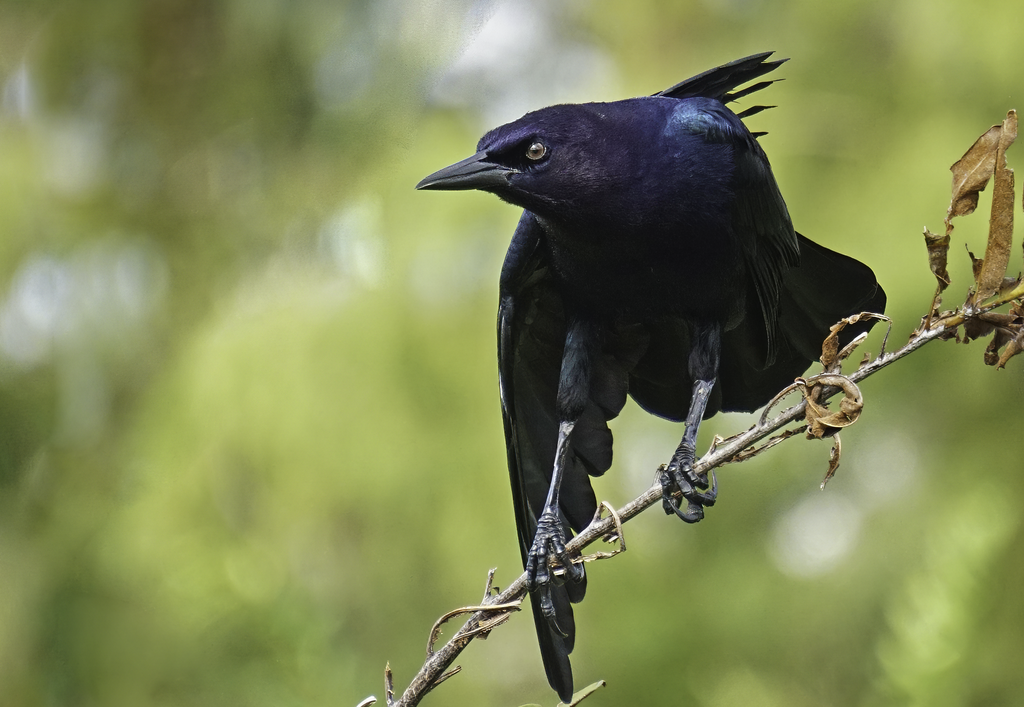
Boat-tailed Grackle
Photo © Eridan Xharahi
Photo © Eridan Xharahi — CC BY 4.0 — Source: iNaturalist photo #104398236The boat-tailed grackle (Quiscalus major) is a passerine bird of the family Icteridae found as a permanent resident on the coasts of the Southeastern and Mid-Atlantic United States. == Habitat == The boat-tailed grackle is found in coastal saltwater marshes and across the Florida peninsula. In salt marsh areas, least bitterns will often associate with and make mixed colonies with grackles. Boat-tailed grackles have established significant populations in several United States Gulf Coast cities and towns, using human activity as protection against predation and scavenging through human trash. Urban boat-tailed grackle populations can be found foraging in trash bins, parking lots, and outdoor restaurant patios. == Breeding == The nest is a well-concealed cup in trees and shrubs near water; the average clutch size is just over three eggs. Male boat-tailed grackles compete to defend and mate with a harem of closely nesting females, although DNA evidence shows that females often successfully mate with other males while away from their colony, with only about a quarter of the young being fathered by the dominant male. == Description == The male boat-tailed grackle is 37–43 cm (15–17 in) long and weighs 165–250 g (5.8–8.8 oz). Adult males have entirely iridescent black…
Everglades National Park
Monroe County, United States
+345 birds+22 mammals
Where freshwater marsh meets subtropical sky, the Everglades sprawls across southwestern Florida as one of North America's most expansive wetland ecosystems. Spanning over 13,000 square kilometers,…
VIEW NATIONAL PARKBiscayne National Park
Miami-Dade County, United States
+263 birds+7 mammals
Coral reefs and mangrove shallows dominate this marine sanctuary where the Florida Keys meet the Atlantic, creating a mosaic of shallow seagrass meadows, patch reefs, and…
VIEW NATIONAL PARKJ.N. “Ding” Darling National Wildlife Refuge
Sanibel, United States
+277 birds+6 mammals
Mangrove channels and coastal marshlands dominate this 6,400-acre sanctuary on Florida's Gulf coast, where brackish waterways weave between dense stands of red, black, and white mangrove…
VIEW WILDLIFE SANCTUARYMerritt Island National Wildlife Refuge
Brevard County, United States
+341 birds+19 mammals
Brackish marshes and palmetto scrub define this wildlife sanctuary spanning the coastal lowlands of central Florida, where the Atlantic tide meets freshwater systems in a dynamic…
VIEW WILDLIFE SANCTUARYOkefenokee National Wildlife Refuge
Charlton County, United States
+206 birds+14 mammals
Vast wetlands of cypress and blackwater creeks define this wildlife sanctuary straddling the Georgia–Florida border, where the landscape shifts between open marsh, dense swamp forest, and…
VIEW WILDLIFE SANCTUARYChincoteague National Wildlife Refuge
Chincoteague, United States
+362 birds+16 mammals
Across the barrier islands and salt marshes of Virginia's Eastern Shore, where Atlantic tides sculpt an intricate mosaic of sandy spits and tidal flats, lies one…
VIEW WILDLIFE SANCTUARYBombay Hook National Wildlife Refuge
Kent County, United States
+323 birds+15 mammals
Tidal marshes and brackish shallows define this sanctuary on Delaware's Atlantic coast, where the meeting of freshwater and salt creates some of the Mid-Atlantic's most dynamic…
VIEW WILDLIFE SANCTUARYBlackwater National Wildlife Refuge
Fishing Creek, United States
+293 birds+15 mammals
Tidal marshes and brackish waterways define this wildlife sanctuary where the Chesapeake Bay's influence reshapes the landscape with every rise and fall of the water. Shallow…
VIEW WILDLIFE SANCTUARYAlligator River National Wildlife Refuge
Dare County, United States
+288 birds+17 mammals
Where the coastal plain of North Carolina meets the Albemarle Peninsula, a sprawling mosaic of freshwater marshes, pocosins, and swamp forest creates one of the Atlantic…
VIEW WILDLIFE SANCTUARYPea Island National Wildlife Refuge
Dare County, United States
+356 birds+15 mammals
Where the Outer Banks taper toward the Atlantic, a sliver of barrier island creates a microcosm of coastal ecology. Pea Island National Wildlife Sanctuary spans over…
VIEW WILDLIFE SANCTUARYPelican Island National Wildlife Refuge
Windsor, United States
+265 birds+4 mammals
Where Florida's Indian River widens into a brackish estuary, a small island sanctuary commands the attention of waterbirds across the Atlantic Flyway. Pelican Island National Wildlife…
VIEW WILDLIFE SANCTUARYSt. Marks National Wildlife Refuge
Saint Marks, United States
+324 birds+16 mammals
Where the Apalachee Bay begins to define the Florida coastline, salt marshes and freshwater impoundments merge into one of the southeastern United States' most productive wildlife…
VIEW WILDLIFE SANCTUARYCedar Keys National Wildlife Refuge
Levy County, United States
+268 birds+8 mammals
Where the Florida Gulf Coast transitions from mainland to archipelago, Cedar Keys National Wildlife Sanctuary protects a mosaic of salt marshes, shallow estuaries, and maritime hammocks…
VIEW WILDLIFE SANCTUARYChassahowitzka National Wildlife Refuge
Homosassa, United States
+299 birds+14 mammals
Where the Gulf of Mexico's coastal marshes dissolve into brackish tidal flats and mangrove thickets, the Chassahowitzka National Wildlife Sanctuary near Homosassa represents one of Florida's…
VIEW WILDLIFE SANCTUARYNo community photos yet. Log in to add the first one.
No community observations of this species yet.