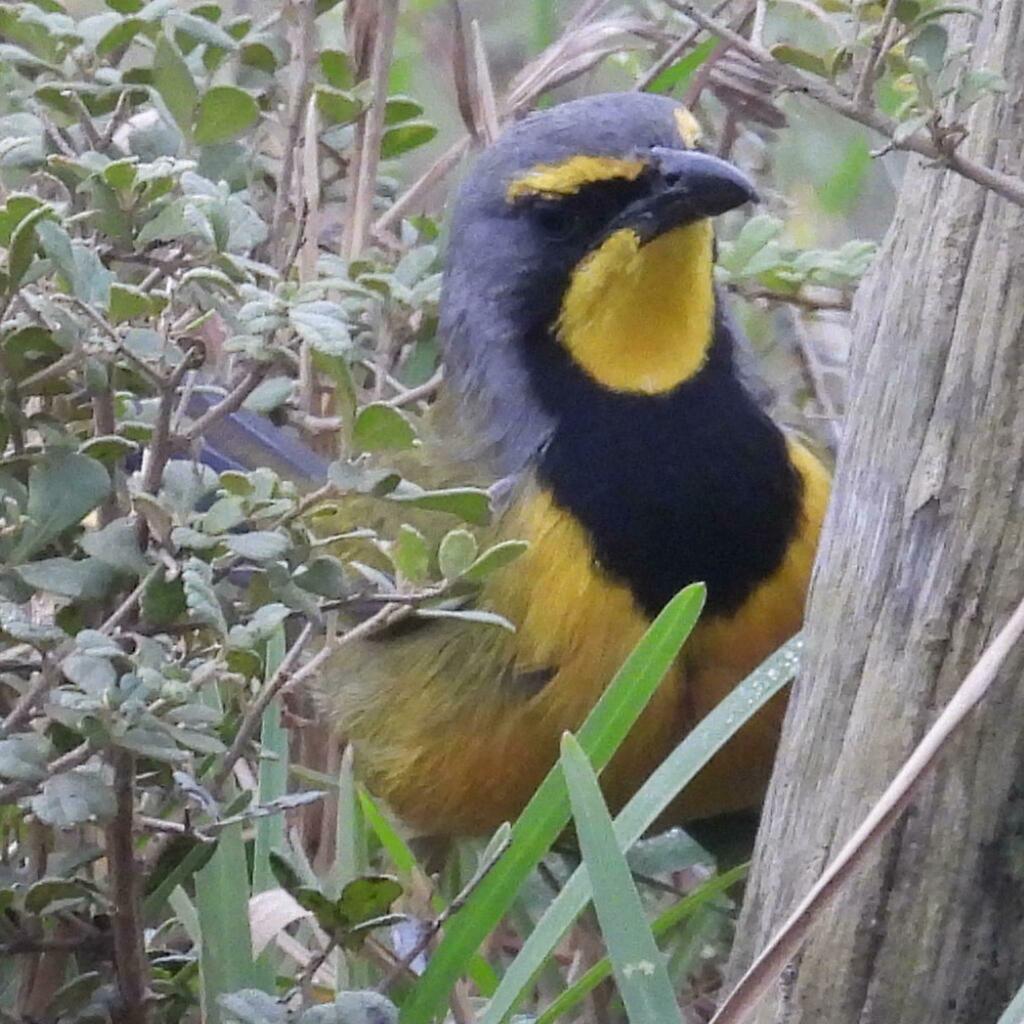
Bokmakierie
Photo © Henry de Lange
Photo © Henry de Lange — CC BY 4.0 — Source: iNaturalist #212496238Identification
The bokmakierie is a compact bushshrike measuring 22–23 cm in length. Adults are unmistakable: olive-green upperparts contrast sharply with bright yellow underparts, while the black tail features a conspicuous bright yellow tip. The head is grey with a distinctive yellow supercilium, and a striking broad black collar runs from the throat up through the breast and sides of the neck to the bill. The strong bill has a characteristic hooked upper mandible, and the legs and feet are blue-grey. The sexes are similar in plumage. Juveniles are duller, with greyish-green underparts and lack the adult's bold black gorget.
Four subspecies are recognized, differing mainly in colour shade and size. The isolated subspecies restrictus from the Chimanimani Mountains is noticeably darker than other populations.
Range & Habitat
The bokmakierie is endemic to southern Africa, occurring mainly in South Africa and Namibia, with an isolated population in the mountains of eastern Zimbabwe and western Mozambique. This species favours open habitats including karoo scrub, fynbos, and parks and gardens in urban areas, where it constructs bulky cup nests in hedges, scrub, or tree forks.
Behaviour & Diet
Unlike true shrikes, the bokmakierie is notably shy and skulking in behaviour. It has a typical shrike diet, feeding on insects, small lizards, snakes, small birds, and frogs. The species is highly vocal, producing a range of loud whistles and calls, often given by pairs in antiphonal duet. Its most characteristic call—which gives the species its name—is the distinctive bok-bok-mak-kik, reflected in local names and the Afrikaans name bokmakierie.
Breeding pairs construct bulky cup nests in hedges, scrub, or tree forks. Clutches typically number three eggs, though 2–6 eggs may be laid; these are greenish-blue with red-brown or lilac blotches. Both sexes incubate for about 16 days to hatching, with a further 18 days until fledging. The species faces predation from snakes, mongooses, and large shrikes such as the northern fiscal and southern boubou.
Best Time & Places to See It
The bokmakierie is best observed in open scrubland and fynbos habitats of South Africa and Namibia. Its shy, skulking nature means patience and careful observation are required, though its loud vocalizations often betray its presence. Urban parks and gardens in these regions also provide accessible viewing opportunities. The isolated population in the Chimanimani Mountains of eastern Zimbabwe and western Mozambique is considerably rarer, with fewer than 400 individuals of the dark subspecies restrictus remaining.
Photography Tips
The bokmakierie's vibrant plumage—particularly its bright yellow underparts, black collar, and yellow-tipped tail—makes it an attractive photographic subject when visible. However, its shy and skulking behaviour presents challenges. Position yourself quietly in suitable habitat and listen for its distinctive calls to locate birds. Early morning is often productive for both sightings and photography. The contrast between its olive-green back and yellow underparts photographs well in good light, and a telephoto lens is recommended given the species' tendency to remain partially concealed in scrub and vegetation.
Addo Elephant National Park
Agulhas National Park
Augrabies Falls National Park
Bontebok National Park
Camdeboo National Park
Cederberg Wilderness Area
Dorob National Park
Garden Route National Park
Kruger National Park
Nothing matches these filters.
No community photos yet. Log in to add the first one.
No community observations of this species yet.