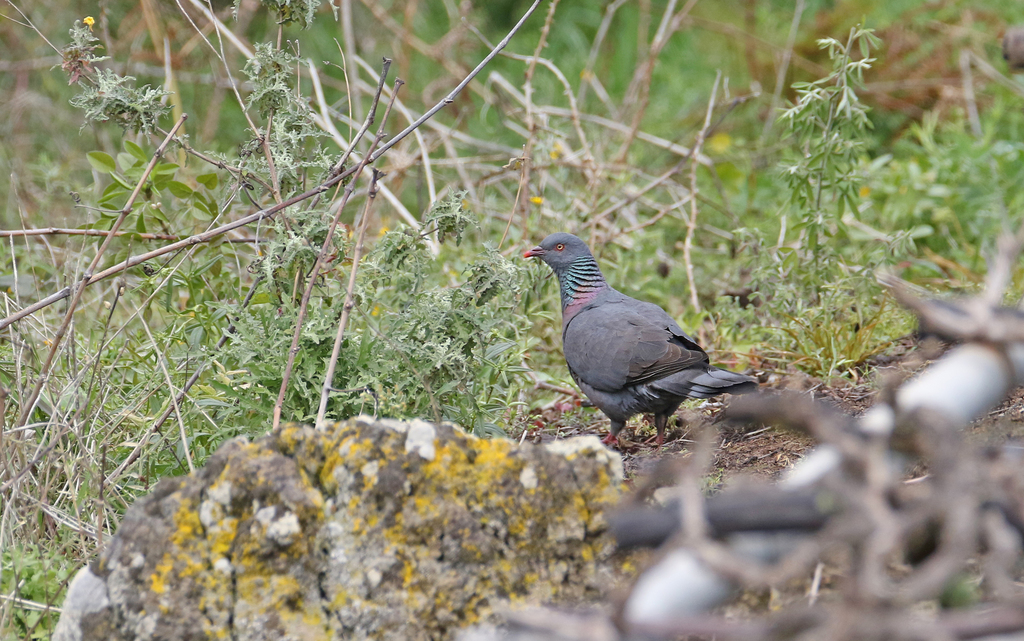
Bolle’s Pigeon
Photo © Christoph Moning
Photo © Christoph Moning — CC BY 4.0 — Source: iNaturalist photo #184476205Identification
Bolle's pigeon is a large, distinctive dove measuring 36–38 cm in length, noticeably bigger than the common pigeon. Its most striking feature is its uniformly dark grey plumage, which sets it apart from the similar laurel pigeon endemic to the same islands. The dark bands on its grey tail are particularly diagnostic. Look for a pinkish breast tinged with a purple-blue hue in males, contrasting with a pale grey belly. The bird's head is slate grey with striking metallic blue or green reflections on the hindneck and back of neck in males. Its red beak is most intense at the tip, while the yellow to orange eye is ringed thinly with flesh-coloured skin. The blackish-brown flight feathers contrast against the otherwise grey wings. Females are noticeably less colourful, lacking the metallic sheen and reflections of males. Its voice is a guttural, mournful cooing, and when alarmed, it takes off with a loud clattering sound.
In flight, watch for the quick, characteristic pigeon wingbeats punctuated by occasional sharp flicks. The bird flies low and fast over forest, making it relatively easy to spot once you know where to look. Confusion is most likely with the white-tailed laurel pigeon or dark feral pigeons, but the absence of white markings and darker overall plumage of Bolle's pigeon should resolve identification.
Range & Habitat
Bolle's pigeon is endemic to the Canary Islands, Spain, and is found nowhere else in the world. Its distribution is concentrated in the mountain laurisilva forests of Tenerife (particularly at Anaga and Teno), La Palma (in restricted areas of the north-east), La Gomera (especially within Garajonay National Park), and El Hierro (in Golfo and Sabinosa). The species may have formerly occurred on Gran Canaria, though this remains uncertain. The bird is highly mobile, making altitudinal movements throughout the year to exploit different fruiting areas.
This species is specialist in dense laurel forest habitat, particularly in mountainous ravines where tall laurisilva forest is cloud-covered for much of the year. It also inhabits heath zones dominated by Myrica faya and Erica arborea, and occasionally ventures into more open cultivated areas. The forests where it lives consist of characteristic trees including Azores laurel, Til, Viñátigo, Barbusano, and various other native species. During the hottest parts of the day, the bird retreats into deep shade, emerging to feed when conditions are cooler.
Behaviour & Diet
Bolle's pigeon is primarily frugivorous, feeding extensively on the drupes and fruits of native laurel forest trees including Azores laurel, Viñátigo, Til, and faya. The bird also consumes sweet acorns, hazelnuts, other nuts, and berries. It feeds actively on fruiting trees, plucking berries directly from branches, but will also feed on the ground. During late summer, it makes altitudinal movements to take advantage of ripening cereals and fruits at lower elevations. Birds will gather in large concentrations on productive fruiting trees, particularly when food is abundant.
Breeding occurs primarily between February and June, with nests built high in tree canopies from sticks and twigs lined with mosses and lichens. The nest is more elaborate than those of many other pigeon species. The female typically lays one or two white eggs, which hatch after an 18-day incubation period shared by both parents. The species is highly mobile throughout the year, moving between different areas to exploit seasonal food availability.
Best Time & Places to See It
The best locations to find Bolle's pigeon are the protected laurel forest zones of Tenerife, particularly around Anaga and Teno, and Garajonay National Park on La Gomera. La Palma and El Hierro offer additional opportunities for dedicated birdwatchers. The breeding season from February to June offers the chance to observe birds at nest sites, though recreational disturbance during breeding should be minimised. Look for birds flying low and fast over the dense forest canopy, particularly in mountainous ravines and cloud-covered forest zones.
The population appears to be stable or slowly increasing, with recent estimates suggesting 5,000–20,000 individuals. The species has recovered from historical lows caused by forest clearance, and the expansion of occupied territory offers hope for its future. Visit during early morning or late afternoon when the birds are most active in feeding areas, and search for congregations on fruiting trees during peak fruiting seasons.
Photography Tips
Photographing Bolle's pigeon presents challenges due to its preference for dense forest and quick, low flight. The bird's dark plumage demands careful exposure management, particularly in the shaded forest habitat where it spends much of its time. Fast shutter speeds of at least 1/1000th second are necessary to freeze its rapid wingbeats and quick movements between branches. A telephoto lens of 300–400 mm is ideal for capturing distant birds without disturbing them, which is particularly important during the breeding season.
Position yourself near known fruiting trees during peak feeding times to maximise encounter opportunities and allow the birds to become accustomed to your presence. The distinctive metallic blue-green neck reflections and pinkish breast of males are best captured in soft, directional light. Early morning light in clearings within the forest may provide the best photographic conditions. Patience is essential—these birds are mobile and alert, so allow plenty of time for productive photography sessions.
Teide National Park
La Orotava, Spain
+83 birds+7 mammals
At nearly 3,900 metres, Spain's highest peak rises from the Canary Islands as a singular volcanic monument, its slopes sweeping through five distinct climate zones in…
VIEW NATIONAL PARKCaldera de Taburiente National Park
El Paso, Spain
+40 birds+1 mammals
Where volcanic ramparts rise nearly two kilometres above the Atlantic, Caldera de Taburiente reveals one of the Canary Islands' most dramatic geological narratives. This national park…
VIEW NATIONAL PARKGarajonay National Park
Hermigua, Spain
+68 birds+1 mammals
Laurel forests cloak the volcanic ridges of this Canarian national park, their evergreen canopy so dense that mist clings to the moss-draped branches even on cloudless…
VIEW NATIONAL PARKNo community photos yet. Log in to add the first one.
No community observations of this species yet.