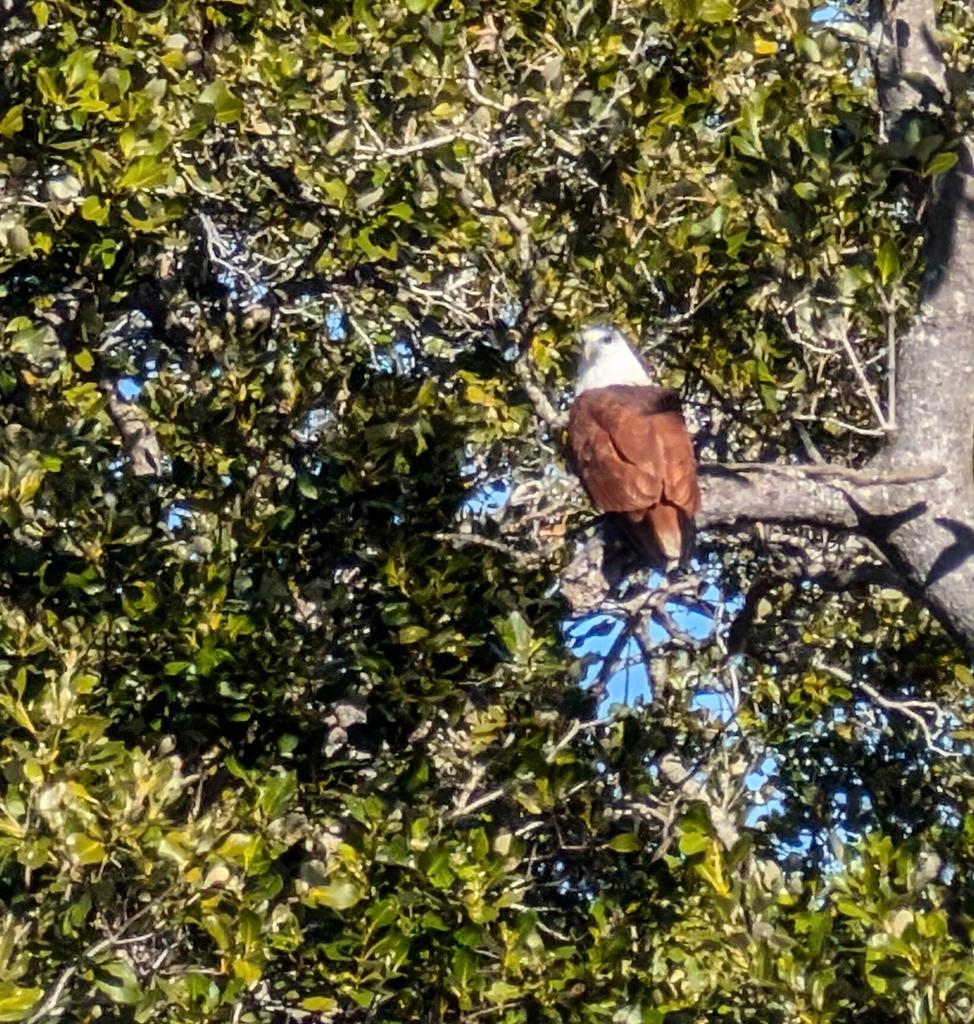
Identification
The brahminy kite is a medium-sized bird of prey measuring 45–51 cm in length with a wingspan of 109–124 cm, making it roughly comparable in size to the black kite. Its most striking feature is its distinctive and highly contrasting plumage: a chestnut-reddish-brown body contrasts sharply with a pure white head and breast, while the wing tips are black. This colour combination makes the brahminy kite easy to distinguish from other raptors in its range. In flight, the bird displays a typical kite silhouette with angled wings, but unlike black kites and red kites, its tail is rounded rather than forked. Juveniles are browner overall but appear paler than young black kites, with noticeably shorter wings and a rounded tail. The bird's call is a distinctive mewing "keeyew."
Range & habitat
The brahminy kite is found across a vast geographic range spanning the Indian subcontinent, Southeast Asia, and Australia. It is a familiar sight in the skies of India, Sri Lanka, Nepal, Iran, Pakistan, Bangladesh, and throughout Southeast Asia, with its range extending as far south as New South Wales in Australia, where it is widespread and resident. The species primarily inhabits coastal regions and inland wetlands, though it is occasionally recorded above 5,000 feet in the Himalayas. In various parts of its range, the brahminy kite performs seasonal movements associated with rainfall patterns. While the species is evaluated as being of least concern overall on the IUCN Red List, it has experienced population declines in some areas, notably on the island of Java.
Behaviour & diet
The brahminy kite is primarily a scavenger, feeding mainly on dead fish and crabs found in wetlands and marshland, though it occasionally hunts live prey such as hares and bats. The species has even been recorded taking advantage of Irrawaddy dolphins herding fish to the surface in the Mekong River, and a rare instance of feeding on honey from Apis florea hives has been documented. In India, brahminy kites also consume rice and cooked food left as offerings. The bird may engage in kleptoparasitism, stealing prey from other birds, and occasionally lands in water while fishing, swimming competently and taking off without difficulty.
Brahminy kites breed seasonally, with timing varying by region: December to April in South Asia, August to October in southern and eastern Australia, and April to June in the north and west. They construct nests from small branches and sticks lined with leaves, typically in trees such as mangroves, and show considerable site fidelity, returning to the same nesting areas year after year. A clutch of two dull-white or bluish-white eggs is laid, with an incubation period of about 26 to 27 days. Both parents participate in nest building and feeding, though likely only the female incubates. Young birds engage in play behaviour, dropping leaves and attempting to catch them in flight. The species roosts communally in large, isolated trees, with as many as 600 individuals recorded at a single location.
Best time & places to see it
The brahminy kite is widely distributed and resident throughout much of its range, making it a reliable species to encounter for nature travellers visiting coastal and wetland areas across South Asia, Southeast Asia, and Australia. Coastal regions, inland wetlands, marshlands, and areas near large bodies of water offer the best opportunities for sightings. The species' communal roosting behaviour means that large numbers may congregate on prominent trees during early morning and late evening hours, particularly near major river systems and coastal habitats. Breeding seasons vary by location and may offer opportunities to observe nesting behaviour and parental care.
Photography tips
The brahminy kite's striking white head and chestnut body plumage create excellent contrast for photography, particularly in bright tropical light. Early morning and late afternoon light will enhance the colours of the plumage and reduce harsh shadows. Look for birds hunting or soaring over wetlands and coastal waters, where their silhouette against water backgrounds can be dramatic. Communal roosting sites near sunset and sunrise offer opportunities to photograph multiple individuals and social interactions. When the bird lands on water or in shallow wetlands, be prepared to capture its impressive swimming ability and take-off sequence. A telephoto lens is essential, as brahminy kites often keep their distance from observers, particularly when feeding or nesting.
Minneriya National Park
Aketajawe Lolobata National Park
Angamedilla National Park
Annan River (Yuku Baja-Muliku) National Park
Bako National Park
Bandipur National Park
Berbak National Park
Bouddi National Park
Bribie Island National Park
Nothing matches these filters.
No community photos yet. Log in to add the first one.
No community observations of this species yet.