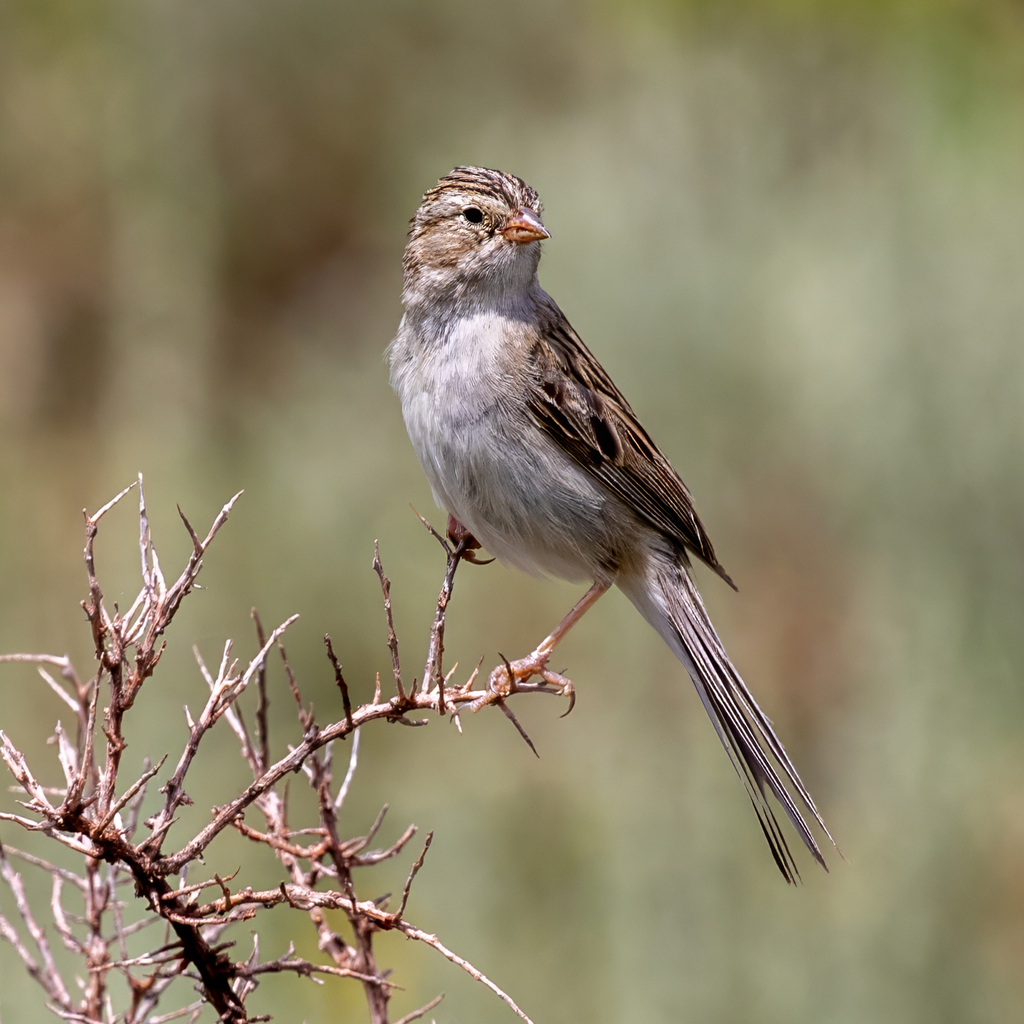
Brewer’s Sparrow
Photo © Dan Vickers
Photo © Dan Vickers — CC BY 4.0 — Source: iNaturalist photo #611747326Identification
Brewer's Sparrow is a small, slim sparrow measuring 5.1–5.9 inches in length with a wingspan of 7.1–7.9 inches. Adults display grey-brown backs with dark streaks and distinctive speckled brown crowns, also streaked. A pale eye-ring is prominent, and the underparts are pale grey. The wings are brown with light wing bars, and the bill is pale with a dark tip. The long, notched tail is characteristic. This species closely resembles the Clay-colored Sparrow, but lacks the pale crown stripe and grey neck patch that distinguish that species.
Two subspecies exist: the nominate Brewer's Sparrow of brushy sagebrush areas in southern western Canada and the western United States, and the Timberline Sparrow, found in thicketed areas around treeline in the Rockies of British Columbia, Alberta, northern Montana, southern Yukon, and southeastern Alaska. The Timberline subspecies is somewhat darker and larger.
Range & Habitat
Brewer's Sparrow breeds in brushy areas, particularly those dominated by sagebrush, across the southern portions of western Canada and throughout the western United States. The Timberline subspecies inhabits thicketed areas around the tree line in Rocky Mountain regions. These birds are migratory, wintering in the southwestern United States south to central Mexico.
Behaviour & Diet
Males sing to defend nesting territories, producing a long, varied mix of notes and trills with two distinct song types classified as short and long songs. Outside the breeding season, these sparrows typically forage in flocks, sometimes joining mixed-species groups. They forage primarily in shrubs and low vegetation, though they also feed on the ground. During summer, insects comprise the majority of their diet, while seeds become increasingly important at other times of the year. Females typically lay three to four eggs, occasionally up to five, in cup nests built in low shrubs.
Best Time & Places to See It
Spring and summer are ideal for observing breeding birds in sagebrush habitats of the western interior. Winter birders should focus on the southwestern United States and Mexico. Look for Brewer's Sparrows in characteristic sagebrush scrubland and brushy areas, particularly during migration when flocking behaviour makes them more visible. The Timberline subspecies can be found in Rocky Mountain treeline habitats during breeding season.
Photography Tips
Photograph this small, active sparrow in early morning light when males are most vocal. The pale eye-ring and streaked crown are key field marks worth capturing in clear detail. In sagebrush habitat, use the landscape context to show the bird's preferred environment. During winter or migration, watch for foraging flocks in open scrub where you can isolate individuals against clear backgrounds. Patient waiting near singing males during breeding season can yield excellent territorial behaviour shots.
Arches National Park
Badlands National Park
Banff National Park
Bear River Migratory Bird Refuge
Big Bend National Park
Bitter Lake National Wildlife Refuge
Black Canyon of the Gunnison National Park
Bosque del Apache National Wildlife Refuge
Bryce Canyon National Park
Nothing matches these filters.
No community photos yet. Log in to add the first one.
No community observations of this species yet.