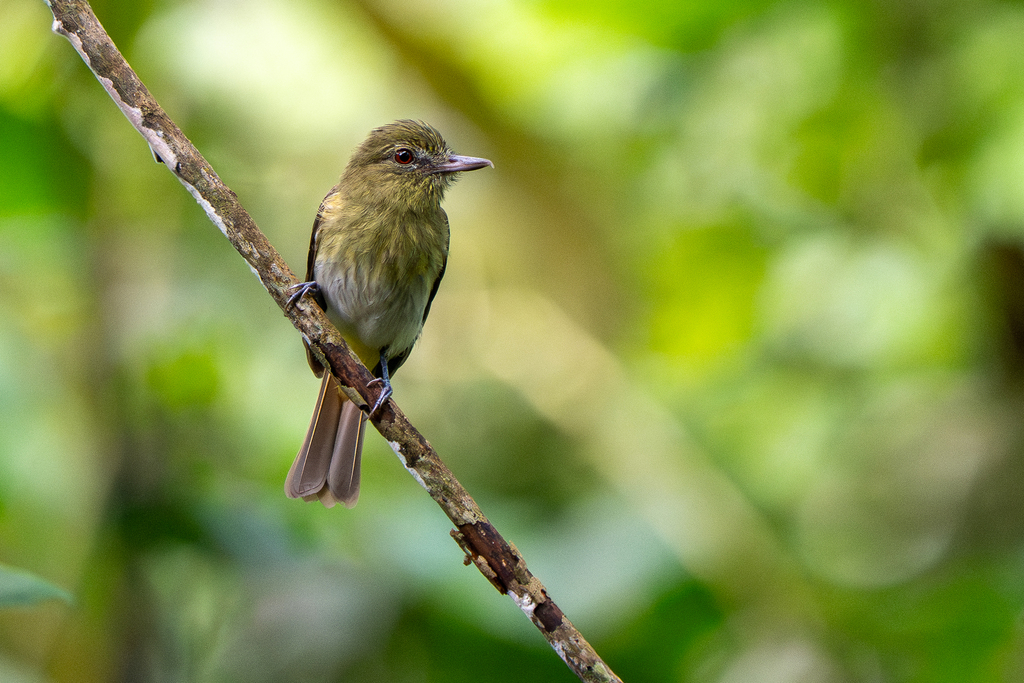
Bright-rumped Attila
Photo © Anthony Batista
Photo © Anthony Batista — CC BY 4.0 — Source: iNaturalist photo #618411645Identification
The Bright-rumped Attila is a large tyrant flycatcher measuring 7 inches (18 cm) long and weighing 1.4 oz (40 g). Its most distinctive feature is its bright yellow rump, which contrasts sharply with its chestnut or olive back. The head is olive-green streaked with black, and the wings are dark brown with two pale wing bars and paler feather edging. The throat is whitish or yellow, the breast is yellow with variable darker streaking, and the belly is white becoming yellow near the tail. The red iris is a striking field mark. Sexes are similar, though young birds have a cinnamon-fringed crown and brown eyes. Plumage is highly variable across its range, but the streaking below and obvious wing bars help distinguish it from other Attila species. This bird has an upright posture with a large head and a hooked, slightly upturned bill.
Range & Habitat
The Bright-rumped Attila breeds from northwestern Mexico through Central America to western Ecuador, Bolivia, and southeastern Brazil, and on Trinidad. Twelve subspecies are recognized across this vast range. The species is common from the lowlands to 7,000 feet (2,100 m) above sea level. It inhabits forests, second growth, pastures and tree plantations, and shady gardens. Remarkably adaptable, it apparently tolerates considerable habitat destruction, making it a relatively widespread species despite deforestation in many parts of its range.
Behaviour & Diet
The Bright-rumped Attila is an active, aggressive, and noisy species usually seen alone. It is primarily insectivorous, feeding on insects and spiders taken from vegetation or the ground, but also hunts frogs and lizards. It employs multiple foraging techniques, pursuing prey on foot as well as making short sallies from perches, and notably follows army ant columns to catch flushed prey. Beyond insects, it regularly consumes fruits and seeds, particularly from trees like gumbo-limbo.
Breeding birds construct a deep cup nest of mosses, leaves, and plant fiber, typically placed below 3 meters high among epiphytes, between buttress roots, or in a bank, not necessarily within the forest. A typical clutch comprises 3–4 eggs marked with lilac or rufous on a dull white or pink background. The female incubates for 18–19 days, with fledging occurring approximately 18 days after hatching.
Best Time & Places to See It
The Bright-rumped Attila is common throughout its range, making it a reliable find for patient birders. However, locating this bird can be challenging because it often remains stationary while singing, making it difficult to spot despite its loud vocalizations. The loud beat-it, beat-it call and the plaintive ooo weery weery weery weery woo are often heard before the bird is seen. Early morning visits to second growth, gardens with mature trees, and forest edges throughout lowland and foothill regions offer the best chances of encounter.
Photography Tips
The Bright-rumped Attila's upright posture and bold field marks make it visually rewarding to photograph when visible. The bright yellow rump is most conspicuous when the bird moves or changes perches. Early morning light is ideal for capturing the intricate streaking on the head and breast, as well as the details of the pale wing bars. Since this species often remains perched while vocalizing, listening for its characteristic calls and then waiting patiently with your lens ready can yield excellent results. Focus on capturing the red iris and the contrasting colors of the rump and back, which are the species' most diagnostic features.
Amacayacu National Park
Anavilhanas National Park
Arenal Volcano National Park
Bahuaja Sonene National Park
Barbilla National Park
Barra del Colorado National Wildlife Refuge
Baru Volcano National Park
Braulio Carrillo National Park
Cahuita National Park
Nothing matches these filters.
No community photos yet. Log in to add the first one.
No community observations of this species yet.