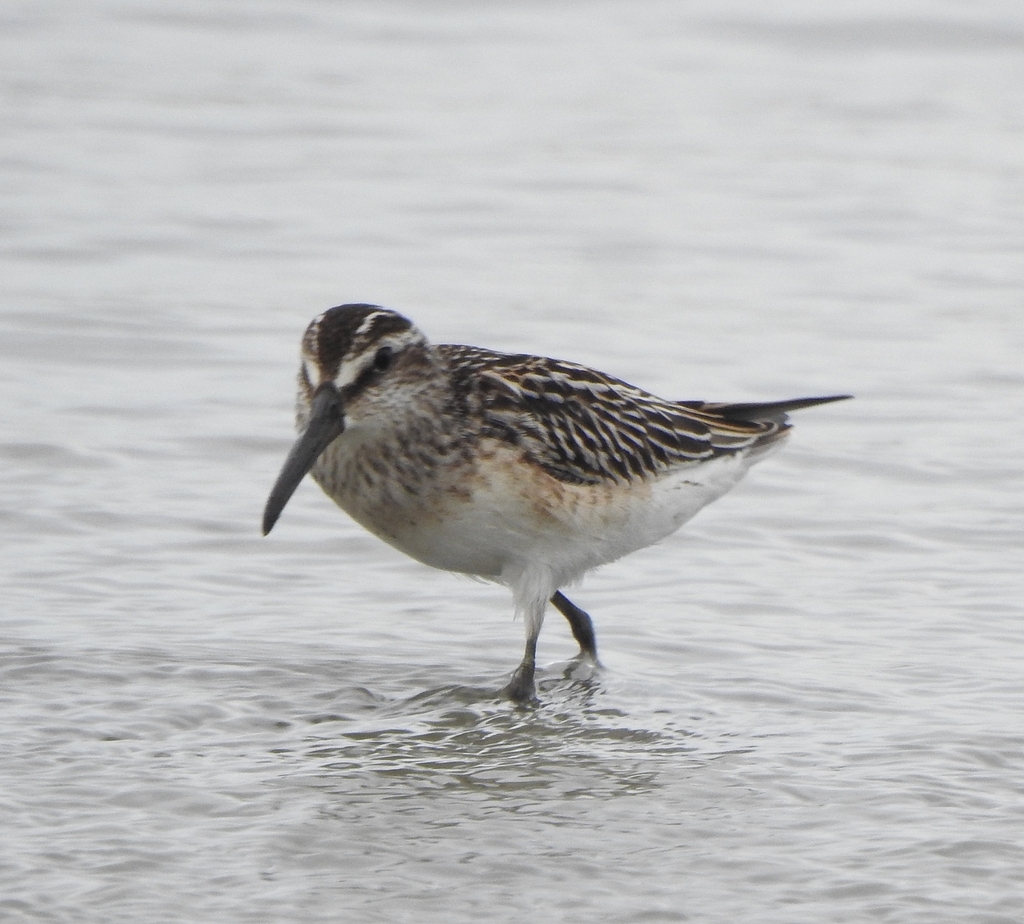
Broad-billed Sandpiper
Photo © Afsar Nayakkan
Photo © Afsar Nayakkan — CC BY 4.0 — Source: iNaturalist #138619153Identification
The broad-billed sandpiper is a small wader measuring 16–18 cm long, making it slightly smaller than a dunlin but larger than a little stint. Its most distinctive feature is a longer, straighter bill with a characteristic downward kink at the tip—a trait that inspired its scientific name falcinellus, Latin for "small sickle." The bill is indeed slightly broader than in most other Calidris species, though this trait is rarely obvious in the field. Another reliable identification mark is the bird's bold head pattern: a pale crown stripe combined with a distinctive split supercilium (eyebrow), visible even in winter plumage.
Breeding adults display dark brown upperparts patterned with narrow, pale feather fringes and white underparts with blackish markings on the breast. The two subspecies differ subtly in summer: C. f. falcinellus shows narrow white fringing, while the eastern C. f. sibirica displays brighter, rufous-toned edges. Winter plumage becomes much paler and greyer above, resembling a winter dunlin, yet the distinctive head pattern always remains. Juveniles show pale "tramlines" down the mantle like young dunlins or little stints, but can be distinguished by their white flanks and belly combined with a brown-streaked breast. In the field, listen for a dry, whistling dree-it, dree-it or a clicking dik dik call similar to the little stint.
Range & Habitat
This strongly migratory species breeds in two disjunct regions representing two separate subspecies: C. f. falcinellus nests in northern Scandinavia and northwest Russia, while C. f. sibirica occupies central and eastern Siberia. Both populations disperse widely during the non-breeding season, ranging from easternmost Africa through south and south-east Asia to Australasia. Notably, despite its European breeding range, the species is rare on passage in western Europe due to its south-easterly migration route.
The broad-billed sandpiper breeds in wet taiga bogs across the Arctic, where males perform aerial courtship displays. Pairs nest in simple ground scrapes, laying four eggs. During migration and winter, they favor soft mud on marshes in summer and coastal areas in winter, often foraging by sight. The species is gregarious and frequently joins mixed flocks with other waders, particularly dunlins.
Behaviour & Diet
These birds are highly gregarious, regularly forming flocks with other scolopacid waders. Males engage in spectacular aerial displays during the breeding season as part of courtship rituals. The species feeds primarily by sight, carefully picking through soft substrates for food rather than probing randomly.
The broad-billed sandpiper's diet consists mostly of insects and other small invertebrates gleaned from muddy habitats. This feeding strategy makes them dependent on suitable wet environments with exposed mud and shallow water, whether in breeding marshes or wintering coastal areas.
Best Time & Places to See It
Finding broad-billed sandpipers requires visiting their wintering grounds in Africa, the Middle East, India, or southeast Asia during the non-breeding season, as they are rare passage migrants in western Europe. The species' preference for muddy marshes and coastal areas means focusing on wetland habitats with soft substrates. Look for them within mixed wader flocks, particularly alongside dunlins, which often share the same feeding grounds.
Birdwatchers and photographers should time visits to coincide with the non-breeding season and target known wintering sites in their respective subspecies' ranges. Patience and careful scanning of wader flocks are essential, as the bird's small size and subtle plumage can make it easy to overlook.
Photography Tips
The broad-billed sandpiper's small size and tendency to feed in mixed flocks present photographic challenges. Focus on capturing the diagnostic head pattern—the pale crown stripe and split supercilium are key identification features. The bird's bent bill tip is another valuable detail worth highlighting, even though it may not always be obvious in every angle.
Photograph birds in soft early morning or evening light to reveal plumage details. Winter plumage is paler and greyish, requiring careful exposure management. Capture the bird in its natural feeding posture on muddy substrates to show habitat preference. Documentary shots of the bird within mixed wader flocks illustrate its gregarious behavior and are valuable for field guide purposes.
S’Albufera Natural Park
Platja de Muro, Spain
+253 birds+6 mammals
Where Mediterranean lagoons meet the Balearic coast, S'Albufera stretches across nearly 1,600 hectares of wetland and dune systems that rank among Europe's most ecologically vital shallow-water…
VIEW NATURAL PARKMuddus / Muttos National Park
Norrbottens län, Sweden
+128 birds+7 mammals
Where boreal forest meets wetland across the high plateaus of Swedish Lapland, Muddus National Park unfolds as one of northern Europe's most pristine wilderness sanctuaries. Vast…
VIEW NATIONAL PARKL’Albufera Natural Park
València, Spain
+321 birds+18 mammals
Where shallow lagoons meet Mediterranean coastal marshland, L'Albufera Nature Park unfolds as one of Spain's most vital wetland complexes. This protected landscape, designated under IUCN Category…
VIEW NATURAL PARKSchleswig-Holsteinisches Wattenmeer National Park
Germany
+378 birds+49 mammals
Where the North Sea ebbs and flows across a vast expanse of exposed mud and sand, the Schleswig-Holsteinisches Wattenmeer National Park reveals one of Europe's most…
VIEW NATIONAL PARKDelta de l’Ebre Natural Park
Eucaliptus, Spain
+341 birds+18 mammals
Where the Ebro River spreads into a vast labyrinth of shallow lagoons, reed beds, and brackish marshes before surrendering to the Mediterranean, one of southern Europe's…
VIEW NATURAL PARKDanube Delta Biosphere Reserve
Tulcea, Romania
+277 birds+27 mammals
Where the Danube surrenders to the Black Sea, a vast labyrinth of channels, reed beds, and freshwater lakes sprawls across nearly 13,400 square kilometers of eastern…
VIEW NATIONAL PARKPyhä-Luosto National Park
Pelkosenniemi, Finland
+113 birds+6 mammals
Where boreal forest meets fell landscape in Finnish Lapland, Pyhä-Luosto National Park sprawls across 616 square kilometres of terrain that embodies the raw essence of the…
VIEW NATIONAL PARKPallas-Yllästunturi National Park
Muonio, Finland
+137 birds+19 mammals
Where boreal forest meets fell, across the Finnish Arctic frontier, nearly 3,650 square kilometres of pristine subarctic wilderness unfold in a landscape sculpted by glacial epochs…
VIEW NATIONAL PARKUrho Kekkonen National Park
Sodankylä, Finland
+122 birds+11 mammals
Across nearly 2,700 square miles of boreal wilderness in Lapland, where the Arctic Circle's influence shapes every ecosystem, lies a landscape dominated by dense spruce and…
VIEW NATIONAL PARKHortobágy National Park
Hortobágy, Hungary
+260 birds+17 mammals
Across the North Great Plain of Hungary stretches one of Europe's most expansive semi-natural grassland systems, where horizon-wide vistas of steppe and wetland create a landscape…
VIEW NATIONAL PARKFertő–hanság National Park
Fertőszéplak, Hungary
+246 birds+11 mammals
Where the Austro-Hungarian plains meet the foothills of Western Transdanubia, nearly 900 square kilometres of wetland, reed bed, and mixed woodland form one of Central Europe's…
VIEW NATIONAL PARKSarek
Norrbotten County, Sweden
+119 birds+8 mammals
Where granite gorges cut through boreal wilderness and meltwater streams cascade across weathered plateaus, Sarek National Park sprawls across nearly 3,100 square kilometres of Swedish Lapland's…
VIEW NATIONAL PARKBribie Island National Park
Brisbane, Australia
+284 birds+20 mammals
Across tidal flats and shallow waterways north of Brisbane, Bribie Island National Park spreads across nearly four hundred square kilometres of subtropical coastal wilderness—a patchwork of…
VIEW NATIONAL PARKCamargue Regional Nature Park
Saintes-Maries-de-la-Mer, France
+378 birds+48 mammals
Where the Rhône Delta sprawls into the Mediterranean, a landscape of stark and haunting beauty emerges—vast salt marshes punctuated by shallow lagoons, reed beds, and scrubland…
VIEW NATURAL PARKKolkheti National Park
Nigvziani, Georgia
+60 birds+1 mammals
Where the Caucasus descends to meet the Black Sea, a mosaic of wetlands, reed beds, and coastal lagoons creates one of the Mediterranean's most biodiverse refuges.…
VIEW NATIONAL PARKLahemaa National Park
Lääne-Viru County, Estonia
+237 birds+25 mammals
Where the Baltic coast meets temperate forest in northwestern Estonia, Lahemaa National Park sprawls across more than 1,300 square kilometers of deeply character-filled terrain. Coastal wetlands…
VIEW NATIONAL PARKCirceo National Park
Italy
+232 birds+6 mammals
Where limestone headlands plunge toward the Tyrrhenian Sea, Circeo National Park preserves a rare mosaic of Mediterranean coastal habitats that few Italian reserves can match. The…
VIEW NATIONAL PARKBako National Park
Kuching, Malaysia
+210 birds+17 mammals
Weathered sandstone cliffs rise dramatically from the South China Sea, their ochre faces sculpted by millennia of wind and tide into a landscape of extraordinary geological…
VIEW NATIONAL PARKWolin National Park
Kamień County, Poland
+232 birds+21 mammals
Where the Baltic shoreline meets vast wetland complexes and Pleistocene woodlands, Wolin National Park unfolds across nearly 440 square kilometres of northwestern Poland's most biodiverse terrain.…
VIEW NATIONAL PARKSłowiński National Park
Smołdzino, Poland
+217 birds+16 mammals
Where the Baltic shoreline surrenders to vast inland dunes and freshwater lagoons, Słowiński National Park spans nearly 610 square kilometres of one of Europe's most dynamic…
VIEW NATIONAL PARKKampinos National Park
Roztoka, Poland
+183 birds+18 mammals
Sandy pine forests and wetland mosaics spread across the glacial plains northwest of Warsaw, where Kampinos National Park protects one of central Europe's most distinctive lowland…
VIEW NATIONAL PARKLemmenjoki National Park
Inari, Finland
+87 birds+1 mammals
Where granite gorges cut through pristine boreal forest and the Lemmenjoki River winds through one of Europe's last great wilderness corridors, Finland's Arctic heart reveals itself…
VIEW NATIONAL PARKGobi Gurvan Saikhan National Park
Tsagaan Subarga Hural, Mongolia
+183 birds+23 mammals
Where rust-coloured badlands rise from the southern Gobi steppe, the terrain transforms into a landscape of geological drama that few visitors expect to find in Mongolia's…
VIEW NATIONAL PARKPort-Cros National Park
Hyères, France
+271 birds+29 mammals
Where Mediterranean granite islands rise from crystalline waters off the Provençal coast, Port-Cros National Park protects one of Europe's most intact marine and terrestrial ecosystems. The…
VIEW NATIONAL PARKNewport Wetlands National Nature Reserve
Goldcliff, United Kingdom
+153 birds+7 mammals
Across the Severn Estuary's southern reaches, where the Gwent Levels meet tidal mud and reedbed in a mosaic of wet grassland and shallow pools, lies one…
VIEW NATURE RESERVERibble Estuary National Nature Reserve
Southport, United Kingdom
+197 birds+17 mammals
Where the Ribble flows into the Irish Sea, a landscape of mudflats, salt marshes and shallow pools creates one of northwest England's most dynamic estuarine ecosystems.…
VIEW NATURE RESERVEWatamu Marine National Park
Dabaso ward, Kenya
+328 birds+12 mammals
Where mangrove channels meet coral gardens and sandy shallows blend into the warm waters of the Indian Ocean, Watamu Marine National Park unfolds across the Kilifi…
VIEW NATIONAL PARKNo community photos yet. Log in to add the first one.
No community observations of this species yet.