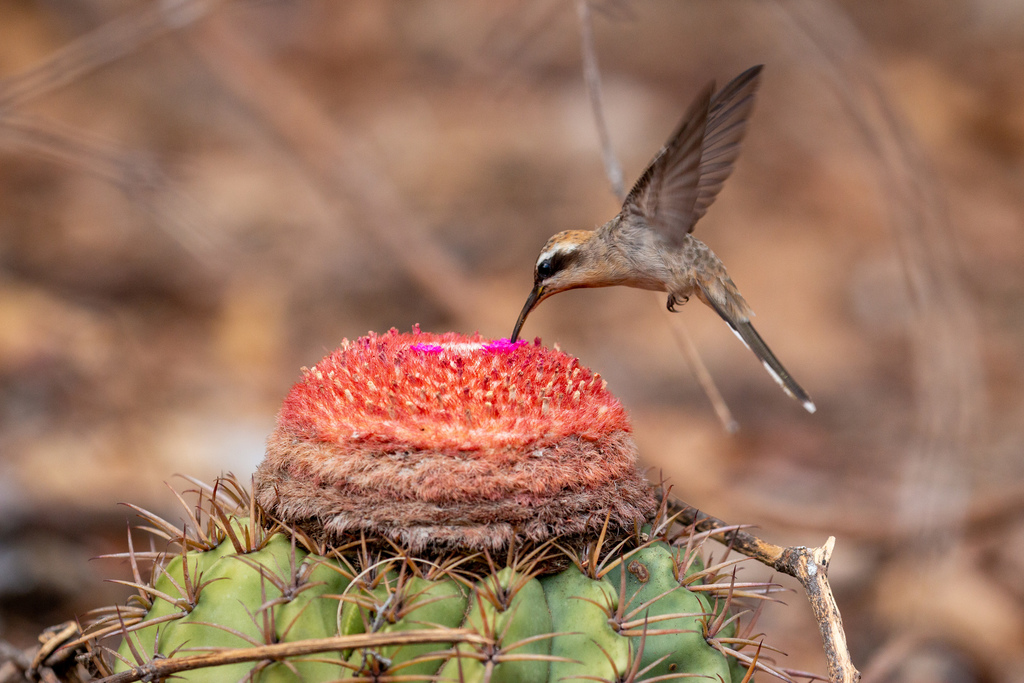
Broad-tipped Hermit
Photo © Thomaz de Carvalho Callado
Photo © Thomaz de Carvalho Callado — CC BY 4.0 — Source: iNaturalist photo #169120222Identification
The broad-tipped hermit is a small hummingbird, measuring 11 to 12.6 cm in length and weighing just 2.6 to 3.4 grams—making it one of the smaller hermit hummingbirds. Its most distinctive feature is its unusually broad bill, where the upper mandible overlaps the lower one, giving the species its common name. The bird's plumage combines bronzy-green upperparts with light brownish to ochraceous underparts. A striking black facial mask contrasts with a white supercilium and white malar stripe, while the throat is dark brown with an orange border. The tail is notably long and forked, with the two inner pairs of feathers extending beyond the others, all tipped in white. Unlike some hermit species, males and females have similarly curved bills.
Range & Habitat
The broad-tipped hermit is endemic to Brazil, found exclusively in the northeastern portions of the country, ranging from Ceará south through western Bahia and into northeastern Minas Gerais. This species favors somewhat humid caatinga landscapes with dense undergrowth beneath shrubs and trees, though it also inhabits more open cerrado areas. Elevation-wise, it occurs from near sea level up to approximately 1,200 metres, allowing birdwatchers to seek it across a range of terrain types within its limited Brazilian range.
Behaviour & Diet
The broad-tipped hermit is believed to be largely sedentary, though ornithologists have documented some small seasonal movements. Like other hermits, it is a "trap-line" feeder, maintaining a circuit of flowering plants that it visits regularly. Its diet is diverse, comprising nectar from a wide variety of plants supplemented by small arthropods. During breeding season, which spans at least December to February, the species exhibits fascinating reproductive behavior: females construct small cup-shaped nests suspended beneath leaves, typically laying clutches of two eggs. Notably, males have been observed incubating eggs, an unusual trait among hummingbirds. The species may also participate in lek displays, where males gather to sing and establish territories.
Best Time & Places to See It
The broad-tipped hermit's breeding season from December to February offers the best opportunity for observation, when birds are most active and territorial. Being mostly sedentary throughout the year, the species can be found in its preferred caatinga and cerrado habitats within northeastern Brazil at any season, though it is presumed to be uncommon overall. Look in areas with dense undergrowth and flowering plants, particularly in Ceará, western Bahia, and northeastern Minas Gerais. The bird's relative rarity and preference for specific habitat types means patience and local knowledge are essential for successful encounters.
Photography Tips
Photographing the broad-tipped hermit requires patience and attention to its behavioral patterns. Since it is a trap-line feeder, positioning yourself near flowering plants within its territory—particularly during the breeding season—increases your chances of consistent photo opportunities. The bird's striking facial markings and broad bill are distinctive features worth capturing, so steady your camera for detail shots. Early morning hours typically offer the best light for hummingbird photography. Given the species' small size and preference for dense undergrowth, a telephoto lens and fast shutter speed are essential. Remember that this is an uncommon bird, so any sighting deserves careful, unobtrusive observation to avoid disrupting natural behavior.
Serra do Teixeira National Park
Brazil
+160 birds+5 mammals
Rugged plateaus and deep escarpments define this 3,112-square-kilometre sweep of the Brazilian Northeast, where the crystalline bedrock of the Borborema Plateau rises abruptly from the surrounding…
VIEW NATIONAL PARKSerra da Capivara National Park
Brazil
+156 birds+6 mammals
Across the semi-arid plateaus and deeply incised canyons of northeastern Brazil, where Piauí's ancient sandstone formations rise and fall in weathered waves, Serra da Capivara National…
VIEW NATIONAL PARKChapada Diamantina National Park
Brazil
+346 birds+5 mammals
Where granite peaks and sandstone cliffs rise abruptly from the Brazilian interior, Chapada Diamantina National Park sprawls across 4,215 square kilometers of some of Brazil's most…
VIEW NATIONAL PARKCatimbau National Park
Brazil
+118 birds+6 mammals
Where sandstone plateaus rise from the semi-arid scrublands of northeastern Brazil, Catimbau National Park unfolds across more than 1,000 square kilometres of geological drama and surprising…
VIEW NATIONAL PARKNo community photos yet. Log in to add the first one.
No community observations of this species yet.