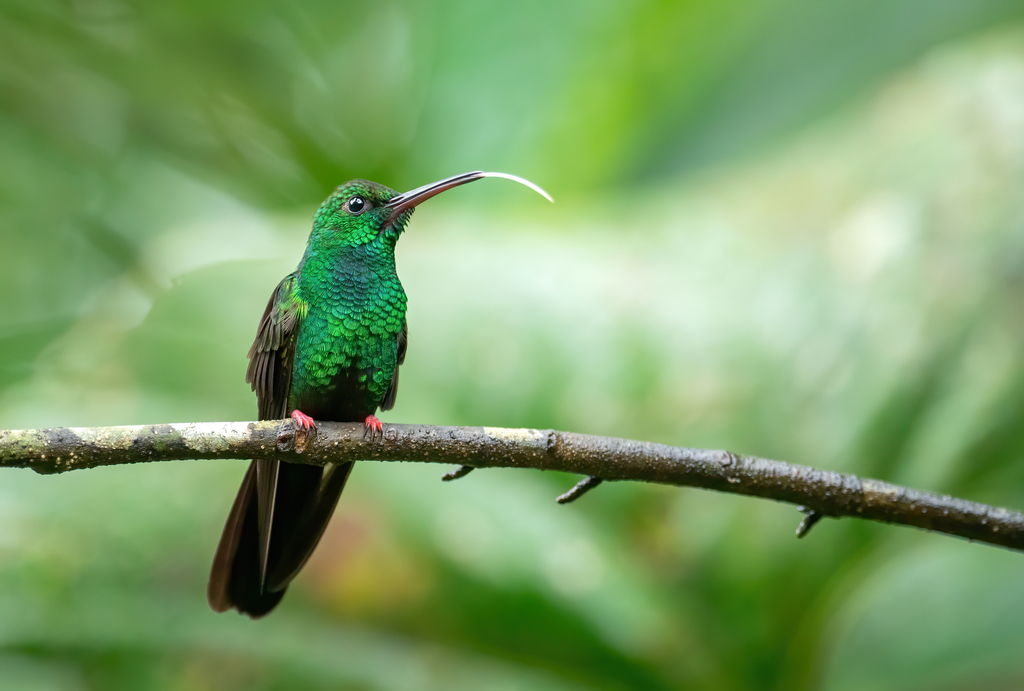
Bronze-tailed Plumeleteer
Photo © Morten Ross
Photo © Morten Ross — CC BY 4.0 — Source: iNaturalist photo #110613815Identification
The bronze-tailed plumeleteer is a small hummingbird, measuring 10.5 to 12 cm in length, with males weighing about 7.1 g and females about 6.1 g. Both sexes share a distinctive black maxilla and black tip to the mandible, with the rest of the mandible dull pink to dark red. The nominate subspecies shows the most glittering appearance: males display metallic green upperparts and glittering green underparts, with characteristic long fluffy white undertail coverts and a bronze-green tail. Females are metallic green above but gray below with green flecks on the sides, grayish-white undertail coverts, and outer tail feathers tipped with gray. Immature birds resemble adults but show buffy to cinnamon fringing on the crown, nape, and rump feathers.
Subspecific variation is notable across the bird's range. The northern subspecies C. u. melanorrhoa has darker green upperparts with purplish bronze uppertail coverts, a dusky bronze belly, and a purplish-black tail. The C. u. isaurae subspecies features males with a distinctive blue throat and breast, bluish-green belly, and a brighter bronze tail than the nominate form, while females have pale gray underparts with minimal green flecking.
Range & Habitat
The bronze-tailed plumeleteer is found across Central America and northwestern South America, with its range spanning Colombia, Costa Rica, Ecuador, Nicaragua, and Panama. The northernmost subspecies, C. u. melanorrhoa, occurs from eastern Nicaragua into Costa Rica with a few records in eastern Honduras. Subspecies C. u. isaurae inhabits the Caribbean slope and locally the Pacific slope of Panama and extreme northwestern Colombia, while the nominate subspecies ranges from eastern Panama's Darién Province through north-central and western Colombia into northwestern Ecuador.
This species favors humid forest interiors and edges, mature secondary forest, and semi-open landscapes such as banana plantations and gardens, but avoids completely open areas. Elevational range varies by location, from sea level up to 700 m in Costa Rica and up to 900 m in Colombia.
Behaviour & Diet
The bronze-tailed plumeleteer is an active and aggressive forager, especially defending rich nectar sources such as Heliconia patches. It typically forages from the understory to mid-strata, occasionally visiting epiphytes in the sub-canopy. Besides nectar, it supplements its diet by hawking small arthropods from a perch and gleaning insects from foliage. The bird feeds on nectar from a variety of plants including Heliconia, Renealmia, Costus, Psychotria, Malvaviscus, Acanthaceae, and Inga.
The northern subspecies is known to make local seasonal movements, likely tracking flowering plants, though movements in other subspecies are undocumented. Breeding occurs primarily between February and April in both Costa Rica and Colombia, with an extended season in Costa Rica from December to June. The bird constructs a characteristic deep cup nest of pale plant down and fibers bound with spiderweb, covered externally with moss and lichen, typically placed in a shrub 0.5 to 1.5 m above the ground, often near streams or trails. Vocalizations include a soft, nasal, scratchy trilled song phrase, energetic chattering trills during chases, and loud chup and chip notes.
Best Time & Places to See It
The bronze-tailed plumeleteer is still locally common at many sites throughout its range despite habitat loss in Central America, particularly in Costa Rica and Panama. Visitors should focus on humid forest edges, mature secondary forest, and areas with flowering plants, especially Heliconia-rich patches. The bird ranges from sea level to moderate elevations, making it accessible in many lowland and foothill locations.
The primary breeding season from February to April offers the best opportunities for observation in both Costa Rica and Colombia, when birds are most active and vocal. The extended breeding window in Costa Rica (December to June) provides a longer window for encounters in that country.
Photography Tips
Photographing the bronze-tailed plumeleteer requires patience and attention to its preferred feeding zones. Focus on flowering plants, especially Heliconia patches where the bird aggressively defends territory and returns predictably. The bird forages at moderate heights in the understory and mid-story, making it more accessible than canopy species. Early morning light best reveals the males' glittering green underparts and metallic sheen.
The long fluffy white undertail coverts of the nominate subspecies provide a distinctive visual marker for identification and composition. Work near streams and trails where nests are often placed, as birds may be more active in these areas. The bird's aggressive territorial behavior means males will often perch visibly while defending nectar sources, offering excellent opportunities for portrait shots and behavioral photography.
Arenal Volcano National Park
Peñas Blancas, Costa Rica
+551 birds+21 mammals
Straddling the border between Alajuela and Guanacaste in northwestern Costa Rica, this national park rises dramatically around one of Central America's most active volcanic systems. The…
VIEW NATIONAL PARKTortuguero National Park
Roxana, Costa Rica
+420 birds+23 mammals
Canals and lagoons thread through a labyrinth of lowland rainforest where the Caribbean coast of Costa Rica meets the wetland frontier. This is terrain shaped by…
VIEW NATIONAL PARKBraulio Carrillo National Park
Las Horquetas, Costa Rica
+547 birds+18 mammals
Where the Caribbean slope descends from the central volcanic cordillera toward the humid lowlands of Heredia, Braulio Carrillo National Park preserves one of Costa Rica's most…
VIEW NATIONAL PARKGuanacaste National Park
Santa Elena, Costa Rica
+461 birds+17 mammals
Where the Pacific slopes of northwestern Costa Rica rise toward the Continental Divide, dry tropical forest gives way to cloud-laden peaks and misty ridges—a landscape that…
VIEW NATIONAL PARKNatural Utría National Park
Alto Baudó (Pie de Pató), Colombia
+372 birds+11 mammals
Where the Chocó's coastal mountains plunge toward the Pacific, Utría National Park preserves one of Colombia's most biodiverse and least-visited wilderness expanses. Sprawling across 1,287 square…
VIEW NATIONAL PARKNatural Farallones de Cali National Park
Buenaventura, Colombia
+733 birds+27 mammals
Where the Pacific coastal plain meets the western slopes of the Andes, Farallones de Cali National Park sprawls across nearly 3,500 square kilometers of dramatic topography…
VIEW NATIONAL PARKNatural Uramba Bahía Málaga National Park
Buenaventura, Colombia
+308 birds+15 mammals
Where the Pacific coastal rainforest descends to mangrove estuaries and rocky headlands, Uramba Bahía Málaga National Park unfolds across nearly 1,000 square kilometres of Colombia's Valle…
VIEW NATIONAL PARKGeneral de División Omar Torrijos Herrera National Park
La Pintada, Panama
+401 birds+2 mammals
Across the highlands of central Panama, where the continental divide funnels moisture-laden trade winds into steep river valleys, the terrain rises and falls in a landscape…
VIEW NATIONAL PARKSoberanía National Park
Cristóbal, Panama
+495 birds+34 mammals
Rainforest and riverine woodland blanket the rolling terrain of this 714-square-kilometre national park in Colón Province, where the Caribbean watershed feeds a maze of streams and…
VIEW NATIONAL PARKChagres National Park
Caimitillo, Panama
+486 birds+19 mammals
Where the Chagres River carves through the humid tropics of central Panama, a vast montane and lowland forest sprawls across more than 2,300 square kilometers, anchoring…
VIEW NATIONAL PARKDarién National Park
Tucutí, Panama
+534 birds+13 mammals
Where the spine of Central America crumbles into wetland and rainforest, Darién National Park sprawls across more than 20,000 square kilometres of some of the tropics'…
VIEW NATIONAL PARKPortobelo National Park
Portobelo, Panama
+366 birds+9 mammals
Where the Caribbean's turquoise waters meet the Darién's verdant shore, Portobelo National Park sprawls across 570 square kilometers of coastal forest, mangrove wetland, and coral-fringed islands…
VIEW NATIONAL PARKCahuita National Park
Talamanca, Costa Rica
+359 birds+15 mammals
Where the Caribbean shoreline dissolves into mangrove creeks and coral gardens, Cahuita's mosaic of habitats unfolds across the Limón coast. The park's signature feature—a living coral…
VIEW NATIONAL PARKRincón de la Vieja National Park
Liberia, Costa Rica
+451 birds+30 mammals
Where volcanic slopes rise abruptly from the Guanacaste lowlands, Rincón de la Vieja National Park sprawls across a landscape shaped by geothermal drama and seasonal extremes.…
VIEW NATIONAL PARKTapantí Macizo de la Muerte National Park
Orosi, Costa Rica
+503 birds+18 mammals
Where montane cloud forest rises steeply from the Orosi Valley, Tapantí Macizo de la Muerte National Park enfolds a landscape of perpetual moisture and emerald complexity.…
VIEW NATIONAL PARKLa Amistad International Park
Crorina, Costa Rica
+532 birds+20 mammals
Where the Caribbean slopes of Costa Rica's Talamanca Mountains rise steeply inland from Limón, the boundary between two nations dissolves into an unbroken expanse of rainforest.…
VIEW NATIONAL PARKBarbilla National Park
Chirripó, Costa Rica
+226 birds
Where the Caribbean slope of Costa Rica's eastern cordillera plunges into perpetual moisture, Barbilla National Park rises as one of Central America's most water-rich ecosystems. Fed…
VIEW NATIONAL PARKVolcán Tenorio National Park
Guatuso, Costa Rica
+480 birds+12 mammals
Where volcanic slopes rise through Costa Rica's northwestern borderlands, Volcán Tenorio National Park sprawls across terrain shaped by ancient lava flows and mineral-rich springs. The park's…
VIEW NATIONAL PARKCaño Negro National Wildlife Refuge
Caño Negro District, Costa Rica
+486 birds+16 mammals
Where the San Juan River's seasonal floodplain opens into expansive wetlands, Caño Negro Wildlife Sanctuary sprawls across one of Central America's most productive freshwater ecosystems. This…
VIEW WILDLIFE SANCTUARYGandoca-Manzanillo National Wildlife Refuge
Manzanillo, Costa Rica
+394 birds+18 mammals
Where the Caribbean coastal plain surrenders to water-logged forest and mangrove tangles, Gandoca-Manzanillo Wildlife Sanctuary shelters one of Costa Rica's most biodiverse lowland wetland ecosystems. The…
VIEW WILDLIFE SANCTUARYBarra del Colorado National Wildlife Refuge
Tortuguero, Costa Rica
+462 birds+36 mammals
Where the Caribbean's restless waters meet the Limón Province coastline, Barra del Colorado National Wildlife Sanctuary unfolds across a landscape of extraordinary ecological complexity. This equatorial…
VIEW WILDLIFE SANCTUARYNo community photos yet. Log in to add the first one.
No community observations of this species yet.