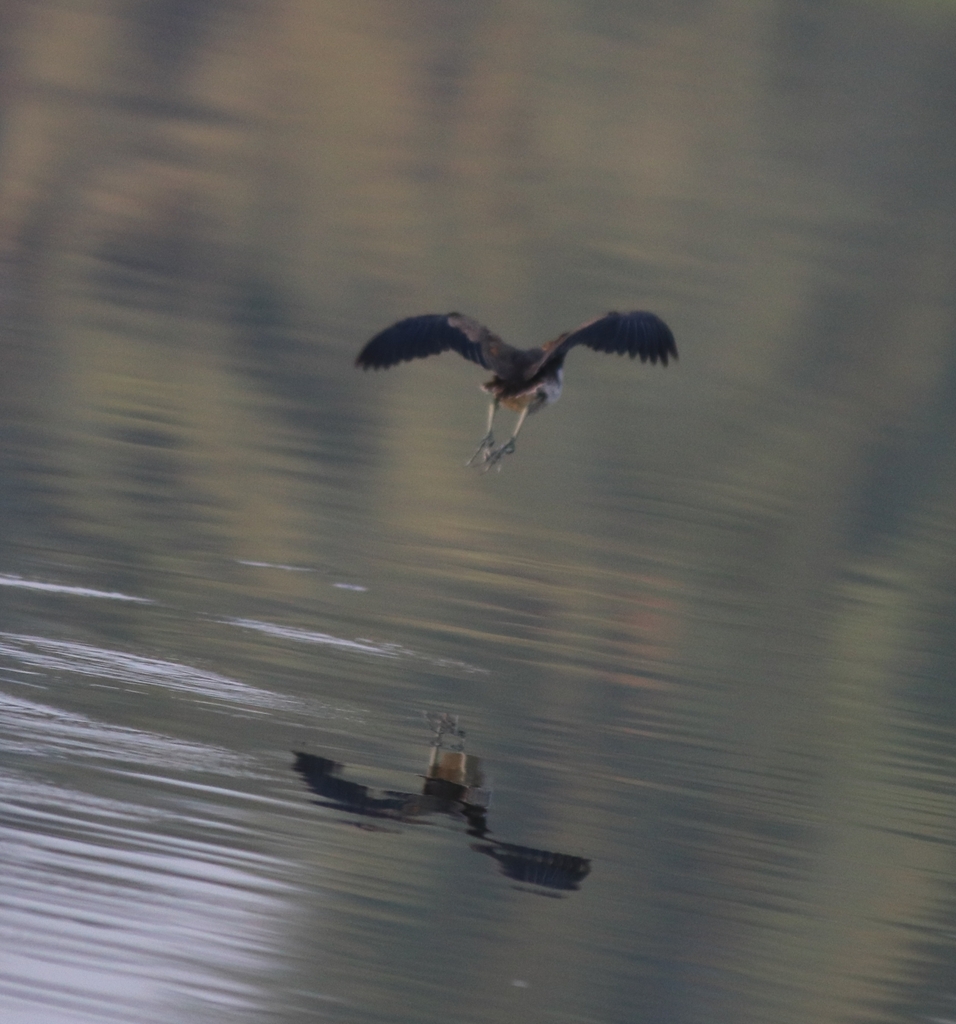
Bronze-winged Jacana
Photo © Afsar Nayakkan
Photo © Afsar Nayakkan — CC BY 4.0 — Source: iNaturalist #231185244Identification
The bronze-winged jacana is a distinctive rail-like wader measuring 29 cm in length. At a distance it appears dark except for a striking broad white supercilium that runs from above the eye to the back of the neck. The head, neck and breast are black, contrasting sharply with this white eyebrow stripe. The wings are bronzy brown with a green sheen, while the lower back and tail coverts are chestnut. The tail is stubby and reddish brown with a black terminal band. A reddish-purple frontal shield (lappet) extends over the forehead, and the greenish-yellow bill has a red base to the upper mandible. The legs are greenish with characteristically long toes, and the elongated nail on the hind toe is notably longer than the toe itself. Females are slightly larger than males, though the sexes are otherwise similar in appearance.
Range & Habitat
The bronze-winged jacana is widely distributed across the Indian subcontinent (excepting Sri Lanka and western Pakistan) and throughout Southeast Asia, primarily at low elevations. It is the sole species within its genus, Metopidius. The bird is generally sedentary, though it undergoes seasonal dispersal in response to drought and monsoon rains. Bronze-winged jacanas inhabit wetlands and can adapt to areas covered in introduced aquatic weeds such as water hyacinth, making use of vegetation like Ipomoea aquatica for breeding cover. They often share habitat with the pheasant-tailed jacana.
Behaviour & Diet
Bronze-winged jacanas are graceful foragers typically found singly or in pairs, balancing on floating aquatic vegetation using their long legs and elongated toes. They feed on plant material, insects and other invertebrates picked from floating vegetation or the water's surface. Their call is a distinctive wheezy piping "seek-seek-seek" given mostly in alarm. When threatened, they may hide by submerging themselves. The breeding season follows the monsoon rains (June to September in India, with occasional breeding during March rains). Males maintain territories and engage in dramatic open-wing and neck-stretched displays to defend them, with territorial activity peaking between 9 and 11 a.m. Females are polyandrous, maintaining harems of males during breeding season. Uniquely, males alone incubate eggs—typically a clutch of four very conical, glossy brown eggs with irregular black zig-zag markings—and care for the young. Young chicks can be sheltered and carried to safety beneath the father's wings, becoming independent at about ten weeks old.
Best Time & Places to See It
The breeding season from June to September offers the best opportunity to observe bronze-winged jacanas, particularly in wetland habitats across the Indian subcontinent and Southeast Asia. Look for them in areas with extensive floating vegetation, including both native aquatic plants and introduced species like water hyacinth. Seasonal wetlands that fill during monsoon rains are particularly productive. Early morning hours, especially between 9 and 11 a.m., are ideal for observing territorial males displaying and calling.
Photography Tips
Photograph bronze-winged jacanas in early morning light when males are most active in territorial displays. Their striking white supercilium and contrasting dark head and neck make them visually distinctive subjects. Position yourself patiently near floating vegetation mats where they forage, as they are often found singly or in pairs. The bird's habit of balancing delicately on aquatic plants provides excellent compositional opportunities. Look for moments when males perform their characteristic open-wing displays. A telephoto lens will help you maintain distance while capturing detail of the frontal shield, wing patterns and facial markings without disturbing these birds.
Orang National Park
Rangagarapathar, India
+298 birds+1 mammals
Where the Brahmaputra's floodplains meet the foothills of Assam, Orang National Park unfolds across a mosaic of riverine grasslands, forests and wetlands that pulse with the…
VIEW NATIONAL PARKRanthambhore National Park
Sawai Madhopur, India
+294 birds+20 mammals
Granite ridges and ravines carved through the Aravalli Range frame this protected landscape in eastern Rajasthan, where deciduous forest mingles with open scrubland and seasonal water…
VIEW NATIONAL PARKKhao Yai National Park
Prachantakham District, Thailand
+377 birds+46 mammals
Evergreen dipterocarp forest blankets the rolling terrain of this national park in eastern Thailand, where limestone hills rise abruptly from the forest floor and seasonal streams…
VIEW NATIONAL PARKKanha Tiger Reserve
Kanha Kisli F.V., India
+321 birds+23 mammals
Where sal forests give way to emerald meadows and crystalline streams carve through ancient valleys, one of India's finest wilderness reserves unfolds across the Maikal Range.…
VIEW NATIONAL PARKTadoba National Park
Palasgaon Singru, India
+270 birds+20 mammals
Where sal forests meet open grasslands and rocky outcrops rise from red laterite soil, central India's landscape unfolds in raw, untamed beauty. Ancient teak woodlands and…
VIEW NATIONAL PARKBandhavgarh National Park
Garhpuri, India
+285 birds+17 mammals
Where granite ridges rise dramatically above sal and bamboo forests, one of India's most pristine tiger reserves unfolds across the Vindhyan plateau. Ancient rock formations tower…
VIEW NATIONAL PARKPanna National Park
Badgadi Kalan, India
+271 birds+17 mammals
Where granite gorges slice through central India's Vindhyan plateau, a landscape of stark beauty unfolds across nearly six hundred square kilometers. The Ken River carves through…
VIEW NATIONAL PARKKaziranga National Park
Kohora, India
+422 birds+26 mammals
Dawn breaks over the floodplains of the Brahmaputra, where tall grasslands stretch endlessly beneath monsoon-heavy skies. This sprawling wilderness of northeastern Assam is a mosaic of…
VIEW NATIONAL PARKKeoladeo National Park
Shreenagar Rural, India
+326 birds+14 mammals
Where shallow wetlands shimmer beneath vast Rajasthani skies, one of Asia's finest bird sanctuaries pulses with extraordinary life. This former maharaja's hunting reserve, now spanning 29…
VIEW NATIONAL PARKBandipur National Park
Hirehalli, India
+302 birds+19 mammals
Where the Western Ghats descend into the Deccan plateau, ancient deciduous forests blanket a landscape carved by the Nugu River. Bandipur unfolds across 880 square kilometres…
VIEW NATIONAL PARKNagarahole Tiger Reserve
Nalkeri Forest, India
+323 birds+23 mammals
Where granite escarpments rise above dense deciduous forests and the Kabini River carves through pristine wilderness, one of India's most biodiverse landscapes unfolds across the Western…
VIEW NATIONAL PARKGir National Park
Asundrali, India
+258 birds+13 mammals
Dry deciduous forests cloak the rolling hills of western Gujarat where the Gir landscape rises as a final sanctuary for one of the world's rarest felids:…
VIEW NATIONAL PARKNo community photos yet. Log in to add the first one.
No community observations of this species yet.