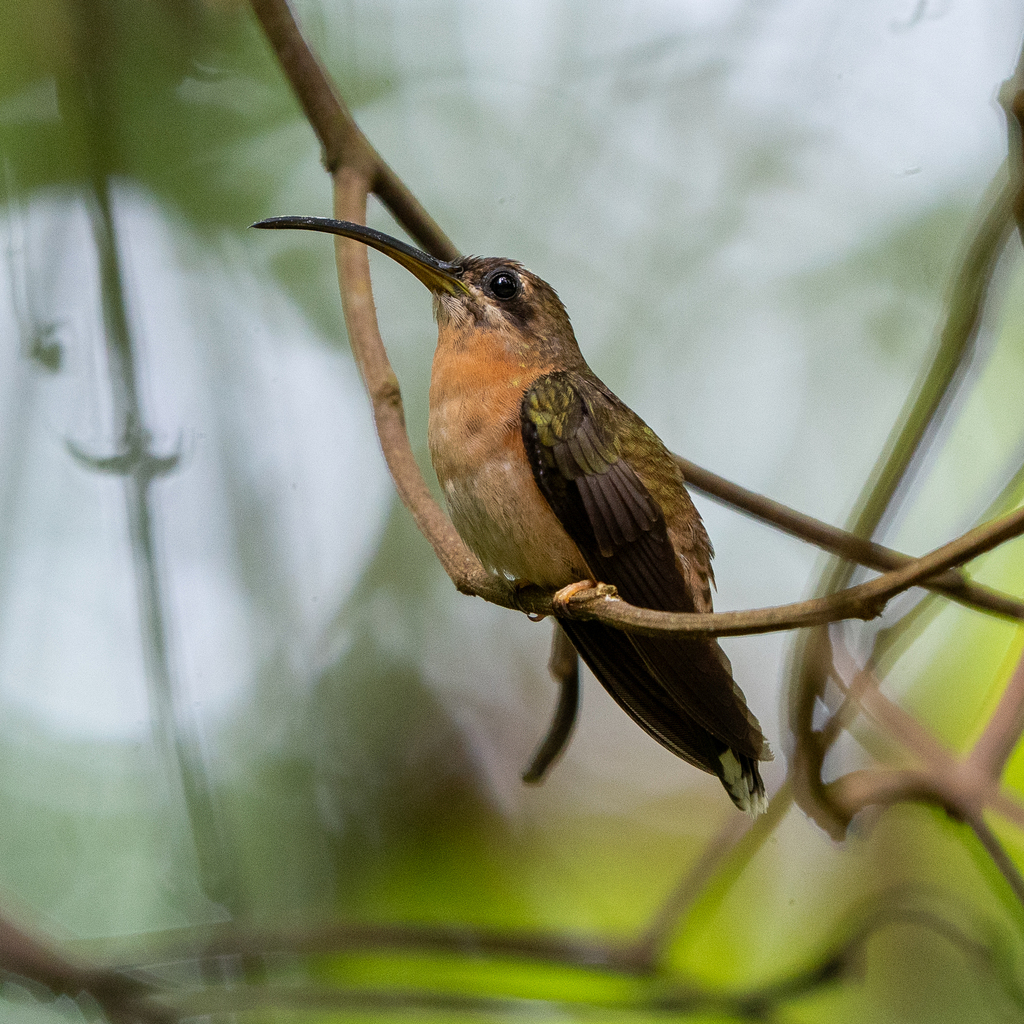
Bronzy Hermit
Photo © Anthony Batista
Photo © Anthony Batista — CC BY 4.0 — Source: iNaturalist photo #667393262Identification
The bronzy hermit is a diminutive hummingbird, measuring just 9 to 10 centimetres in length, with males weighing 3 to 6.5 grams and females slightly less. Both sexes share identical plumage featuring bronzy or coppery green upperparts that give the species its common name. The throat and breast are deep buff, contrasting with a paler buff belly, while the face is characterized by a distinctive white "moustache" marking against otherwise dusky features.
The sexes are subtly distinguished by bill structure rather than appearance: males possess a decurved bill with serrated edges on the maxilla, while females display a more curved bill without serrations. The tail is particularly striking, with gray-green upperside feathers tipped white, while the underside shows a striking pattern of reddish colouration near the body, blackish in the middle, and white at the tips. Central American populations have slightly longer wings than their South American counterparts, though plumage remains identical between the two.
Range & Habitat
The bronzy hermit occurs in two geographically separated populations across Central and South America. The Central American population ranges from eastern Honduras through eastern Nicaragua and into both the eastern and western regions of Costa Rica, extending into western Panama. The South American population is found from western Colombia into northwestern Ecuador, with its southern limit reaching Pichincha Province.
This species favours semi-open landscapes and demonstrates considerable habitat flexibility. It inhabits disturbed primary forest, mature secondary forest, swamp forest, and shrublands, ranging from sea level up to 750 metres elevation in Costa Rica and 800 metres in Colombia. The bronzy hermit is believed to be non-migratory throughout its range, making it a year-round resident in suitable habitats.
Behaviour & Diet
The bronzy hermit is primarily nectarivorous, feeding extensively on flowering plants such as Heliconia species. However, this hummingbird supplements its diet with small arthropods, which it typically obtains through hover-gleaning—carefully picking prey from spider webs, leaves, and twigs—with occasional forays into capturing insects in flight.
Breeding behaviour includes the construction of distinctive cone-shaped cup nests made from plant fibres bound together with spider web and decorated with lichens. These nests are attached to the underside of drooping leaves, likely providing shelter from rain and predators. Clutches consist of two eggs, and breeding seasons vary geographically, though exact timing has not been fully documented. The bronzy hermit is a vocal species, producing a distinctive high-pitched song with descending phrases of "tsee-tsee-tsi-tsi-tsitstitsi" punctuated by high-pitched "seee" notes, along with sharp "tzeeet!" flight calls.
Best Time & Places to See It
The bronzy hermit's year-round residency throughout its range means it can be encountered at any season, though specific breeding timing varies by location. The species is deemed "very common" in Colombia, making that country an excellent destination for reliable sightings. The bird's preference for semi-open habitats and forest edges makes it more accessible than species restricted to dense forest interiors, increasing chances of successful observation.
Photography Tips
Photographing this tiny hummingbird requires patience and appropriate equipment. The bronzy hermit's small size and active feeding behaviour demand fast shutter speeds and precise focusing. Position yourself near flowering Heliconia plants or other nectar sources where birds are likely to visit repeatedly. The distinctive white facial "moustache" and colourful tail pattern provide excellent identifying features to capture, while the bird's preference for semi-open habitats offers better lighting opportunities than forest-interior species.
Corcovado National Park
Puerto Jiménez, Costa Rica
+444 birds+48 mammals
Where the Osa Peninsula juts into the Pacific, rainforest descends almost to the tide line, and Corcovado National Park protects one of Central America's most intact…
VIEW NATIONAL PARKManuel Antonio National Park
Quepos, Costa Rica
+426 birds+22 mammals
Where tropical rainforest descends steeply to a rocky Pacific coastline, Manuel Antonio National Park distills Central American biodiversity into one of Costa Rica's most compressed and…
VIEW NATIONAL PARKArenal Volcano National Park
Peñas Blancas, Costa Rica
+551 birds+21 mammals
Straddling the border between Alajuela and Guanacaste in northwestern Costa Rica, this national park rises dramatically around one of Central America's most active volcanic systems. The…
VIEW NATIONAL PARKTortuguero National Park
Roxana, Costa Rica
+420 birds+23 mammals
Canals and lagoons thread through a labyrinth of lowland rainforest where the Caribbean coast of Costa Rica meets the wetland frontier. This is terrain shaped by…
VIEW NATIONAL PARKBraulio Carrillo National Park
Las Horquetas, Costa Rica
+547 birds+18 mammals
Where the Caribbean slope descends from the central volcanic cordillera toward the humid lowlands of Heredia, Braulio Carrillo National Park preserves one of Costa Rica's most…
VIEW NATIONAL PARKPiedras Blancas National Park
Golfito, Costa Rica
+386 birds+24 mammals
Where the Golfo Dulce meets the southwestern Pacific coast of Costa Rica, Piedras Blancas National Park protects a dramatic transition zone where lowland rainforest descends toward…
VIEW NATIONAL PARKGuanacaste National Park
Santa Elena, Costa Rica
+461 birds+17 mammals
Where the Pacific slopes of northwestern Costa Rica rise toward the Continental Divide, dry tropical forest gives way to cloud-laden peaks and misty ridges—a landscape that…
VIEW NATIONAL PARKNatural Utría National Park
Alto Baudó (Pie de Pató), Colombia
+372 birds+11 mammals
Where the Chocó's coastal mountains plunge toward the Pacific, Utría National Park preserves one of Colombia's most biodiverse and least-visited wilderness expanses. Sprawling across 1,287 square…
VIEW NATIONAL PARKNatural Farallones de Cali National Park
Buenaventura, Colombia
+733 birds+27 mammals
Where the Pacific coastal plain meets the western slopes of the Andes, Farallones de Cali National Park sprawls across nearly 3,500 square kilometers of dramatic topography…
VIEW NATIONAL PARKNatural Uramba Bahía Málaga National Park
Buenaventura, Colombia
+308 birds+15 mammals
Where the Pacific coastal rainforest descends to mangrove estuaries and rocky headlands, Uramba Bahía Málaga National Park unfolds across nearly 1,000 square kilometres of Colombia's Valle…
VIEW NATIONAL PARKBaru Volcano National Park
Cerro Punta, Panama
+402 birds+6 mammals
Where the land rises sharply toward the Caribbean's western spine, Baru Volcano National Park sprawls across roughly 220 square kilometres of southwestern Panama, anchored by the…
VIEW NATIONAL PARKCarara National Park
Tárcoles, Costa Rica
+397 birds+19 mammals
Where the Pacific coastal plain meets transitional forest, Carara National Park straddles one of Central America's most dynamic ecological boundaries. The park's landscape encompasses lowland deciduous…
VIEW NATIONAL PARKCahuita National Park
Talamanca, Costa Rica
+359 birds+15 mammals
Where the Caribbean shoreline dissolves into mangrove creeks and coral gardens, Cahuita's mosaic of habitats unfolds across the Limón coast. The park's signature feature—a living coral…
VIEW NATIONAL PARKRincón de la Vieja National Park
Liberia, Costa Rica
+451 birds+30 mammals
Where volcanic slopes rise abruptly from the Guanacaste lowlands, Rincón de la Vieja National Park sprawls across a landscape shaped by geothermal drama and seasonal extremes.…
VIEW NATIONAL PARKLa Amistad International Park
Crorina, Costa Rica
+532 birds+20 mammals
Where the Caribbean slopes of Costa Rica's Talamanca Mountains rise steeply inland from Limón, the boundary between two nations dissolves into an unbroken expanse of rainforest.…
VIEW NATIONAL PARKVolcán Tenorio National Park
Guatuso, Costa Rica
+480 birds+12 mammals
Where volcanic slopes rise through Costa Rica's northwestern borderlands, Volcán Tenorio National Park sprawls across terrain shaped by ancient lava flows and mineral-rich springs. The park's…
VIEW NATIONAL PARKMarino Ballena National Park
Bahía Ballena, Costa Rica
+336 birds+8 mammals
Where mangrove forests meet coral-fringed shorelines along Costa Rica's southern Pacific coast, Marino Ballena National Park encompasses a marine and terrestrial mosaic that ranks among Central…
VIEW NATIONAL PARKCaño Negro National Wildlife Refuge
Caño Negro District, Costa Rica
+486 birds+16 mammals
Where the San Juan River's seasonal floodplain opens into expansive wetlands, Caño Negro Wildlife Sanctuary sprawls across one of Central America's most productive freshwater ecosystems. This…
VIEW WILDLIFE SANCTUARYGandoca-Manzanillo National Wildlife Refuge
Manzanillo, Costa Rica
+394 birds+18 mammals
Where the Caribbean coastal plain surrenders to water-logged forest and mangrove tangles, Gandoca-Manzanillo Wildlife Sanctuary shelters one of Costa Rica's most biodiverse lowland wetland ecosystems. The…
VIEW WILDLIFE SANCTUARYBarra del Colorado National Wildlife Refuge
Tortuguero, Costa Rica
+462 birds+36 mammals
Where the Caribbean's restless waters meet the Limón Province coastline, Barra del Colorado National Wildlife Sanctuary unfolds across a landscape of extraordinary ecological complexity. This equatorial…
VIEW WILDLIFE SANCTUARYNo community photos yet. Log in to add the first one.
No community observations of this species yet.