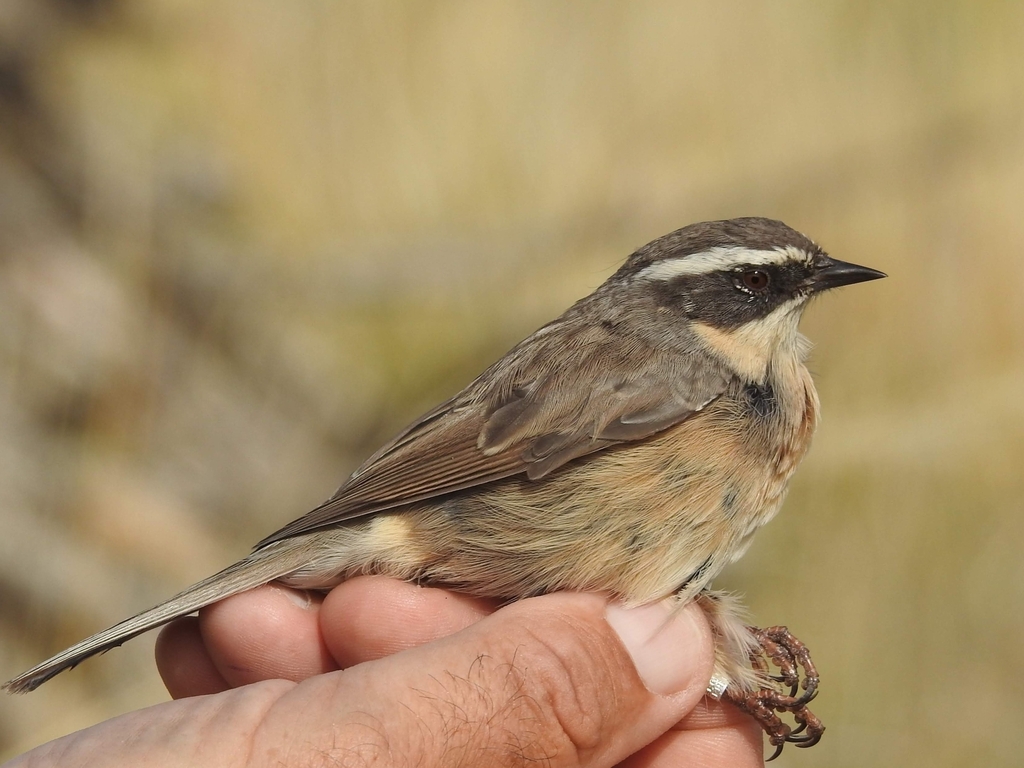
Brown Accentor
Photo © Olivier Morel
Photo © Olivier Morel — CC BY 4.0 — Source: iNaturalist #142324654Identification
The brown accentor is a small passerine with distinctive facial markings that make it relatively straightforward to identify in the field. Look for a prominent white supercilium (eyebrow stripe) that broadens behind the eye, contrasting with a blackish-brown mask and blackish-brown ear-coverts. The breast and belly are washed with yellowish tones, giving the species its common name despite the darker upper parts. Males are noticeably larger than females, a useful distinction when comparing individuals.
Range & Habitat
This accentor occupies a vast range across Central, South, and East Asia, occurring in Afghanistan, China, India, Kazakhstan, Mongolia, Nepal, Pakistan, Russia, Tajikistan, Turkmenistan, and Uzbekistan. The species shows a marked preference for drier habitats compared to other accentors, making it well-adapted to harsh alpine environments.
Brown accentors breed at high altitudes between 3,300 and 5,100 meters, favoring Mediterranean-type shrubby vegetation. This elevational preference places them among the mountain specialists of the accentor family, occupying terrain characterized by sparse, hardy plant growth suited to extreme conditions.
Behaviour & Diet
Brown accentors are primarily monogamous, though polyandry has been recorded in some populations, revealing flexibility in their breeding system. During the breeding season, which begins in late May, pairs become highly territorial. Females lay clutches of 3–4 eggs from late June through late July, incubating them for 12–14 days. Both sexes participate in feeding nestlings over a 13–15 day period, though females undertake the majority of feeding duties.
Adults maintain a mixed diet of seeds, fruits, and insects, allowing them to exploit available food sources across seasons. Nestlings, by contrast, are fed exclusively on insects, which provide the protein-rich nutrition essential for rapid chick development in the demanding mountain environment.
Best Time & Places to See It
The breeding season, beginning in late May and continuing through July, is the optimal window for encountering brown accentors at their high-altitude breeding grounds. The species is reported to be common in Central Asia year-round, making this region the most reliable destination. Outside the breeding season, the species becomes locally common in winter in Pakistan and locally common in northern India, with common populations also reported in north-western Nepal.
Photography Tips
The brown accentor's preference for Mediterranean-type shrubby vegetation means subjects are often partially obscured by low plants and rocks. Patience and a telephoto lens (at least 300mm) are essential for capturing clean images without disturbing birds in this sensitive alpine environment. Early morning light on the high plateaus will best illuminate the subtle yellowish tones of the underparts and the clean facial pattern. Given the remote, high-altitude terrain these birds inhabit, approach photography sessions with proper acclimatization and respect for the harsh mountain conditions.
Langtang National Park
Helambu, Nepal
+364 birds+14 mammals
Where the southern slopes of the Himalayan highlands descend toward the subtropical valleys of central Nepal, Langtang National Park sprawls across one of the subcontinent's most…
VIEW NATIONAL PARKSagarmatha National Park
Khumjung, Nepal
+219 birds+7 mammals
Soaring peaks and deep glacial valleys define this alpine wilderness in northeastern Nepal, where the terrain rises from forested foothills into a realm of high-altitude tundra…
VIEW NATIONAL PARKGiant Panda National Park
Mianyang, China
+447 birds+47 mammals
Where the eastern slopes of China's Sichuan plateau descend into cloud-wrapped valleys, one of Asia's most biodiverse landscapes unfolds across more than 350,000 square kilometres. This…
VIEW NATIONAL PARKHemis National Park
Raigahar Dhar, India
+131 birds+13 mammals
Where granite gorges cleave through the Himalayas at dizzying altitudes, a vast wilderness of alpine desert unfolds across the rain shadow of Ladakh. Hemis sprawls across…
VIEW NATIONAL PARKKhangai Nuruu National Park
Erdenetsogt, Mongolia
+136 birds+7 mammals
Where granite ridges pierce Mongolia's central steppe, alpine meadows give way to dense coniferous forests that climb toward windswept summits. Khangai Nuruu sweeps across 1.2 million…
VIEW NATIONAL PARKGorkhi-Terelj National Park
Ulaanbaatar, Mongolia
+137 birds+5 mammals
Where granite monoliths rise abruptly from rolling steppe grasslands, Gorkhi-Terelj National Park unfolds across the landscape north of Ulaanbaatar, a sanctuary where forest and alpine meadow…
VIEW NATIONAL PARKAltai Tavan Bogd National Park
Tsengel, Mongolia
+146 birds+3 mammals
Where the Altai Mountains rise in jagged defiance along Mongolia's western frontier, the terrain transforms into a realm of alpine tundra, rocky plateaus, and glacier-carved valleys…
VIEW NATIONAL PARKHustai National Park
Altanbulag, Mongolia
+198 birds+16 mammals
Where the steppe rolls endlessly beneath vast Mongolian skies, Hustai National Park preserves one of Central Asia's most dynamic grassland ecosystems. Rolling hills and open prairie…
VIEW NATIONAL PARKGobi Gurvan Saikhan National Park
Tsagaan Subarga Hural, Mongolia
+183 birds+23 mammals
Where rust-coloured badlands rise from the southern Gobi steppe, the terrain transforms into a landscape of geological drama that few visitors expect to find in Mongolia's…
VIEW NATIONAL PARKSanjiangyuan National Park
Nagqu, China
+187 birds+25 mammals
Where the headwaters of three great Asian rivers emerge from a high alpine plateau, the landscape unfolds in tundra and dwarf shrubland—a world of austere beauty…
VIEW NATIONAL PARKWolong National Nature Reserve
Wenchuan County, China
+333 birds+17 mammals
Where the Qingyi River cuts through the eastern flanks of the Minshan Range, a temperate montane forest cloaks steep valleys in dense canopy that thins dramatically…
VIEW NATURE RESERVEQinghai Lake National Nature Reserve
Hainan Tibetan Autonomous Prefecture, China
+243 birds+11 mammals
At 3,200 metres above sea level on the Tibetan plateau, where winter temperatures plunge far below freezing and snow blankets the landscape for half the year,…
VIEW NATURE RESERVEBaima Snow Mountain National Nature Reserve
Diqing Tibetan Autonomous Prefecture, China
+204 birds+3 mammals
High-altitude ridges and steep-sided valleys define this reserve in northwestern Yunnan, where elevations surge from around 3,000 metres to peaks above 4,100 metres. The terrain supports…
VIEW NATURE RESERVENo community photos yet. Log in to add the first one.
No community observations of this species yet.