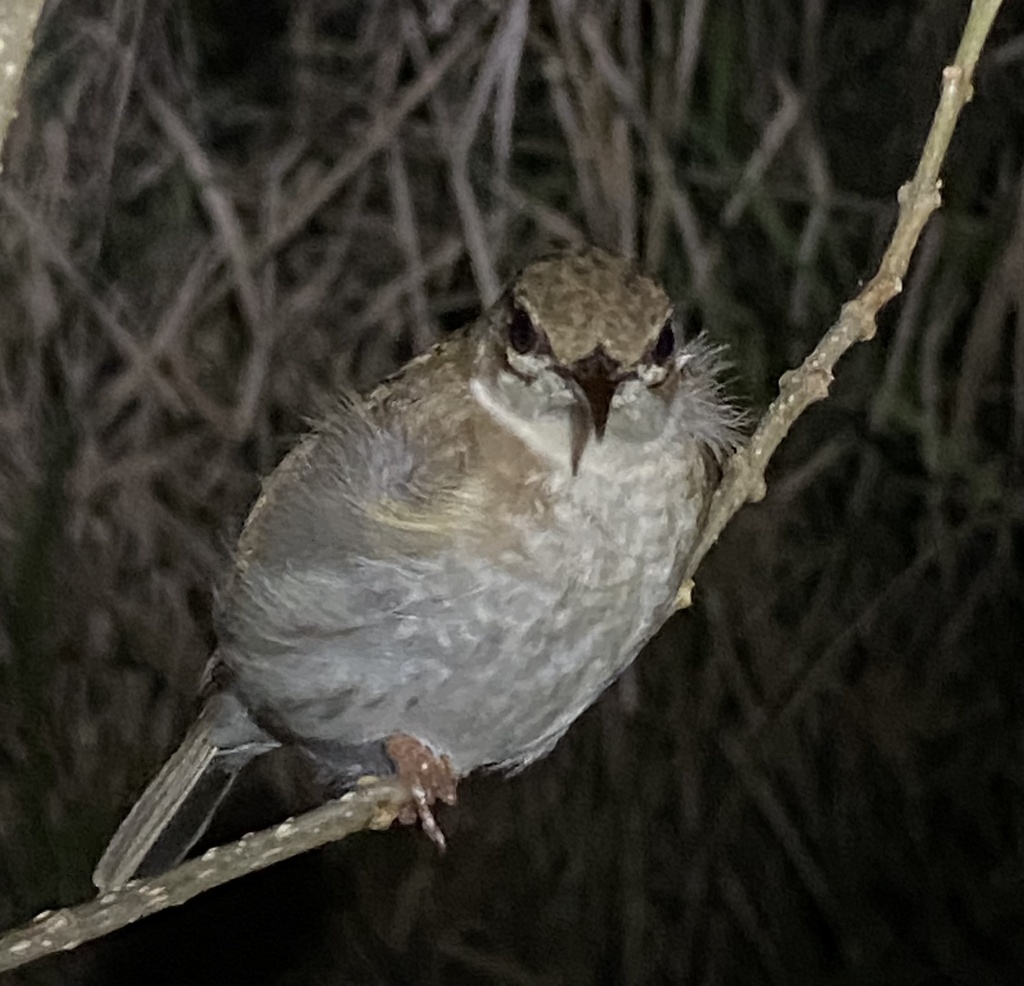
Brown-backed Honeyeater
Photo © Greg Tasney
Photo © Greg Tasney — CC BY-SA 4.0 — Source: iNaturalist #137851439The brown-backed honeyeater (Ramsayornis modestus) is a species of bird in the family Meliphagidae. It is found in New Guinea and Cape York Peninsula in Queensland, Australia. Its natural habitat is subtropical or tropical mangrove forests. == Description == The Brown-backed honeyeater is small in size, measuring around 11–12cm in length with a weight of 11–14 g. The average wingspan is 6.2–7 cm (2.4 to 2.7 in), and the bill is 1.5–1.8 cm in length. Like the name suggests, it has a brown back with brown streaks across an otherwise white chest and belly, and a red bill. Similar in appearance to the Bar-breasted Honeyeater, but with a differing facial pattern. === Calls === Calls include a rapid mick, mick, and a chattering shee-shee. == Distribution == The Brown-backed honeyeater is found along the coast of Far North Queensland, particularly around the Cape York Peninsula. Its range extends across the islands of the Torres Strait and into New Guinea. Unlike similar birds that migrate across the Torres Strait, the Brown-backed honeyeater is partly resident and nomadic, meaning it tends to stay in the same area year-round but will travel depending on environmental factors, such as food availability and rainfall. It…
Daintree National Park
Dedin, Australia
+362 birds+37 mammals
Daintree National Park is one of the world’s oldest and most biologically diverse tropical rainforests, protecting an extraordinary landscape where ancient forests meet the Great Barrier…
VIEW NATIONAL PARKAnnan River (Yuku Baja-Muliku) National Park
Australia
+78 birds
Where the Annan River winds through northeastern Queensland's coastal hinterland, a compact national park of roughly 246 square kilometers protects a mosaic of subtropical rainforest, eucalypt…
VIEW NATIONAL PARKEndeavour River National Park
Philadelphia, Australia
+203 birds+1 mammals
Where the Endeavour River winds through northeastern Queensland's tropical lowlands, a compact mosaic of rainforest, open woodland, and riverine corridor creates one of Australia's most ecologically…
VIEW NATIONAL PARKRinyirru National Park
Lakefield, Australia
+258 birds+7 mammals
Where the savanna grasslands of far north Queensland meet seasonal wetlands and eucalypt woodlands, Rinyirru National Park sprawls across more than 12,500 square kilometres of rugged,…
VIEW NATIONAL PARKGirringun National Park
Australia
+231 birds+10 mammals
Where granite gorges cleave through subtropical woodland in North Queensland, Girringun National Park unfolds across rugged terrain shaped by millions of years of weathering and erosion.…
VIEW NATIONAL PARKWooroonooran National Park
Australia
+240 birds+28 mammals
Where the Great Dividing Range rises sharply inland from Queensland's tropical coast, Wooroonooran National Park encompasses a landscape of steep, forested gorges and cascading waterways carved…
VIEW NATIONAL PARKNo community photos yet. Log in to add the first one.
No community observations of this species yet.