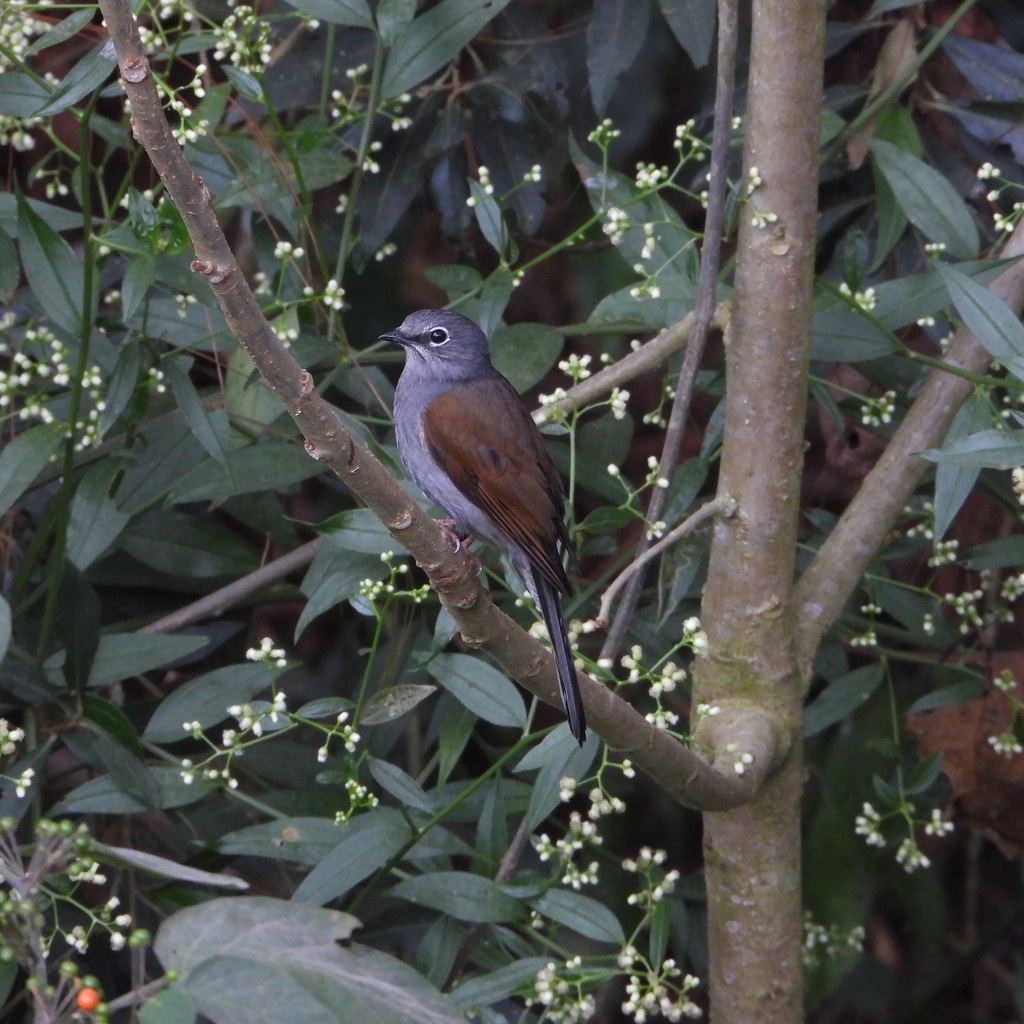
Brown-backed Solitaire
Photo © Grete Pasch
Photo © Grete Pasch — CC BY 4.0 — Source: iNaturalist #203308460The brown-backed solitaire (Myadestes occidentalis) is a thrush found in montane pine-oak woodlands from Mexico to Honduras. == Taxonomy and systematics == The brown-backed solitaire was originally described as Myadestes obscurus. In 1882, Stejneger split it as the mainland Myadestes obscurus var occidentalis and Myadestes obscurus var. insularis, endemic to the Tres Marías Islands. However, the binomial Myadestes obscurus was later found to have been assigned to another species. By the principle of priority, Stejneger's two taxa were then named M. occidentalis occidentalis and M. occidentalis insularis. In addition to the subspecies M. o. occidentalis and M. o. insularis (both Stejneger, 1882), the brown-backed solitaire has a third subspecies, M. o. oberhoseri (Dickey & van Rossem, 1925), which is found further south than the other two. == Description == The brown-backed solitaire is 20.5 to 21.5 cm (8.1 to 8.5 in) long and weighs 38 to 44 g (1.3 to 1.6 oz). The sexes have the same plumage. Adults of the nominate subspecies M. o. occidentalis have black lores with a white stripe above them, a broken white eye-ring, a white "moustache" stripe, black cheeks, and a white chin and upper throat on an otherwise dull darkish gray head. Their…
Lagunas de Montebello National Park
Laguna de Montebello, Mexico
+360 birds+2 mammals
Where turquoise lagoons pierce the limestone plateau of southeastern Chiapas, the Lagunas de Montebello National Park unfolds across roughly 174 square kilometers of spectral water and…
VIEW NATIONAL PARKParque Nacional Benito Juárez
San Andrés Huayápam, Mexico
+128 birds+4 mammals
High in the Sierra Madre del Sur of Oaxaca, where cloud forest mingles with pine woodland and the terrain climbs steeply through ravines carved by mountain…
VIEW NATIONAL PARKTutuaca
Tosanachi, Mexico
+147 birds+13 mammals
Where copper canyons plunge deeper than the Grand Canyon itself, Mexico's remote Sierra Madre Occidental unfolds in dramatic vertical relief. Tutuaca anchors this wilderness realm, a…
VIEW PROTECTED LANDSCAPENo community photos yet. Log in to add the first one.
No community observations of this species yet.