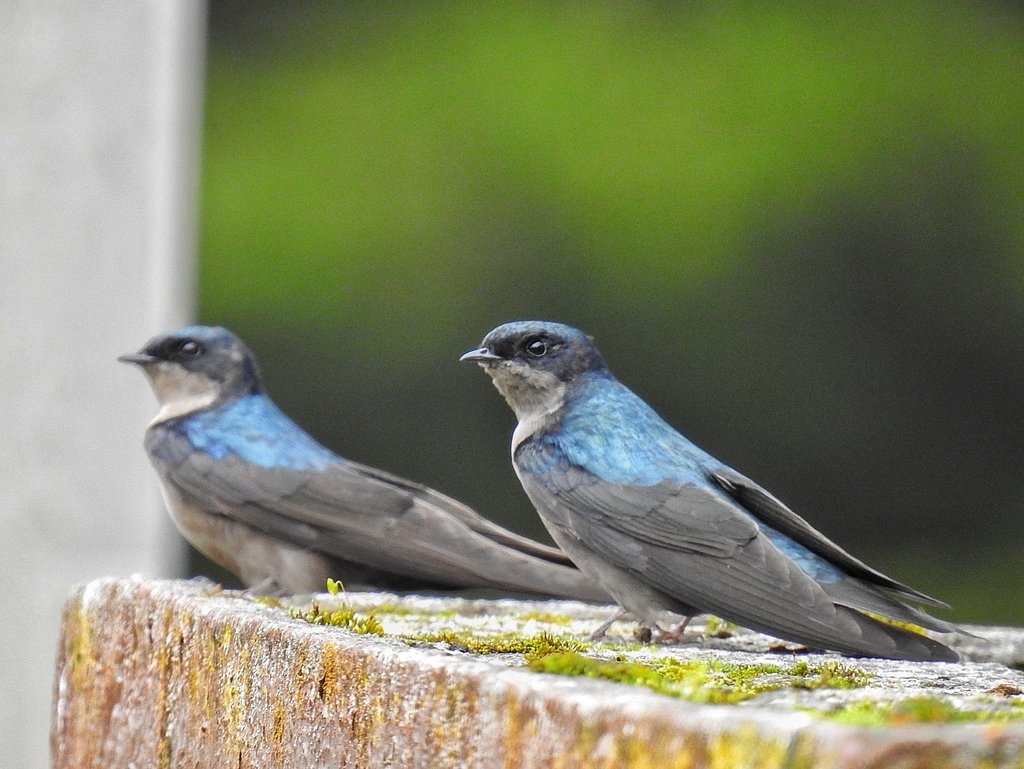
Brown-bellied Swallow
Photo © Esteban Poveda
Photo © Esteban Poveda — CC BY 4.0 — Source: iNaturalist photo #114982764Identification
The brown-bellied swallow is a small swallow, about 14 cm (5.5 inches) long and weighing approximately 12.5 g. Males are noticeably more striking than females, with a mostly blackish head and neck displaying a distinctive blue-green gloss, contrasting with a sooty gray-brown throat. The upperparts are blackish with the same blue-green iridescence, while the tail is moderately forked and dark brown. The underparts are predominantly sooty gray-brown with black undertail coverts. Juveniles are considerably duller, featuring a brown throat, gray-white underparts, and a proportionally shorter tail. Three subspecies exist: the nominate O. m. murina shows the standard pattern; O. m. meridensis displays bluer upperparts; and O. m. cyanodorsalis exhibits a steel-blue gloss on the back.
Range & Habitat
This Andean species has a disjunct distribution across five countries: Colombia, Ecuador, Peru, Venezuela, and Bolivia. The northernmost subspecies (meridensis) inhabits the Sierra Nevada de Santa Marta and Serranía del Perijá in northern Colombia and Venezuela, extending south through Colombia's Eastern Andes to Boyacá. The nominate subspecies ranges from northwestern Colombia through Ecuador to south-central Peru, while cyanodorsalis occurs from southeastern Peru to central Bolivia. Elevations vary by region, from 2,000 to 4,300 meters depending on location. The species favors open to semi-open montane landscapes including grasslands, shrublands, elfin forest, Polylepis woodlands, farmland, and human settlements, particularly in areas near water.
Behaviour & Diet
Brown-bellied swallows are primarily year-round residents, though some seasonal movements occur in Venezuela. They are aerial insectivores, capturing flying insects with remarkable agility in swift, direct flight low over the ground, though they also circle high in the air while foraging. They are flexible in their grouping behavior, feeding singly, in pairs, or in flocks of up to approximately 30 individuals, often mixing with other swallow species. During breeding season (at least September–October in Colombia and Ecuador), they nest both solitarily and in small colonies, constructing cup-shaped nests lined with feathers in cavities such as cliffs, road cuttings, or buildings. They typically lay two to three eggs per clutch.
Best Time & Places to See It
The brown-bellied swallow is numerous in the Venezuelan Andes during the wet season and less abundant in the dry season. It is considered common throughout Colombia and Ecuador, and fairly common in Peru. The species is stable and secure, occurring in multiple protected areas across its range. Visiting mountain grasslands and open habitats between 2,500 and 4,000 meters elevation offers the best chances of encounter, particularly during the breeding season from September onward.
Photography Tips
Photographing this species requires patience and a good understanding of its feeding behavior. Position yourself in open terrain where you can observe flocks foraging, allowing you to predict flight paths and capture birds in dynamic aerial pursuit. The metallic blue-green gloss on the head and upperparts is most striking in good light, so morning or afternoon sun angling across the birds will enhance these iridescent qualities. Use a fast shutter speed (at least 1/1000th second) to freeze the rapid flight. Males are more colorful than females, so try to identify and focus on males when possible. Watch for mixed-species flocks, which often provide better photographic opportunities through prolonged observation in one area.
Antisana National Park
Cajas National Park
Cotopaxi National Park
El Tamá National Park
Huascarán National Park
Llanganates National Park
Manu National Park
Natural Chingaza National Park
Natural el Cocuy National Park
Nothing matches these filters.
No community photos yet. Log in to add the first one.
No community observations of this species yet.