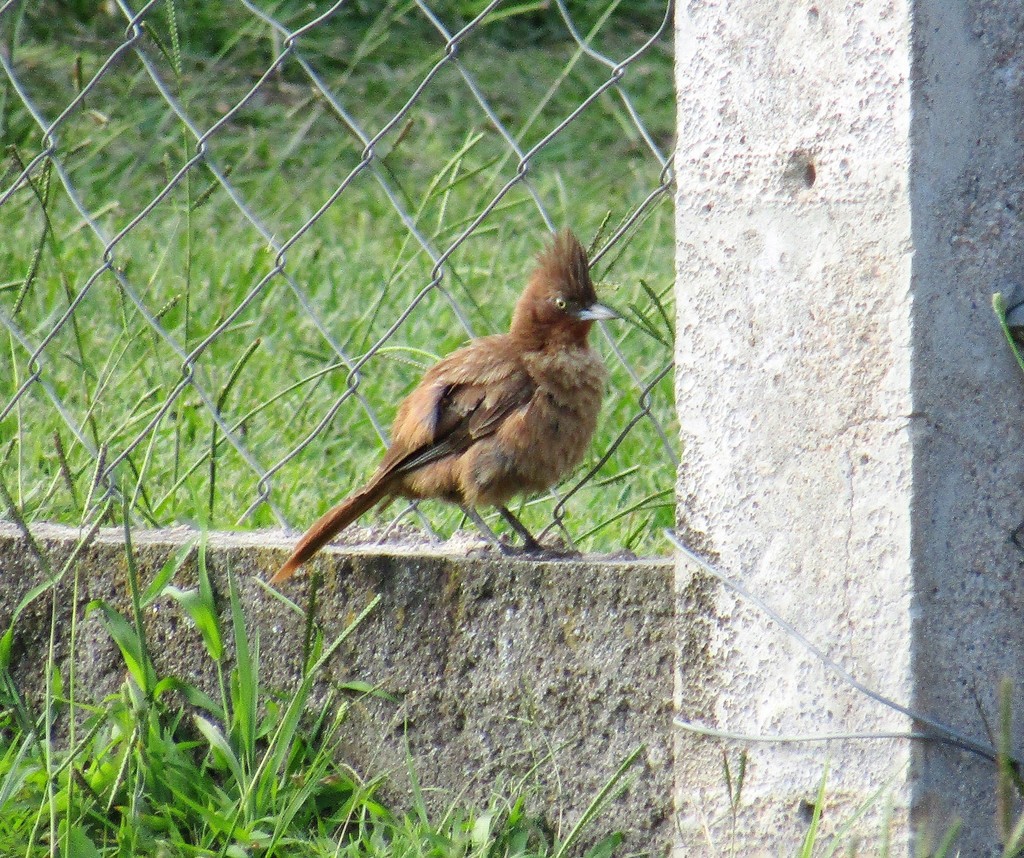
Brown Cacholote
Photo © Ezequiel Vera
Photo © Ezequiel Vera — CC BY 4.0 — Source: iNaturalist #20230461The brown cacholote (Pseudoseisura lophotes) is a medium-sized bird of the ovenbird family Furnariidae. It was described by Ludwig Reichenbach in 1853, with its subspecies, argentina, described in 1960 by Kenneth Carroll Parkes. It is nonmigratory, and is found in the forests and parks of Argentina, Bolivia, Brazil, Paraguay, and Uruguay. Unlike many other birds, the brown cacholote builds large, pitcher-like nests year-round, each weighing many times more than the bird itself. Breeding begins in mid-November, with both parents sharing the responsibility for taking care of the nest equally. Incubation takes 17–20 days, and nestlings fledge at 19 days. They are omnivorous, primarily eating various arthropods, along with the eggs of other birds, fruits, and grain. The causes of death in adults is not well researched; however, nestlings are subject to parasitism from various insects. Egg success rate is 59%. They are a least-concern species. == Taxonomy and systematics == The brown cacholote was first described as Homorus lophotes by Ludwig Reichenbach in 1853 in his book Handbuch der speciellen Ornithologie. It was later moved into the genus Pseudoseisura by Miguel Lillo in 1902. The specific epithet, lophotes, derives from the Greek word lophōtos, meaning "crested". P. l. lophotes Reichenbach…
El Palmar National Park
Distrito Sexto, Argentina
+244 birds+14 mammals
Across the Paraná River floodplain in northeastern Argentina, palms rise from wetland and grassland in a landscape shaped by water and time. El Palmar National Park…
VIEW NATIONAL PARKEl Rey National Park
Municipio de Las Lajitas, Argentina
+317 birds+4 mammals
Where the eastern slopes of the Andes descend into northwestern Argentina's subtropical transition zone, El Rey National Park unfolds across 841 square kilometers of dramatically varied…
VIEW NATIONAL PARKSierra de las Quijadas National Park
Argentina
+168 birds+5 mammals
Sandstone cliffs and deeply incised canyons define this 1,137-square-kilometre expanse in San Luis Province, where the dry Chacoan landscape of central Argentina reveals an unexpected ecological…
VIEW NATIONAL PARKNo community photos yet. Log in to add the first one.
No community observations of this species yet.