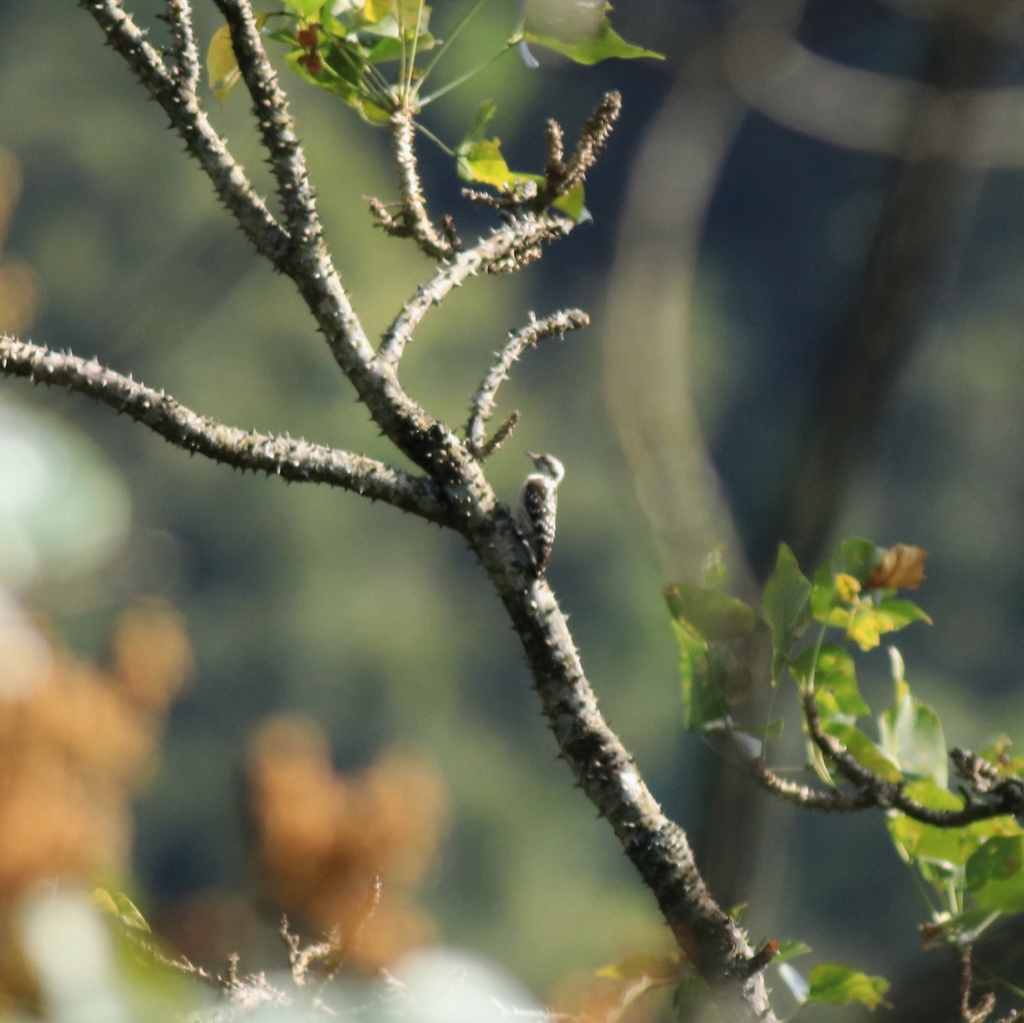
Brown-capped Pygmy Woodpecker
Photo © Afsar Nayakkan
Photo © Afsar Nayakkan — CC BY 4.0 — Source: iNaturalist #270445155Identification
The brown-capped pygmy woodpecker is a small woodpecker with distinctive plumage that makes it recognizable to keen-eyed observers. It sports a brownish cap extending from the forehead to the hindneck, with a paler brown crown edged in red on males. The bird's most striking feature is its distinctive pink-rimmed white irises, which stand out against its facial markings. White supercilia and cheeks contrast sharply with darker eyestripes, while the upperparts are barred in brown and white. The underparts are lightly streaked in dirty white, and the tail is spotted with white.
Range & Habitat
The brown-capped pygmy woodpecker is found across Nepal, India (excluding the northeast and Thar desert regions), and Sri Lanka. This is a non-migratory resident species throughout most of its range, though birds at higher altitudes may descend to lower elevations during winter months. The species inhabits diverse environments up to 2,300 meters in elevation, demonstrating impressive adaptability to various landscape types.
Despite preferring tropical and subtropical dry, moist, and deciduous forests, this woodpecker readily colonizes mangroves, orchards, and cultivated areas including urban gardens. This willingness to use human-modified landscapes makes it more accessible to travelers than many forest specialists, though spotting them still requires patience and attention.
Behaviour & Diet
The brown-capped pygmy woodpecker is highly active and constantly foraging, yet paradoxically remains elusive despite its energetic habits. These birds are social creatures, often seen in pairs or small family groups, and frequently join mixed-species flocks foraging in the tree canopy. They forage by gleaning and probing wood for small invertebrates, supplementing their diet with nectar and fruit. Monogamous and territorial by nature, they maintain established territories throughout the year.
During the breeding season from February to May, both sexes cooperate in excavating nesting cavities in dead branches 2–14 meters high, creating entrance holes approximately 3 centimeters in diameter. Both partners share feeding responsibilities once chicks hatch. Their presence is often announced by a weak, rapid rattling call on a rising scale, lasting 1.2 to 1.5 seconds—a useful identifier for birders searching the canopy.
Best Time & Places to See It
The breeding season from February to May offers the best opportunity to locate this species, as birds are more vocal and visible while nesting and feeding young. Any wooded habitat within the species' range—from urban gardens to forest edges—is worth checking. Look upward into tree canopies, particularly in mixed-species flocks, where these small woodpeckers often forage alongside other foragers.
Photography Tips
Photographing brown-capped pygmy woodpeckers requires patience due to their constant movement and small size. Focus on dead branches and snags where they forage and nest; these birds spend considerable time on deadwood. Early morning hours when activity peaks offer your best chances. The distinctive pink-rimmed white irises and facial pattern make excellent focal points for close-up photography. Be prepared for quick movements and distant subjects in the canopy—a telephoto lens is essential.
Lunugamvehera National Park
Sri Lanka
+204 birds+14 mammals
Dry scrubland and shallow wetlands converge in Sri Lanka's southeastern lowlands, where Lunugamvehera National Park anchors one of the island's most ecologically vital landscapes. The park's…
VIEW NATIONAL PARKMinneriya National Park
Sri Lanka
+158 birds+9 mammals
Across the dry zone of Sri Lanka's North Central Province spreads a landscape of shallow tanks, grassland margins, and scattered dry forest—a mosaic of water and…
VIEW NATIONAL PARKWasgamuwa National Park
Sri Lanka
+156 birds+8 mammals
Dry deciduous forest and open grassland sweep across the North Central lowlands where Wasgamuwa National Park protects one of Sri Lanka's largest remaining tracts of this…
VIEW NATIONAL PARKMaduru Oya National Park
Sri Lanka
+74 birds+1 mammals
Granite ridges rise abruptly from the humid lowlands of Sri Lanka's Uva Province, their weathered slopes clothed in dry monsoon forest and scattered woodland where deciduous…
VIEW NATIONAL PARKIndravati National Park
Bijapur, India
+41 birds
Where the Indravati River cuts through the elevated plateaus of central India, a landscape of deciduous forest and open woodland unfolds across Bijapur district in Chhattisgarh.…
VIEW NATIONAL PARKRanthambhore National Park
Sawai Madhopur, India
+294 birds+20 mammals
Granite ridges and ravines carved through the Aravalli Range frame this protected landscape in eastern Rajasthan, where deciduous forest mingles with open scrubland and seasonal water…
VIEW NATIONAL PARKKanha Tiger Reserve
Kanha Kisli F.V., India
+321 birds+23 mammals
Where sal forests give way to emerald meadows and crystalline streams carve through ancient valleys, one of India's finest wilderness reserves unfolds across the Maikal Range.…
VIEW NATIONAL PARKTadoba National Park
Palasgaon Singru, India
+270 birds+20 mammals
Where sal forests meet open grasslands and rocky outcrops rise from red laterite soil, central India's landscape unfolds in raw, untamed beauty. Ancient teak woodlands and…
VIEW NATIONAL PARKBandhavgarh National Park
Garhpuri, India
+285 birds+17 mammals
Where granite ridges rise dramatically above sal and bamboo forests, one of India's most pristine tiger reserves unfolds across the Vindhyan plateau. Ancient rock formations tower…
VIEW NATIONAL PARKPanna National Park
Badgadi Kalan, India
+271 birds+17 mammals
Where granite gorges slice through central India's Vindhyan plateau, a landscape of stark beauty unfolds across nearly six hundred square kilometers. The Ken River carves through…
VIEW NATIONAL PARKKeoladeo National Park
Shreenagar Rural, India
+326 birds+14 mammals
Where shallow wetlands shimmer beneath vast Rajasthani skies, one of Asia's finest bird sanctuaries pulses with extraordinary life. This former maharaja's hunting reserve, now spanning 29…
VIEW NATIONAL PARKPeriyar National Park
Mlappara, India
+232 birds+4 mammals
Dawn breaks over mist-shrouded ridges where the Western Ghats tumble toward Kerala's spice-scented lowlands. Here, ancient tropical forests envelope a glittering artificial lake, creating a mosaic…
VIEW NATIONAL PARKPampadum Shola National Park
Vattavada, India
+258 birds+14 mammals
Where misty shola forests cling to the high plateaus of the Nilgiri Mountains, ancient evergreen remnants create a world apart. This 2,316-hectare reserve protects one of…
VIEW NATIONAL PARKBandipur National Park
Hirehalli, India
+302 birds+19 mammals
Where the Western Ghats descend into the Deccan plateau, ancient deciduous forests blanket a landscape carved by the Nugu River. Bandipur unfolds across 880 square kilometres…
VIEW NATIONAL PARKNagarahole Tiger Reserve
Nalkeri Forest, India
+323 birds+23 mammals
Where granite escarpments rise above dense deciduous forests and the Kabini River carves through pristine wilderness, one of India's most biodiverse landscapes unfolds across the Western…
VIEW NATIONAL PARKGir National Park
Asundrali, India
+258 birds+13 mammals
Dry deciduous forests cloak the rolling hills of western Gujarat where the Gir landscape rises as a final sanctuary for one of the world's rarest felids:…
VIEW NATIONAL PARKNo community photos yet. Log in to add the first one.
No community observations of this species yet.