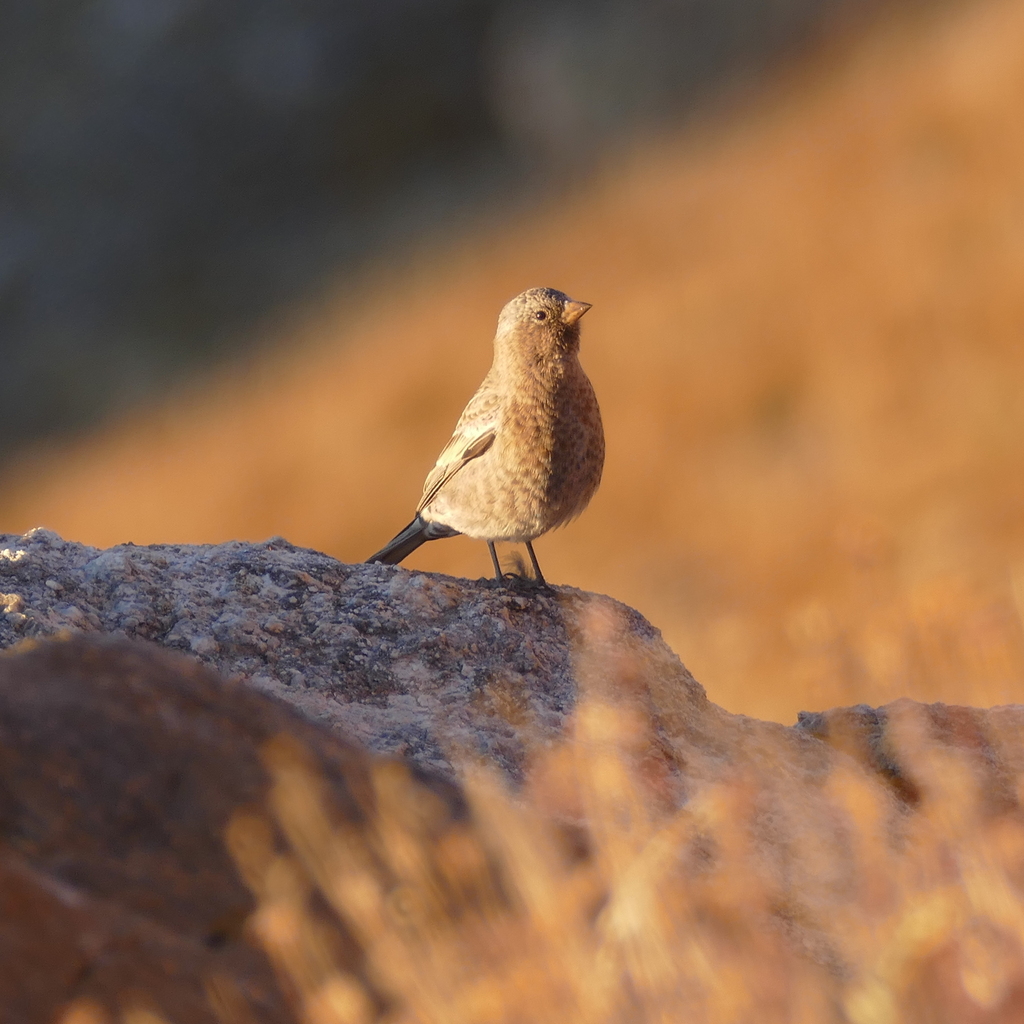
Brown-capped Rosy Finch
Photo © Desiree L. Narango
Photo © Desiree L. Narango — CC BY 4.0 — Source: iNaturalist #256008966The brown-capped rosy finch (Leucosticte australis) is a medium-sized finch endemic to North America in the middle of the Rocky Mountains. Adults are brown on the head, back, and breast. The belly and rump are pink, with additional pink shading on the wings and tail. The pink is pronounced on the male but more subdued on the female. The forehead is black or grayish brown. The bill is yellow in winter and black in summer. These birds have short black legs and a long forked tail. Their breeding habitat is mountain peaks in the central Rocky Mountains of the United States. They build a cup nest in a cavity on a cliff, or re-use abandoned cliff swallow nests. In winter, these birds migrate short distances to lower elevations. After breeding, the female takes three days to finish the nest. These birds can be found in alpine snowfields and also at feeders, especially in the winter. They forage on the ground, but may fly to catch insects in flight. They mainly eat seeds from weeds and grasses and insects. They often feed in small flocks with other rosy finches. At one time, the three North American rosy finches were considered to…
Mesa Verde National Park
Montezuma County, United States
+166 birds+10 mammals
Across the high desert plateau of southwestern Colorado, where sandstone mesas rise abruptly from piñon-juniper scrubland, Mesa Verde National Park preserves one of North America's most…
VIEW NATIONAL PARKBlack Canyon of the Gunnison National Park
Montrose County, United States
+169 birds+13 mammals
Where the Gunnison River has carved one of North America's steepest and most dramatic canyons, ancient metamorphic rock walls plunge nearly 2,000 feet in places, creating…
VIEW NATIONAL PARKRocky Mountain National Park
Larimer County, United States
+259 birds+33 mammals
Where granite peaks rise above 12,000 feet and alpine tundra gives way to subalpine forest, Rocky Mountain National Park spans the Continental Divide across nearly 1,600…
VIEW NATIONAL PARKNo community photos yet. Log in to add the first one.
No community observations of this species yet.