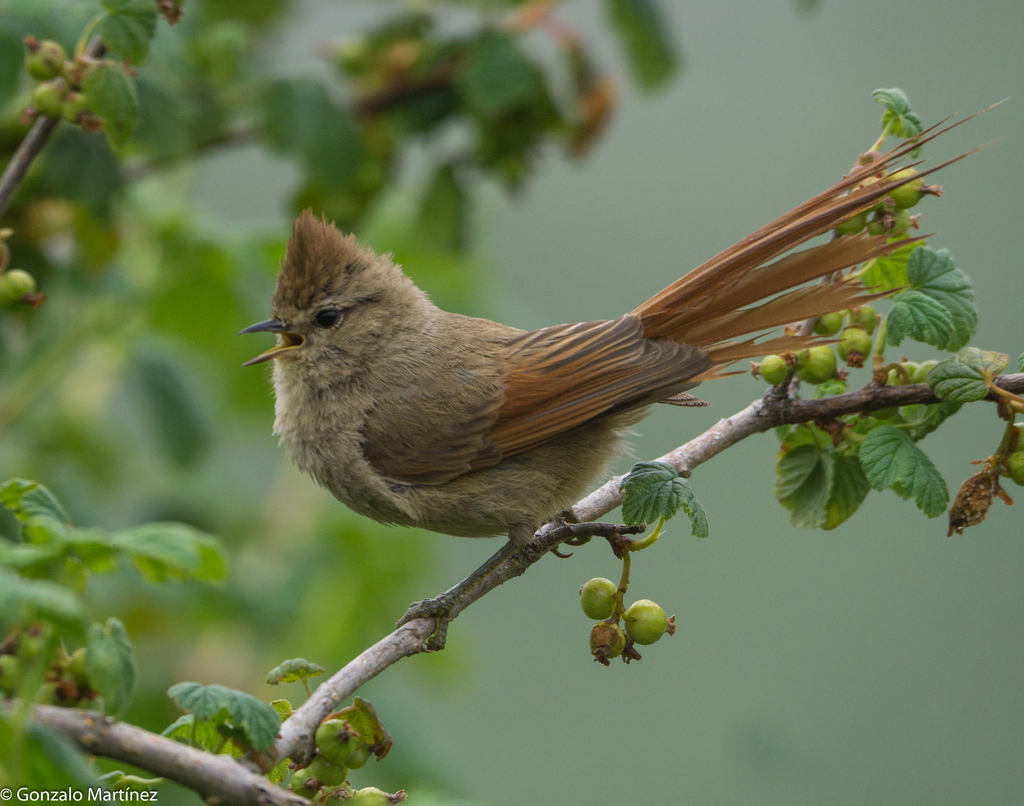
Brown-capped Tit-Spinetail
Photo © Gonzalo Martinez
Photo © Gonzalo Martinez — CC BY 4.0 — Source: iNaturalist #260014694Identification
The brown-capped tit-spinetail is a small, slender furnariid measuring 15–16 cm in length and weighing just 9–13 g. Its most distinctive features include a graduated rufous tail with feathers that narrow at the tips, creating a characteristic spiny appearance. The nominate subspecies displays a brown crown, pale buff supercilium, brownish face, and paler brown upper back. The lower back and rump show a warm rufescent tone, while the wings are predominantly rufous. Underparts are pale tawny-brown with rufescent flanks and undertail coverts. Juveniles show a less pronounced crown, slight breast mottling, and rounded tail feathers. The subspecies L. f. paranensis is grayer overall with a less brownish back and paler underparts.
Range & Habitat
This species is endemic to the Andes of South America, with two distinct populations. The nominate subspecies inhabits the Bolivian Andes from La Paz south through Potosí and Tarija departments. The subspecies paranensis ranges through northwestern Argentina from Jujuy and Salta provinces southward to Mendoza and the sierras de Córdoba. The brown-capped tit-spinetail favors a mosaic of montane habitats including arid, semi-humid, and humid scrublands, Polylepis woodlands, and semi-humid forests. Within scrublands, it shows a preference for steep ravines. Elevation ranges from 1,500–3,900 m in Bolivia and 1,000–2,500 m in Argentina.
Behaviour & Diet
Primarily a year-round resident, though some Argentine populations make seasonal elevation movements. This species feeds on arthropods, foraging in pairs or small groups that frequently join mixed-species feeding flocks. It gleans prey from leaves, twigs, and branch bark, working from the understorey to the canopy and occasionally hanging upside down to access food. During the austral spring and summer, the brown-capped tit-spinetail breeds in monogamous pairs, constructing a distinctive ball-shaped nest of plant material lined with down and feathers in rock crevices or building cavities. Clutches contain two or three eggs. The species produces a faint, insect-like 'pree' call, though its full song remains undescribed.
Best Time & Places to See It
The brown-capped tit-spinetail is considered uncommon to common throughout its range and is resident year-round, making it potentially viewable in any season. However, the breeding season (austral spring and summer) offers the best opportunity for observation and photography. In Argentina, the provinces of Jujuy and Salta in the northwest provide reliable habitat, with additional populations in Mendoza and the sierras de Córdoba. In Bolivia, the departments of La Paz, Potosí, and Tarija offer opportunities. Target steep-sided ravines and Polylepis woodlands at appropriate elevations for the best encounter rates.
Photography Tips
The small size and active foraging behavior of this species demand patience and a fast shutter speed. Position yourself in Polylepis woodlands or scrubland ravines during the breeding season when birds are more actively moving. The spiny tail and rufous coloring are striking field marks—compose shots to capture the graduated tail structure. Watch for birds joining mixed-species flocks, which can simplify location. Early morning hours typically offer the most activity. A telephoto lens (300–500 mm equivalent) is essential given the bird's diminutive size and tendency to forage throughout the canopy layers.
Los Cardones National Park
Argentina
+193 birds+6 mammals
Where the Andes descend into northwestern Argentina, Los Cardones National Park sprawls across nearly 1,200 square kilometres of one of South America's most distinctive high-altitude desert…
VIEW NATIONAL PARKEl Rey National Park
Municipio de Las Lajitas, Argentina
+317 birds+4 mammals
Where the eastern slopes of the Andes descend into northwestern Argentina's subtropical transition zone, El Rey National Park unfolds across 841 square kilometers of dramatically varied…
VIEW NATIONAL PARKSierra de las Quijadas National Park
Argentina
+168 birds+5 mammals
Sandstone cliffs and deeply incised canyons define this 1,137-square-kilometre expanse in San Luis Province, where the dry Chacoan landscape of central Argentina reveals an unexpected ecological…
VIEW NATIONAL PARKNo community photos yet. Log in to add the first one.
No community observations of this species yet.