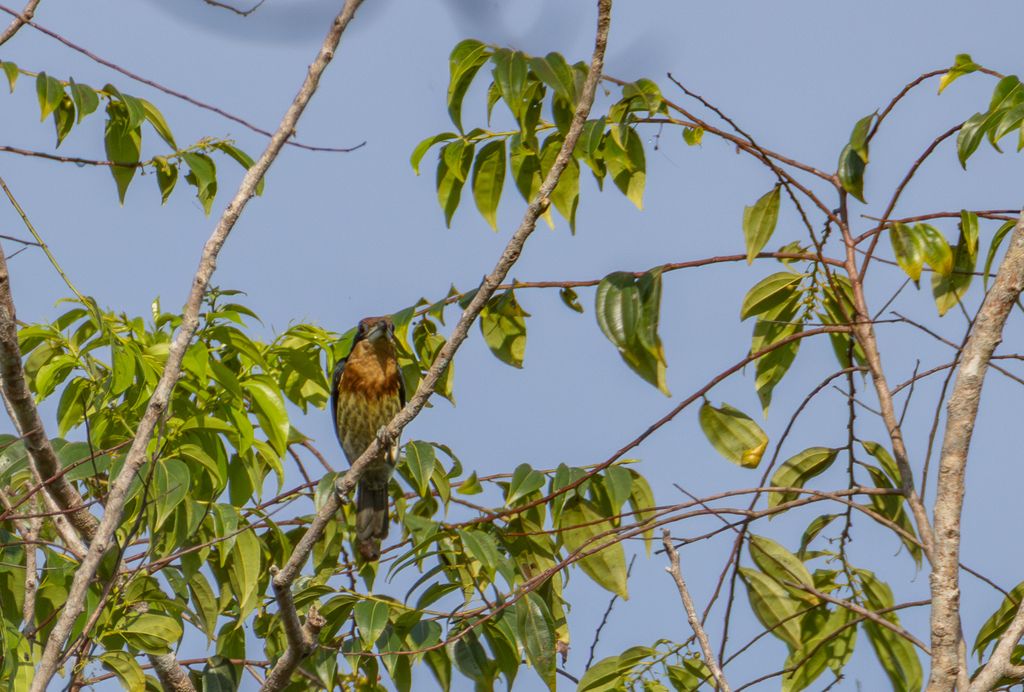
Brown-chested Barbet
Photo © Kevin Brix
Photo © Kevin Brix — CC BY-SA 4.0 — Source: iNaturalist #310329582Identification
The brown-chested barbet is a compact bird approximately 18 cm long, with males weighing around 58 grams. Males are distinctive, featuring a dull gold crown with a striking wide black patch through the eye. The back is black with bold yellow streaks, while the throat is yellowish-white and transitions into a cinnamon breastband with a yellow to olive belly, both faintly streaked. Females are noticeably duller than males, with more yellowish markings on the wings and a black-spotted cinnamon throat, making them slightly trickier to identify in the field.
Range & Habitat
The brown-chested barbet is endemic to Brazil's central Amazon Basin, where it occupies a restricted range south of the Amazon River between the Madeira River to the west and the Tapajós River to the east. The species inhabits the canopy of wet forest, where it spends most of its time foraging among the higher branches and vines. Its southerly range limit remains unknown, suggesting there may still be discoveries to make about its distribution.
Behaviour & Diet
This barbet is an active forager that feeds on both insects and other arthropods, as well as fruit. It typically moves by climbing vines and hopping along branches and twigs within the forest canopy, often joining mixed-species foraging flocks—a common strategy among Amazonian birds that increases feeding efficiency and vigilance against predators. The brown-chested barbet apparently breeds from as early as March through June, though surprisingly little has been published about its complete breeding biology.
The species communicates with a distinctive rapid "hoo" trill of short notes—a sound that can help birdwatchers locate birds in the dense canopy vegetation where visual observation is challenging.
Best Time & Places to See It
The breeding season from March to June offers perhaps the best opportunity to encounter this species, as birds may be more vocal and active during this period. Look for the brown-chested barbet in wet forest canopies within its restricted range in the central Amazon Basin of Brazil, particularly between the Madeira and Tapajós Rivers. Its preference for canopy foraging means patience and good binoculars are essential.
Photography Tips
Photographing the brown-chested barbet presents both challenges and rewards. The species' preference for high canopy perches demands a telephoto lens and a willingness to scan the treetops. Males are more visually striking than females, with their dull gold crowns, black eye-patches, and yellow-streaked black backs offering better photographic contrast. Listen for the rapid "hoo" trill to locate birds, then position yourself with good backlighting if possible to illuminate the yellow streaking and cinnamon breastband. Early morning often brings increased activity and better light conditions in the canopy.
No community photos yet. Log in to add the first one.
No community observations of this species yet.