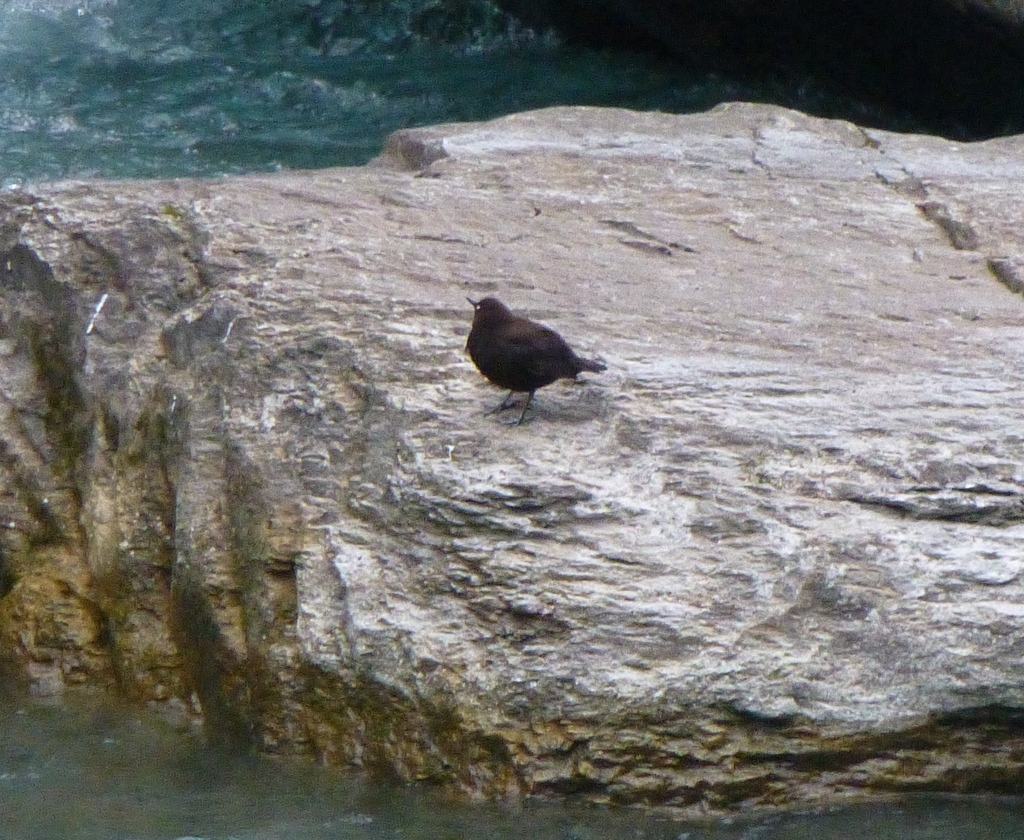
Brown Dipper
Photo © Sheelagh Halsey
Photo © Sheelagh Halsey — CC BY 4.0 — Source: iNaturalist #326366593Identification
The brown dipper is a robust, thrush-like songbird measuring 22 cm (8.7 in) and weighing 87 g (3.1 oz), making it the largest of all dipper species. Its most distinctive feature is its chocolate-brown plumage, which is slightly lighter on the back and breast. Like other dippers, it characteristically holds its tail in a cocked position, giving it a compact and alert appearance even when perched.
Range & Habitat
This species is found across the mountains of the east Palearctic, with a range spanning from Eastern Siberia eastward to Japan and Taiwan, and southward through central Asia to the Himalayas and northern Indochina. Three subspecies are recognized: one occupying north Afghanistan and central Asian mountains through to the central Himalayas; another found from the eastern Himalayas through Myanmar and northwest Thailand; and the nominate subspecies ranging from Eastern Siberia to central China, the Sakhalin and Kuril Islands, and south to southern China and northern Indochina.
The brown dipper inhabits medium to low elevations where mountain streams flow, making it a true specialist of fast-flowing mountain waters. It is seldom encountered in the field, reflecting both its remote habitat preferences and its generally elusive nature.
Behaviour & Diet
An aquatic forager, the brown dipper employs two primary feeding strategies depending on season and prey availability. During the breeding season from December through April, when energy demands are high and larger benthic organisms are abundant, adults dive into streams to capture substantial prey items. For the remainder of the year, they wade in shallower stream sections, picking smaller organisms from the bottom. Young birds, including chicks and fledglings, also readily dive for food.
The species demonstrates remarkable adaptability to extreme environments: one small population that winters at a hot spring in the Suntar-Khayata Mountains of Siberia continues to forage underwater even when air temperatures plunge below −55 °C. Additionally, brown dippers in upland Taiwanese streams show resilience to natural disturbances, using relatively poorer-quality streams as important refuges following typhoon-induced flooding in their primary habitat.
Best Time & Places to See It
Locating brown dippers requires patience and access to remote mountain streams across their east Palearctic range. The breeding season from December through April may offer the best viewing opportunities, as increased foraging activity by adults supports both their own needs and their young. Upland stream regions in Taiwan, the Himalayas, Myanmar, and eastern Siberia represent promising locations, though the species' elusive nature means encounters remain uncommon even in suitable habitat.
Photography Tips
Photographing brown dippers demands considerable patience and stealth, given their shy disposition and remote stream habitats. Focus on areas where mountain streams flow at medium to low elevations, positioning yourself quietly along stream margins before dawn. The contrast between the bird's chocolate-brown plumage and flowing water creates compositional opportunities, particularly when capturing diving behavior or the characteristic cocked-tail posture. A fast shutter speed and good reach are essential for freezing the bird's rapid movements as it hunts among rocks and current.
Gangotri National Park
Bhatwari, India
+119 birds+1 mammals
Where the Bhagirathi River carves through the western Himalayas in northern Uttarakhand, Gangotri National Park rises across steep alpine terrain that defines the boundary between temperate…
VIEW NATIONAL PARKSagarmatha National Park
Khumjung, Nepal
+219 birds+7 mammals
Soaring peaks and deep glacial valleys define this alpine wilderness in northeastern Nepal, where the terrain rises from forested foothills into a realm of high-altitude tundra…
VIEW NATIONAL PARKKhangchendzonga National Park
Sakkyong, India
+290 birds+1 mammals
Where the eastern Himalayas surge toward their crowning peaks, Khangchendzonga National Park embraces a landscape of almost overwhelming vertical drama. Rising from subtropical river valleys into…
VIEW NATIONAL PARKWulingyuan
Jundiping, China
+97 birds+3 mammals
Sandstone peaks erupting from forested valleys define this sprawling 993-square-kilometre national park in Hunan Province, where vertical cliffs rise dramatically above lush subtropical woodland. The landscape—a…
VIEW NATURAL MONUMENTGiant Panda National Park
Mianyang, China
+447 birds+47 mammals
Where the eastern slopes of China's Sichuan plateau descend into cloud-wrapped valleys, one of Asia's most biodiverse landscapes unfolds across more than 350,000 square kilometres. This…
VIEW NATIONAL PARKMount Nanling Forest Park
Ruyang Forest Farm, China
+179 birds+3 mammals
Granite ridges and weathered peaks rise through a canopy of subtropical montane forest where Ruyang Forest Farm anchors one of southern China's most biodiverse landscapes. Across…
VIEW FOREST & JUNGLEJiuzhai Valley
Jiuzhaigou County, China
+226 birds+7 mammals
Where crystalline alpine streams cascade through limestone gorges and karst terrain rises in dramatic vertical walls, Jiuzhai Valley unfolds across nearly 1,300 square kilometers of southwestern…
VIEW NATURAL MONUMENTHuanglong Scenic and Historic Interest Area
Ngawa Tibetan and Qiang Autonomous Prefecture, China
+194 birds+7 mammals
Across the high plateau of northwestern Sichuan, a geological wonder unfolds where limestone terraces and mineral-rich springs have sculpted one of China's most distinctive natural monuments.…
VIEW NATURAL MONUMENTNanda Devi National Park
Garpak, India
+218 birds+5 mammals
Where the Himalayas surge into their most dramatic alpine amphitheater, a wilderness of raw geological power unfolds across 624 square kilometers of pristine terrain. Nanda Devi,…
VIEW NATIONAL PARKValley of Flowers National Park
Ghangaria, India
+117 birds+1 mammals
Where alpine meadows explode with color each monsoon season, the Himalayan slopes of Uttarakhand rise to create one of Earth's most extraordinary floral displays. Perched between…
VIEW NATIONAL PARKHemis National Park
Raigahar Dhar, India
+131 birds+13 mammals
Where granite gorges cleave through the Himalayas at dizzying altitudes, a vast wilderness of alpine desert unfolds across the rain shadow of Ladakh. Hemis sprawls across…
VIEW NATIONAL PARKLand of the Leopard National Park
Khasansky District, Russia
+83 birds+11 mammals
Where coniferous and mixed forests sweep across the rolling terrain of Russia's Far East, Land of the Leopard National Park embraces a landscape shaped by the…
VIEW NATIONAL PARKSanjiangyuan National Park
Nagqu, China
+187 birds+25 mammals
Where the headwaters of three great Asian rivers emerge from a high alpine plateau, the landscape unfolds in tundra and dwarf shrubland—a world of austere beauty…
VIEW NATIONAL PARKNortheast China Tiger and Leopard National Park
Mu Dan Jiang Shi, China
+202 birds+19 mammals
Across the temperate forests of northeastern China, where winters grip the landscape in subzero silence and summers remain cool and brief, the Mudanjiang region supports a…
VIEW NATIONAL PARKWuyishan National Park
Yanshan County, China
+141 birds+2 mammals
Where subtropical monsoon rains sustain a perpetually humid landscape, Wuyishan National Park rises from Fujian's eastern plateau as a realm of forested ridges, cascading streams, and…
VIEW NATIONAL PARKWolong National Nature Reserve
Wenchuan County, China
+333 birds+17 mammals
Where the Qingyi River cuts through the eastern flanks of the Minshan Range, a temperate montane forest cloaks steep valleys in dense canopy that thins dramatically…
VIEW NATURE RESERVEGaoligong Mountain National Nature Reserve
Nujiang Lisu Autonomous Prefecture, China
+443 birds+13 mammals
VIEW NATURE RESERVEBaima Snow Mountain National Nature Reserve
Diqing Tibetan Autonomous Prefecture, China
+204 birds+3 mammals
High-altitude ridges and steep-sided valleys define this reserve in northwestern Yunnan, where elevations surge from around 3,000 metres to peaks above 4,100 metres. The terrain supports…
VIEW NATURE RESERVENo community photos yet. Log in to add the first one.
No community observations of this species yet.