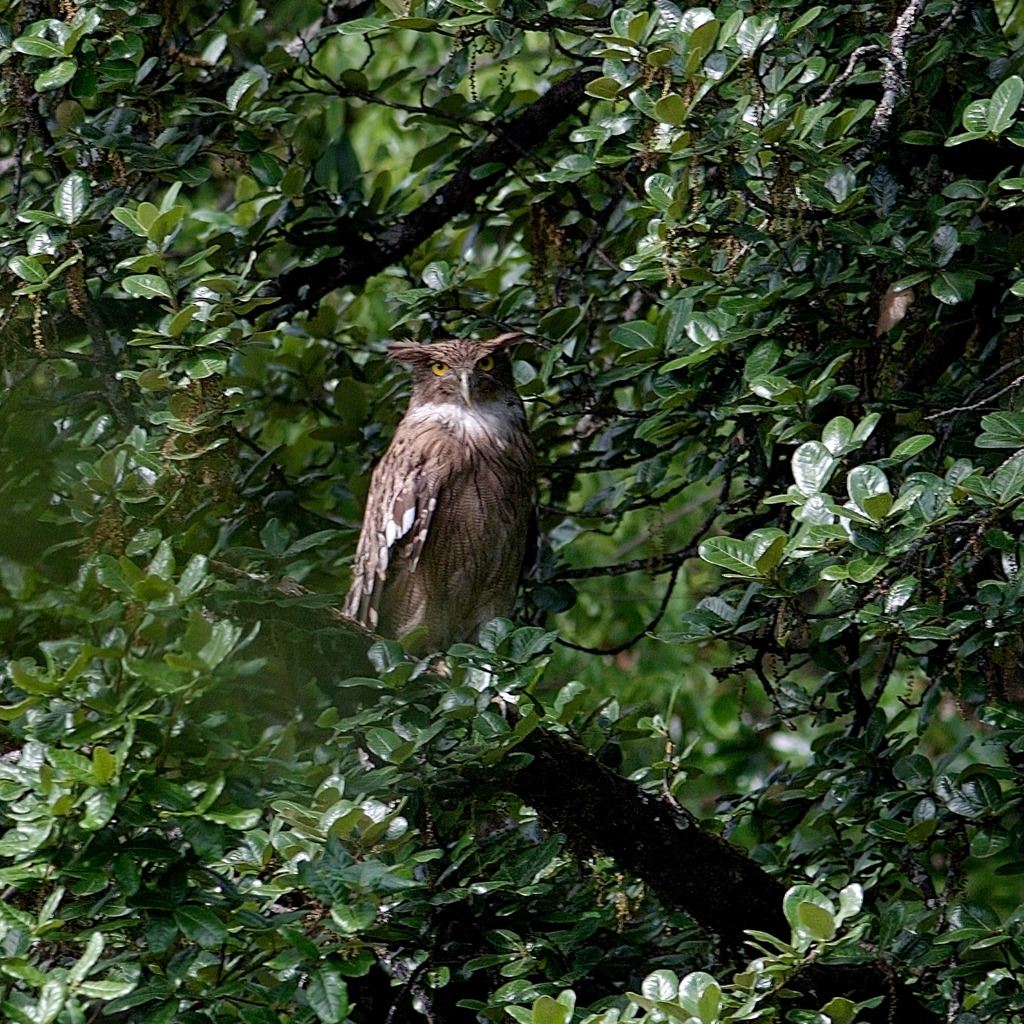
Brown Fish Owl
Photo © Ramnarayan K
Photo © Ramnarayan K — CC BY 4.0 — Source: iNaturalist #86684089Identification
The brown fish owl is a large, robust owl measuring 48 to 61 cm in body length with a wingspan of 125 to 140 cm. Its most distinctive features include prominent ear tufts, rufous-brown upperparts heavily streaked with black or dark brown, and buffy-fulvous underparts with wavy dark streaks and fine barring. The throat is conspicuously white and puffed, the bill is dark, and the iris is a striking golden yellow. The featherless feet are bright yellow—an adaptation for its specialized hunting lifestyle. Females are noticeably larger than males, and two-year-old birds appear somewhat paler than adults. This species is slightly larger and darker than the buffy fish owl.
Range & Habitat
The brown fish owl is native across a vast range spanning from Turkey through the Middle East and South Asia to Southeast Asia, including India, Sri Lanka, Myanmar, Thailand, southern China, Indochina, and the Malay Peninsula. Of the four living fish owl species, it is the most widely distributed and most common. Four subspecies are recognized across this extensive range, which covers over 7,000 km. The species inhabits forests and wooded wetlands, favoring areas where water and woodland habitat intersect.
Behaviour & Diet
As its name suggests, the brown fish owl is a specialized fish-eater with remarkable physical adaptations for this hunting strategy. It has longer legs than typical owls and rough textured feet—features that aid in capturing slippery fish. Unlike most owls, its feathers are not soft and lack the specialized fringes that enable silent flight; consequently, this species produces audible wing beats during hunting. The brown fish owl will hunt on foot, wading into shallow water to pursue its prey, rather than relying solely on silent aerial ambush like terrestrial hunting owls. Its powerful, curved talons feature sharp cutting edges similar to those of eagle owls, making them effective fish-catching tools.
Best Time & Places to See It
The brown fish owl's wide distribution and common status throughout its range make it one of the most accessible fish owl species for wildlife travellers. Look for this species in forested wetland habitats across South and Southeast Asia—particularly in India, Sri Lanka, Myanmar, Thailand, and surrounding regions. Wooded waterside areas, including rivers, lakes, and wetland forests, offer the best opportunities for encounters. Water-based habitats during daylight hours may yield sightings, particularly where the owl hunts in shallow areas.
Photography Tips
The brown fish owl's striking features—golden iris, white puffed throat, and prominent ear tufts—make for compelling photography. Its preference for hunting in daylight and wading in shallow water offers better opportunities than many nocturnal owl species. The rough wetland habitats it frequents can be challenging to navigate, but positioning yourself where water meets woodland increases the chances of observation. The bird's noisy wing beats may actually aid photographers, providing an auditory cue to its presence. Early morning light will best highlight the rich rufous-brown plumage and the contrasting yellow feet and facial features.
Lunugamvehera National Park
Sri Lanka
+204 birds+14 mammals
Dry scrubland and shallow wetlands converge in Sri Lanka's southeastern lowlands, where Lunugamvehera National Park anchors one of the island's most ecologically vital landscapes. The park's…
VIEW NATIONAL PARKMinneriya National Park
Sri Lanka
+158 birds+9 mammals
Across the dry zone of Sri Lanka's North Central Province spreads a landscape of shallow tanks, grassland margins, and scattered dry forest—a mosaic of water and…
VIEW NATIONAL PARKWasgamuwa National Park
Sri Lanka
+156 birds+8 mammals
Dry deciduous forest and open grassland sweep across the North Central lowlands where Wasgamuwa National Park protects one of Sri Lanka's largest remaining tracts of this…
VIEW NATIONAL PARKMaduru Oya National Park
Sri Lanka
+74 birds+1 mammals
Granite ridges rise abruptly from the humid lowlands of Sri Lanka's Uva Province, their weathered slopes clothed in dry monsoon forest and scattered woodland where deciduous…
VIEW NATIONAL PARKOrang National Park
Rangagarapathar, India
+298 birds+1 mammals
Where the Brahmaputra's floodplains meet the foothills of Assam, Orang National Park unfolds across a mosaic of riverine grasslands, forests and wetlands that pulse with the…
VIEW NATIONAL PARKRanthambhore National Park
Sawai Madhopur, India
+294 birds+20 mammals
Granite ridges and ravines carved through the Aravalli Range frame this protected landscape in eastern Rajasthan, where deciduous forest mingles with open scrubland and seasonal water…
VIEW NATIONAL PARKEravikulam National Park
Devikulam, India
+192 birds+7 mammals
High in the Western Ghats of Kerala, where monsoon mists cling to slopes that rise above 2,000 metres, Eravikulam National Park preserves one of South India's…
VIEW NATIONAL PARKKhao Yai National Park
Prachantakham District, Thailand
+377 birds+46 mammals
Evergreen dipterocarp forest blankets the rolling terrain of this national park in eastern Thailand, where limestone hills rise abruptly from the forest floor and seasonal streams…
VIEW NATIONAL PARKKanha Tiger Reserve
Kanha Kisli F.V., India
+321 birds+23 mammals
Where sal forests give way to emerald meadows and crystalline streams carve through ancient valleys, one of India's finest wilderness reserves unfolds across the Maikal Range.…
VIEW NATIONAL PARKTadoba National Park
Palasgaon Singru, India
+270 birds+20 mammals
Where sal forests meet open grasslands and rocky outcrops rise from red laterite soil, central India's landscape unfolds in raw, untamed beauty. Ancient teak woodlands and…
VIEW NATIONAL PARKBandhavgarh National Park
Garhpuri, India
+285 birds+17 mammals
Where granite ridges rise dramatically above sal and bamboo forests, one of India's most pristine tiger reserves unfolds across the Vindhyan plateau. Ancient rock formations tower…
VIEW NATIONAL PARKPanna National Park
Badgadi Kalan, India
+271 birds+17 mammals
Where granite gorges slice through central India's Vindhyan plateau, a landscape of stark beauty unfolds across nearly six hundred square kilometers. The Ken River carves through…
VIEW NATIONAL PARKKaziranga National Park
Kohora, India
+422 birds+26 mammals
Dawn breaks over the floodplains of the Brahmaputra, where tall grasslands stretch endlessly beneath monsoon-heavy skies. This sprawling wilderness of northeastern Assam is a mosaic of…
VIEW NATIONAL PARKKeoladeo National Park
Shreenagar Rural, India
+326 birds+14 mammals
Where shallow wetlands shimmer beneath vast Rajasthani skies, one of Asia's finest bird sanctuaries pulses with extraordinary life. This former maharaja's hunting reserve, now spanning 29…
VIEW NATIONAL PARKPeriyar National Park
Mlappara, India
+232 birds+4 mammals
Dawn breaks over mist-shrouded ridges where the Western Ghats tumble toward Kerala's spice-scented lowlands. Here, ancient tropical forests envelope a glittering artificial lake, creating a mosaic…
VIEW NATIONAL PARKPampadum Shola National Park
Vattavada, India
+258 birds+14 mammals
Where misty shola forests cling to the high plateaus of the Nilgiri Mountains, ancient evergreen remnants create a world apart. This 2,316-hectare reserve protects one of…
VIEW NATIONAL PARKBandipur National Park
Hirehalli, India
+302 birds+19 mammals
Where the Western Ghats descend into the Deccan plateau, ancient deciduous forests blanket a landscape carved by the Nugu River. Bandipur unfolds across 880 square kilometres…
VIEW NATIONAL PARKNagarahole Tiger Reserve
Nalkeri Forest, India
+323 birds+23 mammals
Where granite escarpments rise above dense deciduous forests and the Kabini River carves through pristine wilderness, one of India's most biodiverse landscapes unfolds across the Western…
VIEW NATIONAL PARKGir National Park
Asundrali, India
+258 birds+13 mammals
Dry deciduous forests cloak the rolling hills of western Gujarat where the Gir landscape rises as a final sanctuary for one of the world's rarest felids:…
VIEW NATIONAL PARKGaoligong Mountain National Nature Reserve
Nujiang Lisu Autonomous Prefecture, China
+443 birds+13 mammals
VIEW NATURE RESERVE