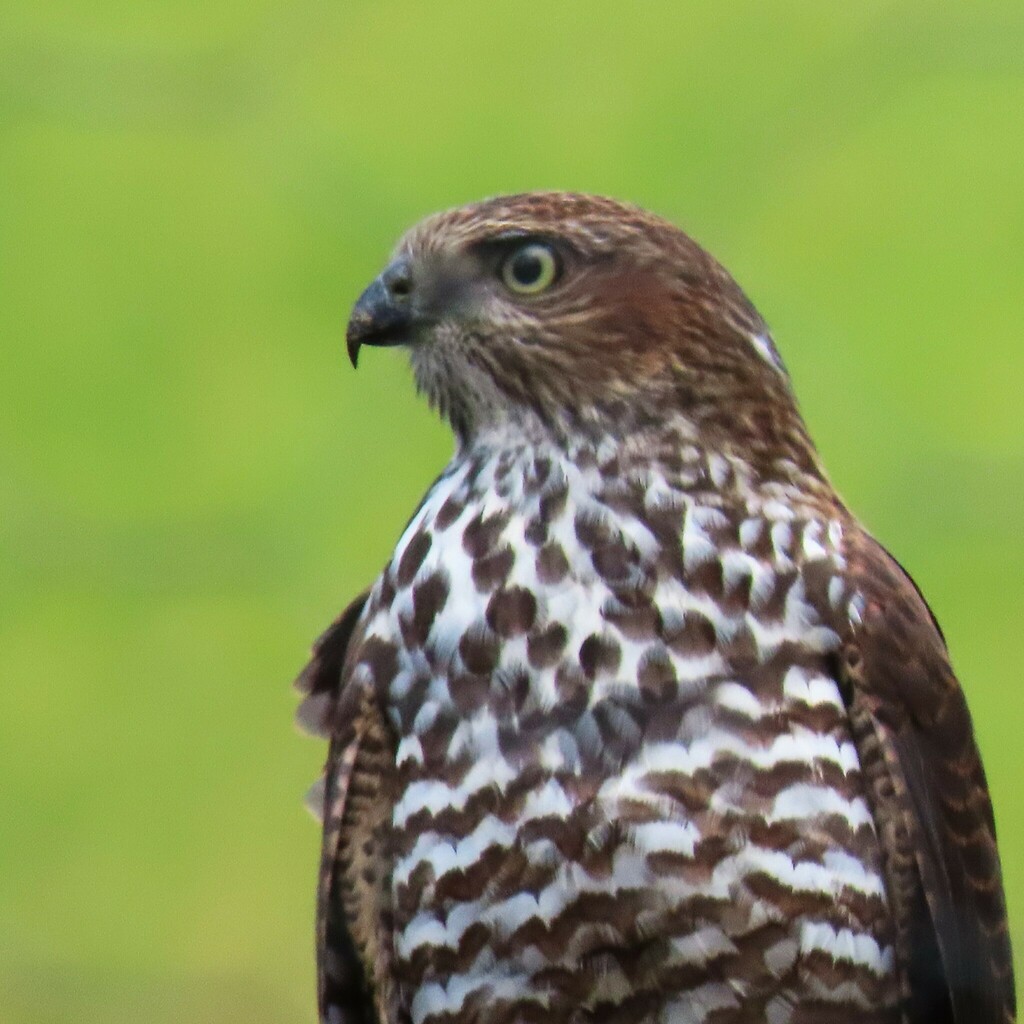
Brown Goshawk
Photo © pimelea
Photo © pimelea — CC BY 4.0 — Source: iNaturalist #196406143Identification
The Australian Goshawk is a medium-sized raptor with distinctive plumage: grey upperparts contrasting with a striking chestnut collar, and rufous underparts finely barred with white. It bears a superficial resemblance to the Collared Sparrowhawk but is noticeably larger. This species measures 40–55 cm in body length with a wingspan of 75–95 cm. Females are considerably larger than males, weighing around 355 g compared to males at 220 g. The bird's flight is characteristically fast and flexible, a hallmark of its genus Tachyspiza, whose name derives from the Ancient Greek words for "fast hawk."
Range & Habitat
The Australian Goshawk is widespread throughout Australia, Wallacea, New Guinea, New Caledonia, Vanuatu, and Fiji, with thirteen recognized subspecies across this vast range. In Australia, it favours eucalypt forests and woodlands, though it readily adapts to farmland and urban areas. Across the Pacific islands, it predominantly inhabits rainforest environments. The species was historically present on Norfolk Island until around 1790, though its current status there remains uncertain.
Behaviour & Diet
An agile and versatile hunter, the Australian Goshawk preys primarily on medium-sized birds including ducks, cockatoos, and pigeons, while also taking small mammals such as rats and rabbits. Its hunting repertoire is diverse: it employs still-hunting from concealed perches, flies low through undergrowth to flush prey, and occasionally stoops from above or even pursues small mammals on foot. It hunts readily near farmland and wetlands where prey is abundant. Smaller birds panic and flee when a goshawk appears, while larger species like ravens, crows, and magpies will aggressively mob the raptor until it departs.
Best Time & Places to See It
The Australian Goshawk can be encountered year-round across suitable habitat throughout its range. Eucalypt woodlands and forests across mainland Australia offer the best opportunities, particularly in regions with a mix of open and wooded country. Farmland edges, wetland margins, and well-vegetated urban gardens are productive locations. In the Pacific, rainforest habitats in New Guinea, Vanuatu, New Caledonia, and Fiji provide excellent viewing prospects. Patient observers positioned near areas with concentrations of smaller birds—such as water holes or fruiting trees—may be rewarded with sightings.
Photography Tips
Capturing the Australian Goshawk's swift, agile flight requires fast shutter speeds and continuous autofocus tracking. The bird's preference for hunting in and around dense vegetation means that dappled light and shadowed perches are common scenarios; increase ISO and use fast lenses (f/4 or wider) to maintain shutter speeds above 1/1000th of a second. The chestnut collar and rufous barring are key identification features—ensure adequate light falls on the underparts to render these markings clearly. Early morning sessions near farmland edges or wetland margins offer the best chance of observing hunting behaviour and obtaining dynamic action shots.
Bribie Island National Park
Chiltern-Mt Pilot National Park
Cleland National Park
Greater Bendigo National Park
Ikara-Flinders Ranges National Park
Kinglake National Park
Morton National Park
Nerang National Park
Rinyirru National Park
Nothing matches these filters.
No community photos yet. Log in to add the first one.
No community observations of this species yet.