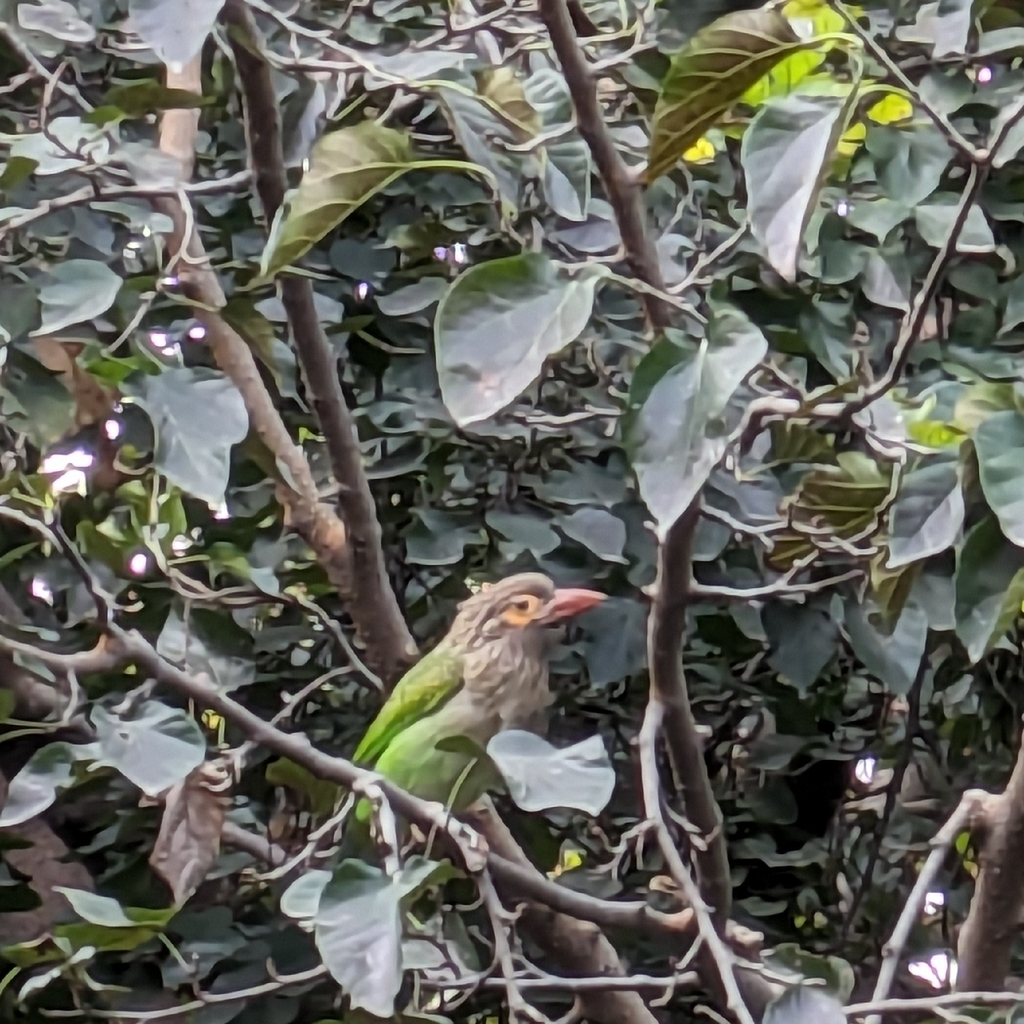
Brown-headed Barbet
Photo © Shikha Sreenivas
Photo © Shikha Sreenivas — CC BY 4.0 — Source: iNaturalist #343349626Identification
The brown-headed barbet is a distinctive Asian barbet measuring 27 cm (11 inches) in length. It has a characteristic streaked brown head, neck, and breast, contrasting with a striking yellow eye patch. The remainder of its plumage is green, and the bird features a notably large head, short neck, and short tail. Its size and coloration make it relatively easy to identify within its range, particularly the bright yellow eye marking that stands out against the darker head plumage.
The species is vocal and highly recognizable by its call: a repetitive kutroo…kutroo…kutroo sound. Interestingly, the bird falls silent during winter months. When one individual calls, others in the vicinity typically join in, creating a chorus that can aid in locating these birds in their habitat.
Range & Habitat
The brown-headed barbet is native to the Indian subcontinent and is widespread throughout much of the region. Its range stretches from the Terai in southern Nepal northward down through most of peninsular India to Sri Lanka in the south. The species inhabits tropical and subtropical moist broadleaf forests, though it shows a notable preference for more open, cultivated areas over dense forest.
This barbet is particularly adapted to human-modified landscapes and is commonly found in gardens and wooded country. It is fairly tolerant of human presence and frequently appears in city parks and urban gardens, making it one of the more accessible barbets for travellers and birdwatchers. The species is listed as Least Concern on the IUCN Red List, indicating stable populations across its range.
Behaviour & Diet
The brown-headed barbet is an arboreal species with a primarily frugivorous diet supplemented by insects. It forages extensively on cultivated fruit trees, particularly mangoes, ripe jackfruit, papaya, banana, and figs. This dietary preference for fruit-bearing trees further explains its affinity for gardens and cultivated areas rather than undisturbed forest.
During breeding season, pairs nest in tree holes, which they will often excavate themselves. The female typically lays 2-4 eggs per clutch. Both sexes participate in incubation duties and maintain contact with their partners through their distinctive kura, kura calls, demonstrating cooperative breeding behaviour typical of many barbet species.
Best Time & Places to See It
The brown-headed barbet's preference for gardens, parks, and cultivated areas makes it accessible to travellers throughout the Indian subcontinent and Sri Lanka. Urban and suburban parks, fruit orchards, and gardens from southern Nepal through peninsular India to Sri Lanka offer the best viewing opportunities. The species' relative tolerance of humans means that observant visitors to city parks and gardens may encounter them without venturing into remote areas.
The bird is most vocal and active during the warmer months when its characteristic kutroo calls are heard regularly. Winter months are less ideal for locating the species by sound, as it becomes silent during this season. Early morning hours, when the species is most active in foraging, typically offer the best chances for observation and photography.
Photography Tips
Photographers should focus on capturing the distinctive yellow eye patch, which is the most striking field mark of this species. The bird's affinity for fruit trees provides excellent opportunities for natural history photography, particularly during fruiting season when brown-headed barbets are actively feeding. Look for individuals perched on or moving through branches of mango, jackfruit, and papaya trees in gardens and parks.
Since the species is fairly tolerant of human presence, gardens and parks offer more forgiving settings than dense forest for photography. The repetitive kutroo calls provide an audio cue that can help locate birds before attempting to photograph them. Early morning light in urban gardens is often ideal for capturing the green plumage and yellow eye markings that characterize this attractive Asian barbet.
Lunugamvehera National Park
Sri Lanka
+204 birds+14 mammals
Dry scrubland and shallow wetlands converge in Sri Lanka's southeastern lowlands, where Lunugamvehera National Park anchors one of the island's most ecologically vital landscapes. The park's…
VIEW NATIONAL PARKMinneriya National Park
Sri Lanka
+158 birds+9 mammals
Across the dry zone of Sri Lanka's North Central Province spreads a landscape of shallow tanks, grassland margins, and scattered dry forest—a mosaic of water and…
VIEW NATIONAL PARKWasgamuwa National Park
Sri Lanka
+156 birds+8 mammals
Dry deciduous forest and open grassland sweep across the North Central lowlands where Wasgamuwa National Park protects one of Sri Lanka's largest remaining tracts of this…
VIEW NATIONAL PARKAngamedilla National Park
Polonnaruwa, Sri Lanka
+40 birds+2 mammals
Ancient tanks and sal forests define this water-rich sanctuary in Sri Lanka's North Central heartland, where seasonal wetlands and dry deciduous woodland create a mosaic of…
VIEW NATIONAL PARKMaduru Oya National Park
Sri Lanka
+74 birds+1 mammals
Granite ridges rise abruptly from the humid lowlands of Sri Lanka's Uva Province, their weathered slopes clothed in dry monsoon forest and scattered woodland where deciduous…
VIEW NATIONAL PARKValmiki National Park
Ramnagar, India
+66 birds+6 mammals
Along Bihar's western frontier, where the Gandak River winds through subtropical forest and grassland, Valmiki National Park sprawls across terrain shaped by monsoon rains and seasonal…
VIEW NATIONAL PARKRanthambhore National Park
Sawai Madhopur, India
+294 birds+20 mammals
Granite ridges and ravines carved through the Aravalli Range frame this protected landscape in eastern Rajasthan, where deciduous forest mingles with open scrubland and seasonal water…
VIEW NATIONAL PARKKanha Tiger Reserve
Kanha Kisli F.V., India
+321 birds+23 mammals
Where sal forests give way to emerald meadows and crystalline streams carve through ancient valleys, one of India's finest wilderness reserves unfolds across the Maikal Range.…
VIEW NATIONAL PARKTadoba National Park
Palasgaon Singru, India
+270 birds+20 mammals
Where sal forests meet open grasslands and rocky outcrops rise from red laterite soil, central India's landscape unfolds in raw, untamed beauty. Ancient teak woodlands and…
VIEW NATIONAL PARKBandhavgarh National Park
Garhpuri, India
+285 birds+17 mammals
Where granite ridges rise dramatically above sal and bamboo forests, one of India's most pristine tiger reserves unfolds across the Vindhyan plateau. Ancient rock formations tower…
VIEW NATIONAL PARKPanna National Park
Badgadi Kalan, India
+271 birds+17 mammals
Where granite gorges slice through central India's Vindhyan plateau, a landscape of stark beauty unfolds across nearly six hundred square kilometers. The Ken River carves through…
VIEW NATIONAL PARKKeoladeo National Park
Shreenagar Rural, India
+326 birds+14 mammals
Where shallow wetlands shimmer beneath vast Rajasthani skies, one of Asia's finest bird sanctuaries pulses with extraordinary life. This former maharaja's hunting reserve, now spanning 29…
VIEW NATIONAL PARKPeriyar National Park
Mlappara, India
+232 birds+4 mammals
Dawn breaks over mist-shrouded ridges where the Western Ghats tumble toward Kerala's spice-scented lowlands. Here, ancient tropical forests envelope a glittering artificial lake, creating a mosaic…
VIEW NATIONAL PARKPampadum Shola National Park
Vattavada, India
+258 birds+14 mammals
Where misty shola forests cling to the high plateaus of the Nilgiri Mountains, ancient evergreen remnants create a world apart. This 2,316-hectare reserve protects one of…
VIEW NATIONAL PARKBandipur National Park
Hirehalli, India
+302 birds+19 mammals
Where the Western Ghats descend into the Deccan plateau, ancient deciduous forests blanket a landscape carved by the Nugu River. Bandipur unfolds across 880 square kilometres…
VIEW NATIONAL PARKNo community photos yet. Log in to add the first one.
No community observations of this species yet.