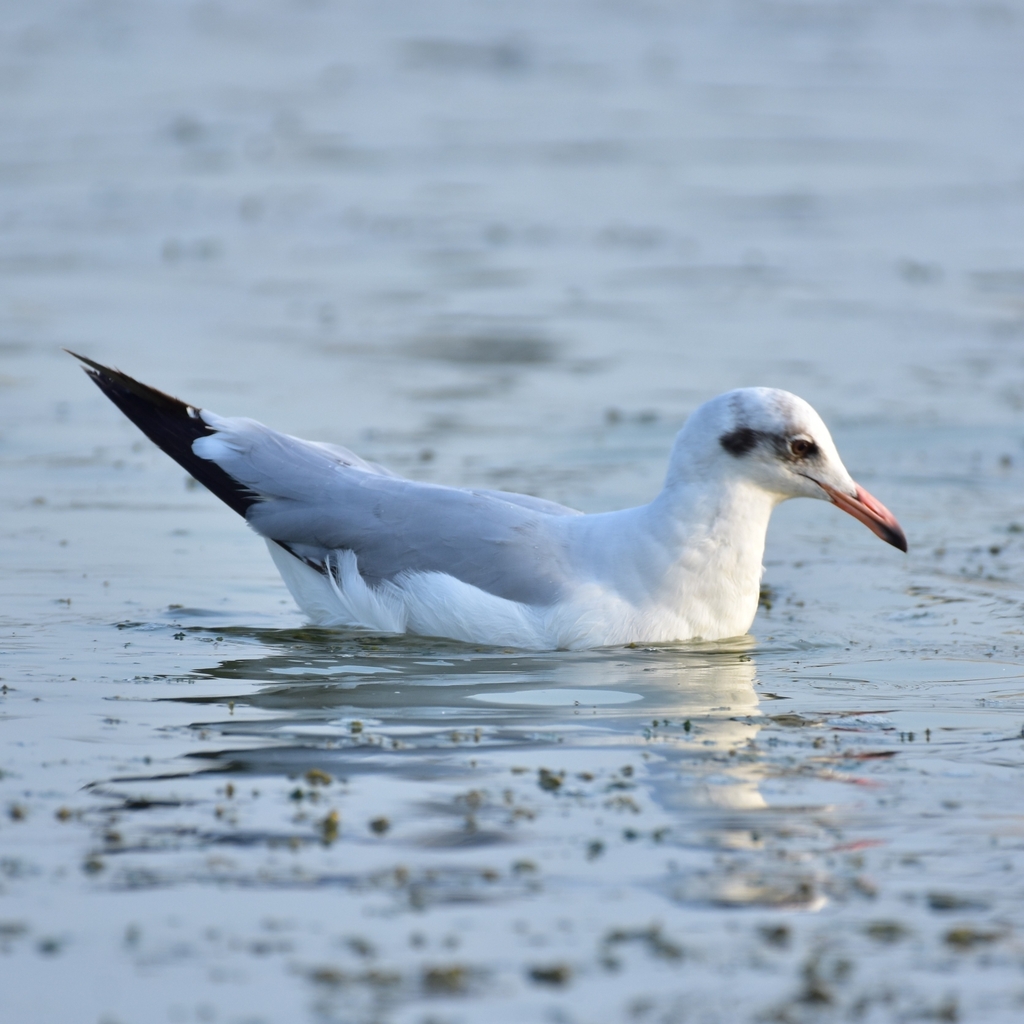
Brown-headed Gull
Photo © Renjith Jacob Mathews
Photo © Renjith Jacob Mathews — CC BY 4.0 — Source: iNaturalist #190475275Identification
The brown-headed gull is a small gull slightly larger than the black-headed gull. In breeding plumage, adults display a distinctive pale brown head (lighter than the black-headed gull's), pale grey body, and striking red bill and legs. The black primary wing tips feature conspicuous white "mirrors"—a useful field mark. The underwing is grey with black flight feathers. In winter, the brown hood disappears entirely, replaced by dark vertical streaks on the head. First-year birds take two years to reach full maturity and show a black terminal tail band, more extensive dark areas in the wings, and a less uniform hood in summer plumage.
Range & Habitat
This Central Asian species breeds across the high plateaus from Tajikistan east to Ordos in Inner Mongolia, where it nests in large colonies within reedbeds, marshes, or on lake islands, building ground nests. It is highly migratory, abandoning breeding grounds to winter on the coasts and large inland lakes of the Indian subcontinent. This is not a pelagic gull and is rarely encountered far from shore at sea.
Behaviour & Diet
Brown-headed gulls are highly gregarious, especially in winter, gathering in large flocks both while feeding and at evening roosts. They are bold and opportunistic feeders with catholic tastes: equally comfortable scavenging in towns or picking invertebrates from freshly ploughed fields. They are notably noisy birds, particularly at breeding colonies where their calls are a constant feature of the soundscape.
Best Time & Places to See It
Winter is the prime season for observing this species, when large numbers concentrate on coastal areas and major inland lakes across the Indian subcontinent. Look for them in urban harbours and around cultivated lowlands where they gather to feed. The species is absent from breeding grounds during winter months, so sightings outside the Indian subcontinent are unlikely outside the breeding season.
Photography Tips
The contrasting red bill and legs against pale plumage make for striking portraits, particularly in breeding season. Photograph birds in flight to capture the diagnostic white mirrors on the black primary tips and the grey underwing pattern. Winter birds photographed at roosts often show the characteristic dark head streaks. Colonies offer opportunities for behaviour shots, though the noisy, active environment can be challenging. Use faster shutter speeds when capturing birds in flight to freeze wing detail, and look for side-lit angles to emphasize the pale head coloration and red facial features.
Bandipur National Park
Bardiya National Park
Chitwan National Park
Giant Panda National Park
Gir National Park
Gobi Gurvan Saikhan National Park
Hemis National Park
Kaeng Krachan National Park
Kaziranga National Park
Nothing matches these filters.
No community photos yet. Log in to add the first one.
No community observations of this species yet.