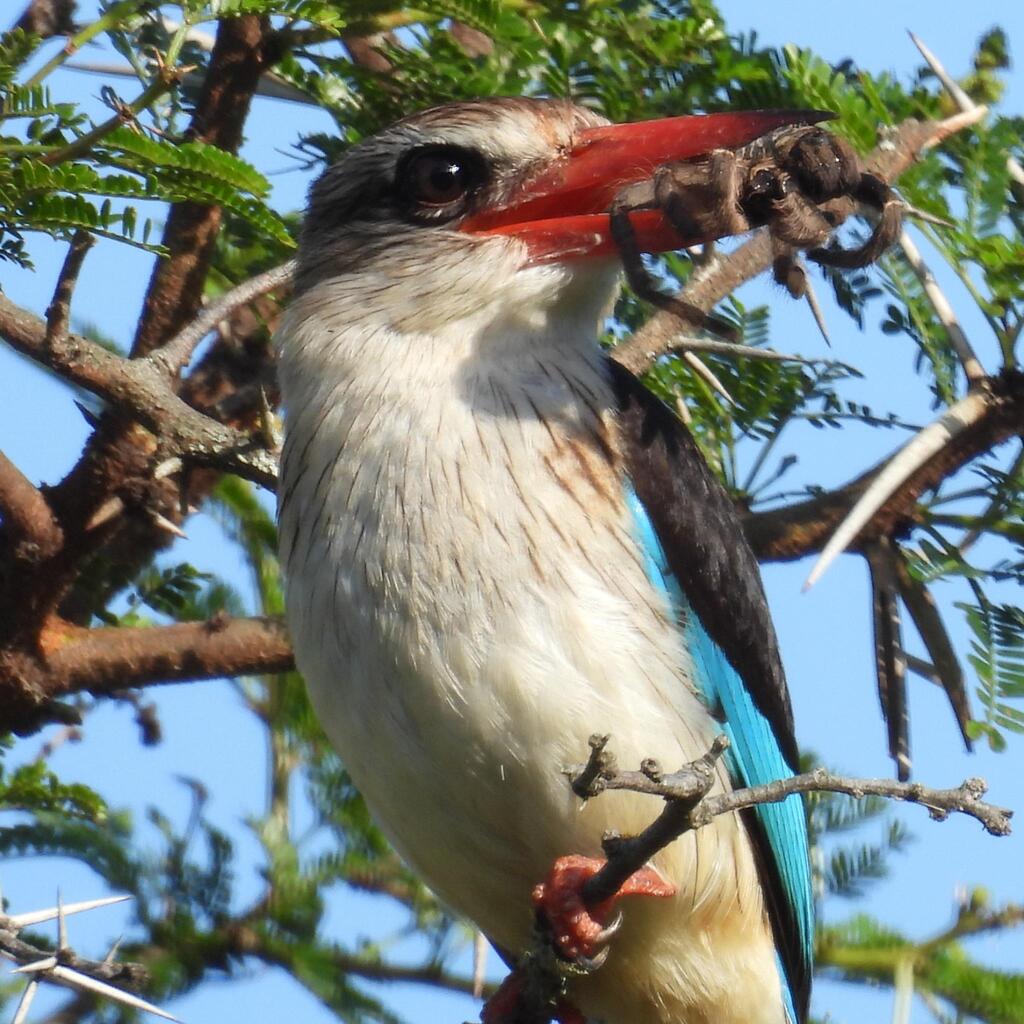
Brown-hooded Kingfisher
Photo © Henry de Lange
Photo © Henry de Lange — CC BY 4.0 — Source: iNaturalist #323963760Identification
The brown-hooded kingfisher is a medium-sized tree kingfisher, measuring approximately 22 cm in length. Its most distinctive features are its brown head with blackish streaks and a broad buffy collar that contrasts with the brownish-black mantle beneath. The wings are striking: the wing coverts are mostly blackish, while the secondary flight feathers display bright turquoise plumage, and the rump is azure-blue. The chin is white, and the breast and belly are tawny to buffy with some streaking.
In terms of soft parts, the bird has a red beak tipped with brown, carmine-coloured legs, and dark brown eyes. Sexual dimorphism is present: females display darker brown upperparts and more heavily streaked underparts than males, while juveniles are duller overall with scalloped whitish underparts. Four recognised subspecies occur across the range, differing subtly in shade and streaking patterns.
Range & Habitat
This kingfisher is widely distributed across Sub-Saharan Africa, occurring in Gabon, Congo, the Democratic Republic of the Congo, Angola, Kenya, Tanzania, Zambia, Somalia, Mozambique, Malawi, Zimbabwe, Botswana, Namibia, South Africa and Eswatini. It is found below 1,800 m in elevation and shows a remarkable adaptability to diverse habitats, thriving in woodland, grassland with scattered trees, scrubland, and forest edges.
Beyond natural areas, the species readily colonises cultivations, parks, gardens and suburban habitats, making it accessible to wildlife travellers in both remote and settled regions. Although it sometimes occurs near water bodies, it is not strictly dependent on aquatic environments. Most populations are resident year-round, though seasonal movements have been documented in some areas.
Behaviour & Diet
The brown-hooded kingfisher is typically observed alone or in pairs. Unlike many kingfisher species, it is primarily a ground forager, using this terrestrial hunting strategy to capture its diverse prey. Its diet consists mainly of insects, but it opportunistically takes scorpions, reptiles, small birds, rodents and fishes. Notably, this adaptable predator has been recorded consuming snakes and lizards up to 25 cm in length.
Vocally, the bird produces a distinctive song comprising a tiiiu or ki-ti-ti-ti trill, accompanied by wing vibrations. When alarmed, it utters a sharp cheerit call. The breeding season spans mainly from September to April, during which pairs excavate burrow nests in river banks, gullies or road cuttings. Family groups remain together for several weeks following the breeding period.
Best Time & Places to See It
The brown-hooded kingfisher's wide distribution and adaptability make it accessible throughout much of Sub-Saharan Africa. Its tolerance of suburban habitats means that travellers need not venture exclusively into remote wilderness areas; the species is often found in parks and gardens within or near towns and settlements. This accessibility makes it an excellent addition to any African wildlife itinerary.
The breeding season from September through April is particularly rewarding for observation, as birds are more active and vocal during this period. Given the species' ground-foraging behaviour and preference for open woodland and grassland with scattered trees, scanning open ground in suitable habitats during morning and late afternoon hours offers the best chances for sightings.
Photography Tips
The brown-hooded kingfisher's colourful plumage—particularly the striking turquoise secondary feathers and azure rump contrasting with the brown head—makes it an attractive photographic subject. The bird's ground-foraging habit means photographers should position themselves to capture it in natural terrestrial hunting poses rather than exclusively on perches. Early morning and late afternoon light will best illuminate the turquoise wing feathers and azure rump.
Since the species is generally seen alone or in pairs, patience and careful approach are essential. The bird's adaptation to suburban gardens and parks provides accessible opportunities for photography without requiring extensive travel to remote areas. Look for perches overlooking open ground where the kingfisher hunts, and be prepared to photograph both perched birds and the more characteristic ground-feeding behaviour.
Serengeti National Park
Tanzania
+558 birds+57 mammals
Across Tanzania's northern plateau, where volcanic soils meet acacia woodland and open grassland, unfolds one of Earth's most dynamic ecosystems. The Serengeti National Park sprawls across…
VIEW NATIONAL PARKArusha National Park
Tanzania
+555 birds+16 mammals
Where the slopes of Mount Mawenzi rise above the Arusha region, a compact yet ecologically rich national park unfolds across montane forest, moorland, and alpine zones.…
VIEW NATIONAL PARKMapungubwe National Park
Musina Local Municipality, South Africa
+358 birds+29 mammals
Where the Limpopo River cuts through sandstone ridges at the convergence of South Africa, Botswana, and Zimbabwe, Mapungubwe National Park preserves a landscape of profound ecological…
VIEW NATIONAL PARKChobe National Park
Botswana
+446 birds+45 mammals
Where the Chobe River cuts a sinuous path through northern Botswana, the landscape transforms into one of Africa's most dynamic wetland-savanna mosaics. This national park encompasses…
VIEW NATIONAL PARKKhaudum National Park
Botswana
+213 birds+13 mammals
Where the Okavango's northern tributaries meander through miombo woodland and riverine forest, Khaudum National Park unfolds across a landscape of profound ecological richness and isolation. This…
VIEW NATIONAL PARKTsavo East National Park
Athi ward, Kenya
+468 birds+50 mammals
Across the semi-arid lowlands of southeastern Kenya, where acacia woodland fragments into scrubland and the landscape rolls toward the Indian Ocean horizon, lies one of Africa's…
VIEW NATIONAL PARKTsavo West National Park
Mwatate, Kenya
+513 birds+49 mammals
Where volcanic ridges and weathered lava flows meet the semi-arid lowlands of south-central Kenya, Tsavo West National Park unfolds across a landscape sculpted by fire and…
VIEW NATIONAL PARKAmboseli National Park
Etonet/Lenkism ward, Kenya
+501 birds+43 mammals
Where the Amboseli basin opens toward the Tanzanian frontier, a shallow alkaline lake mirrors vast skies across one of East Africa's most iconic savanna landscapes. The…
VIEW NATIONAL PARKKilimanjaro National Park
Kenya
+207 birds+16 mammals
Africa's highest mountain rises not in isolation but as the centerpiece of a vast national park that sweeps across the borderlands of northern Tanzania, where savanna…
VIEW NATIONAL PARKTarangire National Park
Tanzania
+527 birds+50 mammals
Acacia woodland and grassland sweep across the Manyara Region where the Tarangire River carves through low hills and volcanic soils, creating one of East Africa's most…
VIEW NATIONAL PARKNgorongoro Conservation Area
Tanzania
+626 birds+55 mammals
Volcanic calderas and open grassland dominate this high plateau in northern Tanzania, where the landscape rises above 2,000 metres and ancient geological forces have shaped both…
VIEW WILDLIFE MANAGEMENT AREAGarden Route National Park
George, South Africa
+353 birds+54 mammals
Sweeping across the Western Cape's coastal and mountainous terrain, this sprawling national park encompasses over five thousand square kilometers of extraordinarily diverse landscape—from coastal limestone cliffs…
VIEW NATIONAL PARKKruger National Park
Ba-Phalaborwa Local Municipality, South Africa
+540 birds+91 mammals
Across the low-lying savanna of northeastern South Africa unfolds one of Africa's largest and most ecologically intact protected areas, where acacia woodlands merge into mopane scrub…
VIEW NATIONAL PARKMountain Zebra National Park
Inxuba Yethemba Local Municipality, South Africa
+265 birds+35 mammals
Across the windswept plateaus and deeply incised valleys of the Eastern Cape's interior, Mountain Zebra National Park unfolds as a landscape of geological drama and ecological…
VIEW NATIONAL PARKBontebok National Park
Swellendam Local Municipality, South Africa
+204 birds+11 mammals
Where the Cape Fold Mountains give way to coastal lowlands, a landscape of rolling sandstone hills and fynbos heathland creates one of South Africa's most compact…
VIEW NATIONAL PARKAugrabies Falls National Park
Kai !Garib Local Municipality, South Africa
+176 birds+20 mammals
Where the Orange River cuts a dramatic scar through the Northern Cape's arid interior, Augrabies Falls National Park sprawls across nearly 1,200 square kilometers of raw,…
VIEW NATIONAL PARKAddo Elephant National Park
Sundays River Valley Local Municipality, South Africa
+388 birds+55 mammals
Where the Eastern Cape's semi-arid scrublands meet transitional woodland, Addo sprawls across 13,478 square kilometres of one of southern Africa's most biodiverse landscapes. The terrain rises…
VIEW NATIONAL PARKMarakele National Park
Modimolle Local Municipality, South Africa
+341 birds+36 mammals
Granite ridges and sprawling grasslands dominate this 1,176-square-kilometre reserve in Limpopo's heartland, where bushveld transitions between rocky outcrops and open savanna. The park's rugged topography creates…
VIEW NATIONAL PARKCamdeboo National Park
Camdeboo Local Municipality, South Africa
+272 birds+24 mammals
Granite ridges and weathered sandstone cliffs rise across a semi-arid landscape where the Karoo transitions into the eastern escarpment of South Africa, creating Camdeboo National Park's…
VIEW NATIONAL PARKKhaudum National Park
Namibia
+221 birds+13 mammals
Where the Kavango River flows through northeastern Namibia, vast miombo woodlands and riverine forests create one of southern Africa's most remote and biodiverse wilderness corridors. Khaudum…
VIEW NATIONAL PARKNkasa Rupara National Park
Namibia
+283 birds+17 mammals
Where the Zambezi's floodplains spill across the border between Namibia and Botswana, Nkasa Rupara National Park unfolds across 518 square kilometers of wetland and woodland mosaic.…
VIEW NATIONAL PARKBwabwata National Park
Namibia
+377 birds+35 mammals
Where the Kavango River winds through northeastern Namibia, vast floodplains and dense riparian woodland create one of southern Africa's most ecologically dynamic protected landscapes. Spanning 14,249…
VIEW NATIONAL PARKEtosha National Park
Namibia
+356 birds+58 mammals
Across northern Namibia's stark semi-arid plateau, a vast shallow depression transforms seasonally into one of Africa's most dramatic wildlife theaters. Etosha National Park, encompassing more than…
VIEW NATIONAL PARKMakgadikgadi Pans National Park
Gucta, Botswana
+272 birds+27 mammals
Where salt-crusted flatlands stretch endlessly toward a shimmering horizon, one of Africa's most extraordinary ecosystems awakens with the rains. The Makgadikgadi Pans comprise vast mineral-rich basins…
VIEW NATIONAL PARKMeru National Park
Igembe Central, Kenya
+408 birds+38 mammals
Granite outcrops and acacia woodland rise across the northern reaches of Meru, where semi-arid savanna transitions into drier scrubland under the fierce equatorial sun. The park's…
VIEW NATIONAL PARKChyulu Hills National Park
Kibwezi East, Kenya
+232 birds+30 mammals
Volcanic cones rise abruptly from the Kenyan savanna floor, their flanks clothed in dense acacia woodland and grassland that transforms the Chyulu Hills into an ecological…
VIEW NATIONAL PARKArabuko Sokoke Forest Reserve
Kilifi, Kenya
+383 birds+29 mammals
Coastal forest rises from the Indian Ocean plains of Kilifi County, where sandy soils and seasonal rainfall have sculpted a woodland ecosystem unlike anywhere else on…
VIEW NATURE RESERVEWatamu Marine National Park
Dabaso ward, Kenya
+328 birds+12 mammals
Where mangrove channels meet coral gardens and sandy shallows blend into the warm waters of the Indian Ocean, Watamu Marine National Park unfolds across the Kilifi…
VIEW NATIONAL PARKNo community photos yet. Log in to add the first one.
No community observations of this species yet.