Brown-throated Wattle-eye
Photo © Zac Peterson
Photo © Zac Peterson — CC BY 4.0 — Source: iNaturalist photo #607830030Identification
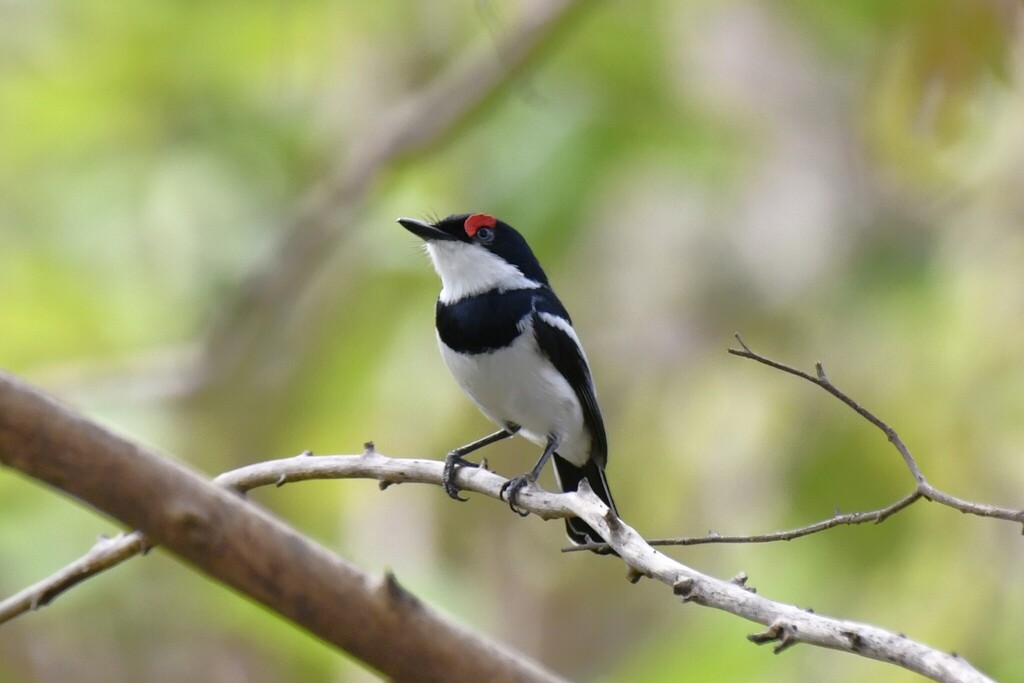
The brown-throated wattle-eye is a small, stout passerine measuring about 14 cm (5.5 in) in length. Most distinctive are the fleshy red wattles above each eye, which give this species its memorable name and make identification straightforward once seen. Breeding males are striking birds with glossy black upperparts, pure white underparts, and a neat black breast band. A strong white wingbar contrasts sharply against the dark plumage. Females present a different appearance, being grey-black above while retaining the white wingbar and red eye-wattles. The female's throat and breast are maroon in colour, separated from the white belly by the characteristic black breast band. A small white patch sits below the bill. Young males resemble females but appear as washed-out, greyer versions, making age and sex determination possible with careful observation.
Range & Habitat
The brown-throated wattle-eye breeds across west, central, and northeast tropical Africa, making it a widespread species throughout much of the continent. This common bird shows a preference for secondary forest and other woodland areas, readily adapting to disturbed habitats including gardens and cultivated landscapes. The species nests in small, neat cups constructed from lichen and cobweb, positioned low in trees or bushes where they remain inconspicuous despite the male's bright plumage.
Behaviour & Diet
True to its classification, the brown-throated wattle-eye is a dedicated insectivore, actively hunting small insects throughout the day. These birds are typically encountered in pairs or small groups as they work through vegetation in search of prey. The species is highly vocal and remarkably easy to locate by ear—once heard, its distinctive call is never forgotten. The ringing, six-note vocalization of doo-dd-dum-di-do-do is so characteristic that it often provides the first indication of the bird's presence in a woodland patch.
Best Time & Places to See It
As a breeding resident across tropical African woodlands, the brown-throated wattle-eye can be encountered year-round throughout its range. Secondary forests and woodland habitats in west, central, and northeast Africa offer the best opportunities for observation. The bird's willingness to use gardens and other human-modified landscapes means that even lodge grounds and cultivated areas within its range may produce sightings. Early morning hours typically yield the most active birds and the best chances of hearing their characteristic calls.
Photography Tips
The striking red wattles and high contrast plumage of breeding males make them rewarding photographic subjects. However, their small size and preference for working in vegetation at low levels can present challenges. Position yourself patiently in good light, particularly in secondary growth where these birds actively forage. The distinctive black and white markings of males photograph particularly well, while the more subtle maroon and grey tones of females require careful exposure metering. Use the bird's vocal behaviour to your advantage—by listening for the distinctive six-note call, you can anticipate the bird's location and position yourself accordingly.
Serengeti National Park
Tanzania
+558 birds+57 mammals
Across Tanzania's northern plateau, where volcanic soils meet acacia woodland and open grassland, unfolds one of Earth's most dynamic ecosystems. The Serengeti National Park sprawls across…
VIEW NATIONAL PARKRubondo Island National Park
Tanzania
+99 birds+8 mammals
Across the waters of Lake Victoria's northeastern arm, Rubondo Island rises as a freshwater wilderness where papyrus swamps grade into acacia woodlands and dense thickets of…
VIEW NATIONAL PARKVirunga National Park
Uganda
+418 birds+13 mammals
Where the Western Rift Valley fractures the landscape of North Kivu, Virunga National Park sprawls across terrain as geologically dramatic as it is ecologically vital. Volcanic…
VIEW NATIONAL PARKBwindi Impenetrable National Park
Kanyashogi, Uganda
+603 birds+26 mammals
Steep ridges cloaked in montane forest rise from Uganda's southwestern borderlands, where the landscape grows so dense and tangled that early explorers named it impenetrable. At…
VIEW NATIONAL PARKVolcanoes National Park
Musanze District, Uganda
+152 birds+6 mammals
Where volcanic cones rise sharply above the montane forests of northern Uganda, Volcanoes National Park protects one of East Africa's most dramatic high-altitude ecosystems. The park's…
VIEW NATIONAL PARKKidepo Valley National Park
Uganda
+478 birds+24 mammals
Where the Narus and Kidepo rivers carve through northeastern Uganda's semi-arid lowlands, a landscape of sparse acacia woodland, grassland, and riverine thickets creates one of East…
VIEW NATIONAL PARKMurchison Falls National Park
Uganda
+608 birds+33 mammals
Where the Victoria Nile compresses through a narrow gorge and explodes across a 45-meter precipice, the landscape speaks in thunder. Murchison Falls National Park sprawls across…
VIEW NATIONAL PARKMgahinga Gorilla National Park
Cyanika, Uganda
+429 birds+6 mammals
Where the Virunga Mountains rise steeply from the Uganda–Rwanda–Democratic Republic of Congo frontier, montane forest cloaks the volcanic slopes in a dense, moisture-laden embrace. Mgahinga Gorilla…
VIEW NATIONAL PARKLake Mburo National Park
Uganda
+505 birds+24 mammals
Rolling acacia woodland and scattered lakes define this intimate savanna preserve in southwestern Uganda, where the rift valley's geological drama shapes every water source and grassland.…
VIEW NATIONAL PARKToro-Semliki Proposed National Park
Uganda
+474 birds+5 mammals
Where the Albertine Rift's western escarpment rises above the Semliki River valley, a vast mosaic of forest, savanna and wetland converges to create one of East…
VIEW NATIONAL PARKQueen Elizabeth National Park
Uganda
+672 birds+30 mammals
Across the southwestern escarpment of Uganda, where the Western Rift Valley descends through ancient volcanic terrain, Queen Elizabeth National Park sprawls across more than 8,300 square…
VIEW NATIONAL PARKMabamba Swamp
Memere, Uganda
+464 birds+2 mammals
Across the Central Region of Uganda spreads one of Africa's most biodiverse freshwater wetlands, a sprawling nature reserve of roughly 283 square kilometres where papyrus swamps…
VIEW NATURE RESERVEZiwa Rhino and Wildlife Ranch
Nakasongola, Uganda
+359 birds+11 mammals
Where papyrus wetlands merge into sprawling savanna, Uganda's central landscape opens into one of East Africa's most vital rhino recovery zones. Ziwa Rhino and Wildlife Ranch…
VIEW WILDLIFE SANCTUARYAbijata-Shalla Lakes National Park
Ethiopia
+438 birds+7 mammals
Two crater lakes of contrasting chemistry define this remote corner of Ethiopia's Rift Valley, where soda lakes and freshwater basins create a mosaic of distinct aquatic…
VIEW NATIONAL PARKBale Mountains National Park
Ethiopia
+397 birds+20 mammals
Where the Ethiopian highlands rise above 4,000 metres, the Bale Mountains create a landscape of stunning ecological extremes—from afroalpine grasslands swept by wind and mist to…
VIEW NATIONAL PARKAwash National Park
Didiga, Ethiopia
+473 birds+23 mammals
Where the Ethiopian Rift Valley carves through volcanic plateaus, a ribbon of riverine forest winds through acacia scrubland and grassland, creating a mosaic of habitats that…
VIEW NATURAL PARKYabelo Wildlife Sanctuary
Bedewera, Ethiopia
+359 birds+5 mammals
Where acacia woodlands meet volcanic plateaus in southern Ethiopia, a landscape of austere beauty unfolds across nearly 2,500 square kilometers. Yabelo Wildlife Sanctuary sprawls across semi-arid…
VIEW WILDLIFE SANCTUARYRuma National Park
Suba, Kenya
+250 birds+8 mammals
Where the Winam Gulf narrows toward the Kenyan mainland, Ruma National Park rises as a sanctuary of evergreen woodland set within the humid tropics of Homa…
VIEW NATIONAL PARKSaiwa Swamp National Park
Sinyerere ward, Kenya
+255 birds+4 mammals
Where papyrus and sedge marshes stretch across a highland plateau in western Kenya, Saiwa Swamp National Park shelters one of East Africa's most productive freshwater wetland…
VIEW NATIONAL PARKNo community photos yet. Log in to add the first one.
No community observations of this species yet.