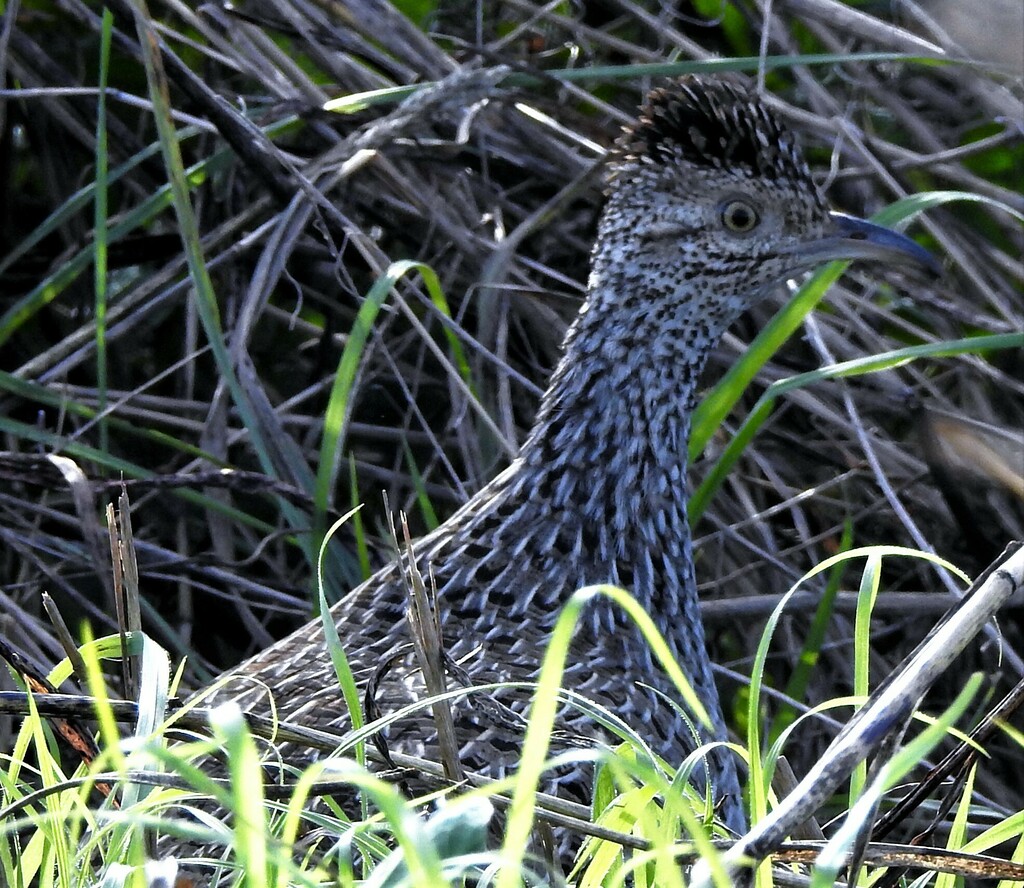
Brushland Tinamou
Photo © Hugo Hulsberg
Photo © Hugo Hulsberg — CC0 1.0 — Source: iNaturalist #142065970Identification
The brushland tinamou is a compact bird, measuring approximately 31.5 cm in length and weighing around 540 g. It is characterized by grey to olive-brown upper parts heavily barred with black and prominently streaked with white. The crown is distinctly black, while the sides of the head and throat are white with black barring on the lower throat. The breast is grey spotted with white, and the belly is whitish. The legs are dark grey. Females are notably larger and darker than males, making them distinguishable in the field.
Range & Habitat
The brushland tinamou is native to southern South America, with populations found in southeastern Bolivia, northwestern Paraguay, and northwestern and central Argentina. Two subspecies are recognized: the nominate race occurs across southeastern Bolivia, northwestern Paraguay, and central Argentina, while the subspecies parvimaculata is restricted to eastern La Rioja Province in northwestern Argentina.
This species shows a strong preference for high-altitude dry shrubland and can be found up to 1,000 m in typical habitat, though it regularly occurs at elevations reaching 2,000 m. Beyond shrubland, the brushland tinamou adapts well to dry savanna, dry grassland, seasonally flooded grassland, pastureland, and farmland, making it a relatively flexible inhabitant of the region's diverse arid and semi-arid environments.
Behaviour & Diet
The brushland tinamou is primarily a ground-dwelling bird with a distinctive vocal presence. Its call comprises a series of seven to ten clear, whistled notes that carry well across the landscape and are particularly audible as pairs defend their territories of approximately 50 acres. Diet consists mainly of insects and small animals, supplemented with fruit, reflecting its opportunistic foraging habits typical of tinamous.
Reproduction in this species demonstrates an unusual mating system where males attract two to four females. Each female lays eggs in a nest typically hidden within brush, after which she departs to seek other mates. The male bears sole responsibility for incubating the eggs and raising the resulting chicks—a parental arrangement that is distinctive among birds.
Best Time & Places to See It
The brushland tinamou is classified as Least Concern with a substantial occurrence range of 1,200,000 km², indicating it remains relatively common throughout its range. Travellers interested in observing this species should focus on dry shrubland habitats in the subtropical and tropical highlands of southeastern Bolivia, northwestern Paraguay, and Argentina. The species' adaptability to farmland and pastureland means it can sometimes be encountered in modified landscapes, not only pristine natural habitats.
Photography Tips
Photographing the brushland tinamou presents challenges typical of ground-dwelling birds in dense shrubland. Early morning sessions are recommended, as the birds' distinctive whistled calls are more frequent during dawn hours, helping photographers locate individuals. The species' preference for staying concealed in brush requires patience and careful stalking. The contrasting plumage—with black crown, white throat and streaking, and grey-barred upperparts—provides good visual contrast when subjects can be observed in open areas. Listen carefully for the characteristic seven to ten-note whistle to pinpoint locations before attempting photography.
El Rey National Park
Municipio de Las Lajitas, Argentina
+317 birds+4 mammals
Where the eastern slopes of the Andes descend into northwestern Argentina's subtropical transition zone, El Rey National Park unfolds across 841 square kilometers of dramatically varied…
VIEW NATIONAL PARKSierra de las Quijadas National Park
Argentina
+168 birds+5 mammals
Sandstone cliffs and deeply incised canyons define this 1,137-square-kilometre expanse in San Luis Province, where the dry Chacoan landscape of central Argentina reveals an unexpected ecological…
VIEW NATIONAL PARKParque Provincial Pampa del Indio
Laguna Limpia, Argentina
+231 birds+4 mammals
Across the flat horizons of Chaco Province, where the Paraná River system spills into vast wetlands and grasslands, Parque Provincial Pampa del Indio protects one of…
VIEW NATURE RESERVEChaco National Park
Municipio de Presidencia de la Plaza, Argentina
+258 birds+7 mammals
Across the humid subtropical lowlands of northeastern Argentina, where the Paraná River basin feeds vast seasonal wetlands and gallery forests, Chaco National Park protects one of…
VIEW NATIONAL PARKNo community photos yet. Log in to add the first one.
No community observations of this species yet.