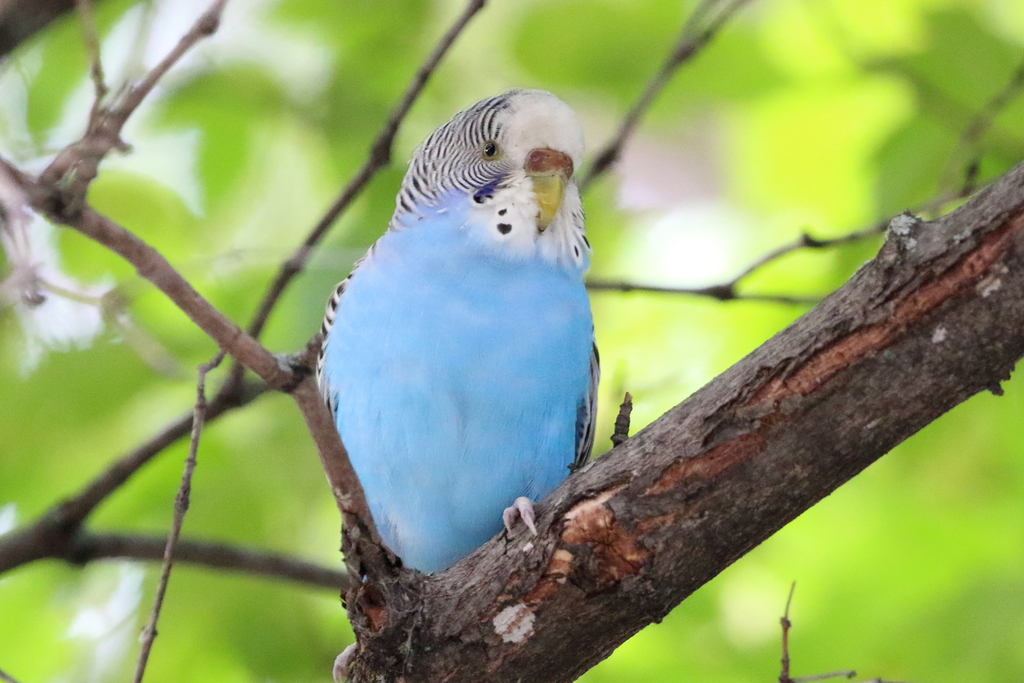
Budgerigar
Photo © David Bird
Photo © David Bird — CC0 1.0 — Source: iNaturalist photo #149854664Identification
The budgerigar is a small, long-tailed parrot averaging 18 cm in length with a wingspan of 30 cm. Wild birds display a striking light green body with pitch-black, scalloped markings on the nape, back, and wings, edged in clear yellow undulations. The forehead and face are bright yellow in adults. Look for iridescent blue-violet cheek patches, three black spots across each side of the throat, and a cobalt tail with yellow flashes on the outer feathers. The wings show greenish-black flight feathers with yellow fringes and central flashes visible in flight. Bills are olive-grey and legs blueish-grey.
Sexual dimorphism is revealed by cere colouring: males display lavender or baby-blue ceres, while females show pale brownish or white (non-breeding) to brown (breeding) ceres. Young birds of both sexes have pink ceres. Juveniles bear blackish stripes extending down to the cere until around 3–4 months of age. Wild budgerigars are noticeably smaller than their captive-bred counterparts, which have been bred in blues, whites, yellows, greys, and crested varieties.
Range & Habitat
Budgerigars are endemic to Australia, found throughout the drier inland regions of the continent. They have thrived in these harsh environments for over five million years, a testament to their remarkable adaptability.
Behaviour & Diet
These are nomadic, seed-eating parrots that live in flocks and breed opportunistically in pairs. Their nomadic lifestyle and ability to breed while on the move have been key to their survival in Australia's challenging interior. They are known for close perching, mutual preening, and forming long-term pair bonds. Budgerigars possess tetrachromatic colour vision, allowing them to perceive ultraviolet light—a capability believed to play a role in mate selection and courtship.
Best Time & Places to See It
Look for budgerigars throughout Australia's drier inland regions. As nomadic birds, they move opportunistically in response to food and water availability, so timing and location require local knowledge. They travel in flocks, so finding one individual often means finding many.
Photography Tips
Capture the birds in flight to reveal the yellow flashes on their wings and tail that are hidden at rest. The ultraviolet spectrum of their plumage can be enhanced under natural sunlight, creating vivid iridescent effects. Focus on the distinctive throat spots and cheek patches, and try to photograph males and females together to highlight the diagnostic cere colour differences that separate the sexes.
Blue Mountains National Park
Bombay Hook National Wildlife Refuge
Boodjamulla National Park
Calanques National Park
Camargue Regional Nature Park
Cape Range National Park
Caps et Marais d’Opale Regional Nature Park
Chassahowitzka National Wildlife Refuge
Chiltern-Mt Pilot National Park
Nothing matches these filters.
No community photos yet. Log in to add the first one.
No community observations of this species yet.