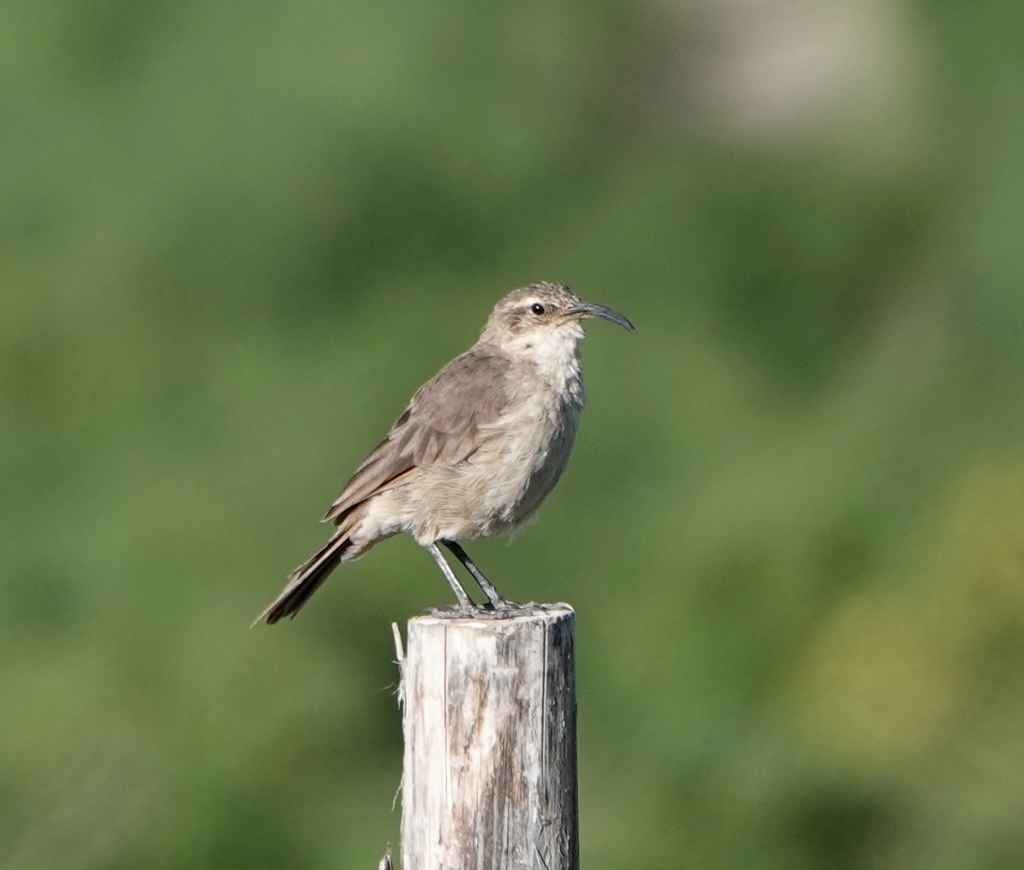
Buff-breasted Earthcreeper
CC BY 4.0
CC BY 4.0 — Source: iNaturalist photo #188539532Identification
The buff-breasted earthcreeper is a medium-sized ovenbird measuring 17–21 cm in length, characterized by a notably long and strongly decurved bill. Adults of the nominate subspecies display a pale buffish-white supercilium contrasting with dull brownish-gray crown, nape, back, and rump. The tail is dark brown with increasing rufous tones toward the outer feathers, while wings show rufous at the base of the primaries. The throat appears grayish-white with brownish specks, the upper breast grayish-white with a brownish scaly pattern, and the lower breast, belly, and undertail coverts are plain light buff. The iris is dark brown, the bill blackish with a paler base, and legs dark brown to blackish. The sexes are alike in plumage, though juveniles show more conspicuous breast markings. Other subspecies vary subtly: U. v. jelskii has a smaller, shorter bill and less rufous in the wings, while U. v. saturata resembles jelskii but with grayer underparts.
Range & Habitat
The buff-breasted earthcreeper is endemic to the Andes, with three subspecies occupying different regions. U. v. jelskii has the widest distribution, ranging from Peru's Department of Lima south through the Andes into Chile's Tarapacá Region, western Bolivia, and northwestern Argentina's Jujuy Province. U. v. saturata occurs in the western Andes of central Peru between Ancash and Pasco departments, while the nominate U. v. validirostris inhabits northwestern Argentina from Salta Province south to Mendoza Province and into western Córdoba Province.
This species is a year-round resident throughout its range, favoring puna grasslands and arid montane scrublands. Within these landscapes, it shows a strong preference for dry ravines with dense scrub and rocky, shrubby slopes, notably avoiding level ground.
Behaviour & Diet
The buff-breasted earthcreeper feeds on adult and larval arthropods, typically foraging singly or occasionally in pairs as it probes the ground and gleans food from its surface. The species is not highly vocal. The nominate subspecies produces a long dry trill of approximately 10 or more 'tyik' notes as song, with a low 'chwit' call. Other subspecies offer richer vocalizations: an irregular trill 'drrrrrr…' lasting one to more than 10 seconds, rising and falling in pitch with acceleration and deceleration, and a metallic 'click' or 'tyi-ík' call.
Breeding occurs during the austral summer, generally between November and March with regional variation. The species is presumed monogamous, nesting in a chamber at the end of a burrow in earthen banks or sometimes in rock crevices, with the nest chamber lined with grasses. Clutch size is two eggs, though details of incubation period, fledging time, and parental care remain unknown.
Best Time & Places to See It
The buff-breasted earthcreeper is considered rare to locally fairly common throughout its range, making sightings unpredictable but rewarding. Peak breeding activity from November to March may increase encounter rates, particularly in suitable habitat. Birders should focus on the puna grasslands and arid montane scrublands of the central Andes, with the widest opportunities in the range of U. v. jelskii, extending from southern Peru through Bolivia into northwestern Argentina. Target dry ravines with dense scrub and rocky, shrubby slopes rather than open, level terrain.
Photography Tips
The buff-breasted earthcreeper's preference for rocky, scrubby terrain and avoidance of open ground makes it a challenging subject for photographers. Its cryptic brownish-gray plumage and ground-foraging behavior demand patience and fieldcraft; approach slowly and use natural cover provided by the habitat's dense vegetation. Early morning light will best illuminate the buff tones on the breast and the pale supercilium that provide key identification marks. The bird's long, decurved bill is a distinctive feature worth capturing in profile shots. Given the remote, high-altitude locations of this species, ensure you are well-acclimatized and prepared for variable mountain weather before attempting photography.
Huascarán National Park
Independencia, Peru
+201 birds+5 mammals
Where granite peaks pierce the Andean sky above 6,000 metres, Huascarán National Park sprawls across more than 11,500 square kilometres of Peru's Cordillera Blanca, a landscape…
VIEW NATIONAL PARKSalar del Huasco National Park
Pica, Chile
+75 birds+2 mammals
High above the Atacama's shimmering flats, where the Andes grip the sky, lies a landscape of stark geological drama and surprising biological richness. Salar del Huasco…
VIEW NATIONAL PARKLauca National Park
Putre, Chile
+139 birds+17 mammals
Where the Andes rise toward the altiplano in Chile's far north, Lauca National Park sprawls across more than 3,000 square kilometres of some of South America's…
VIEW NATIONAL PARKReserva Nacional las Vicuñas
Putre, Chile
+87 birds+6 mammals
High desert plateaus interlace with volcanic ridges across this 4,204-square-kilometre expanse at the border between Chile and Bolivia, where altitudes exceed 3,500 metres and the climate…
VIEW NATIONAL PARKSalar de Surire Natural Monument
Putre, Chile
+61 birds
High across the Altiplano of northern Chile, where the Andes push toward 4,300 metres and the air thins to a crystalline clarity, lies a vast shallow…
VIEW NATURAL MONUMENTLos Cardones National Park
Argentina
+193 birds+6 mammals
Where the Andes descend into northwestern Argentina, Los Cardones National Park sprawls across nearly 1,200 square kilometres of one of South America's most distinctive high-altitude desert…
VIEW NATIONAL PARKNo community photos yet. Log in to add the first one.
No community observations of this species yet.