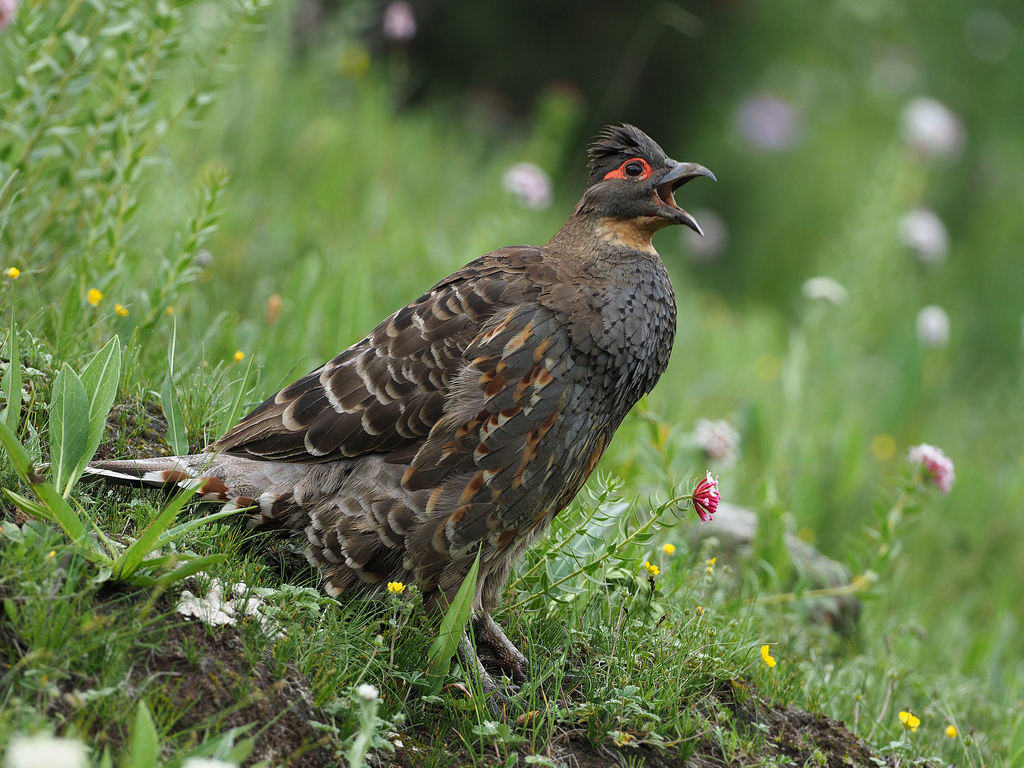
Buff-throated Monal-Partridge
Photo © James Eaton
Photo © James Eaton — CC0 1.0 — Source: iNaturalist #207907616Identification
The buff-throated monal-partridge is a medium-sized, sexually monochromatic partridge ranging from 29–50 cm in length and weighing between 660–1790g. Its most distinctive feature is a bright orange horizontal teardrop-shaped eye ring that frames the eye with striking clarity. The species displays a light gold gorget (throat patch) and a crest that it can occasionally flare up during displays. The upper chest is grey, while the belly is speckled with a mixture of orange and grey plumage.
Range & Habitat
Endemic to western China, the buff-throated monal-partridge is found in the high mountains of southeastern Tibet, southern Qinghai, western Sichuan, and northwestern Yunnan, at elevations between 3350–4600 metres. The species inhabits mixed coniferous forests, rhododendron shrubs, oak thickets, alpine meadows, and rocky ravines—landscapes shaped by extreme altitude and harsh mountain conditions.
These partridges face predation from several sources. Nocturnal avian predators include Père David's owl and tawny owls, while mammalian threats come from leopard cats, Siberian weasels, and mountain weasels.
Behaviour & Diet
The buff-throated monal-partridge feeds primarily on leaves, roots, stems, bulbs, fruits, and seeds of various herbs and shrubs, supplemented with moss. In areas near Tibetan monasteries, monks sometimes provide rice and corn, which has proven beneficial—supplementary feeding leads to earlier first clutches, increased clutch sizes, and larger eggs, improving survival prospects.
Remarkably, this species is one of the few galliformes that practise cooperative breeding. Family units breed from April to June, typically comprising a breeding pair and one to three helpers (usually male). They nest in soil scrapes lined with leaves, sticks, and bark at the base of trees or shrubs. The female lays 3–4 eggs with an incubation period of approximately four weeks. All family members participate in foraging, vigilance, and territorial defence. The species also engages in communal roosting at night on large fir trees, roosting in linear huddles up to 7 metres high to reduce thermoregulatory costs and predation risk.
Best Time & Places to See It
The breeding season from April to June offers the best opportunity to observe this species, when family units are most active and visible. Look for them in the high-altitude mixed coniferous forests and alpine meadows of the Tibetan plateau region, particularly in areas near sacred Tibetan sites where supplementary feeding occurs. Early mornings and late afternoons, when the birds are actively foraging, provide the best viewing windows.
Photography Tips
The buff-throated monal-partridge's distinctive orange eye ring and gold gorget are key photographic subjects—use telephoto lenses to capture these details without disturbing the birds. Shoot during the golden hours of early morning or late afternoon to highlight the warm tones of the plumage. When photographing family groups, position yourself to capture the cooperative behaviour and hierarchical positioning within the group. Patient observers may photograph the remarkable communal roosting behaviour at dusk, when birds form their linear huddles on fir branches. The high-altitude habitat demands careful exposure metering due to intense mountain light.
Giant Panda National Park
Mianyang, China
+447 birds+47 mammals
Where the eastern slopes of China's Sichuan plateau descend into cloud-wrapped valleys, one of Asia's most biodiverse landscapes unfolds across more than 350,000 square kilometres. This…
VIEW NATIONAL PARKSanjiangyuan National Park
Nagqu, China
+187 birds+25 mammals
Where the headwaters of three great Asian rivers emerge from a high alpine plateau, the landscape unfolds in tundra and dwarf shrubland—a world of austere beauty…
VIEW NATIONAL PARKWolong National Nature Reserve
Wenchuan County, China
+333 birds+17 mammals
Where the Qingyi River cuts through the eastern flanks of the Minshan Range, a temperate montane forest cloaks steep valleys in dense canopy that thins dramatically…
VIEW NATURE RESERVEBaima Snow Mountain National Nature Reserve
Diqing Tibetan Autonomous Prefecture, China
+204 birds+3 mammals
High-altitude ridges and steep-sided valleys define this reserve in northwestern Yunnan, where elevations surge from around 3,000 metres to peaks above 4,100 metres. The terrain supports…
VIEW NATURE RESERVENo community photos yet. Log in to add the first one.
No community observations of this species yet.