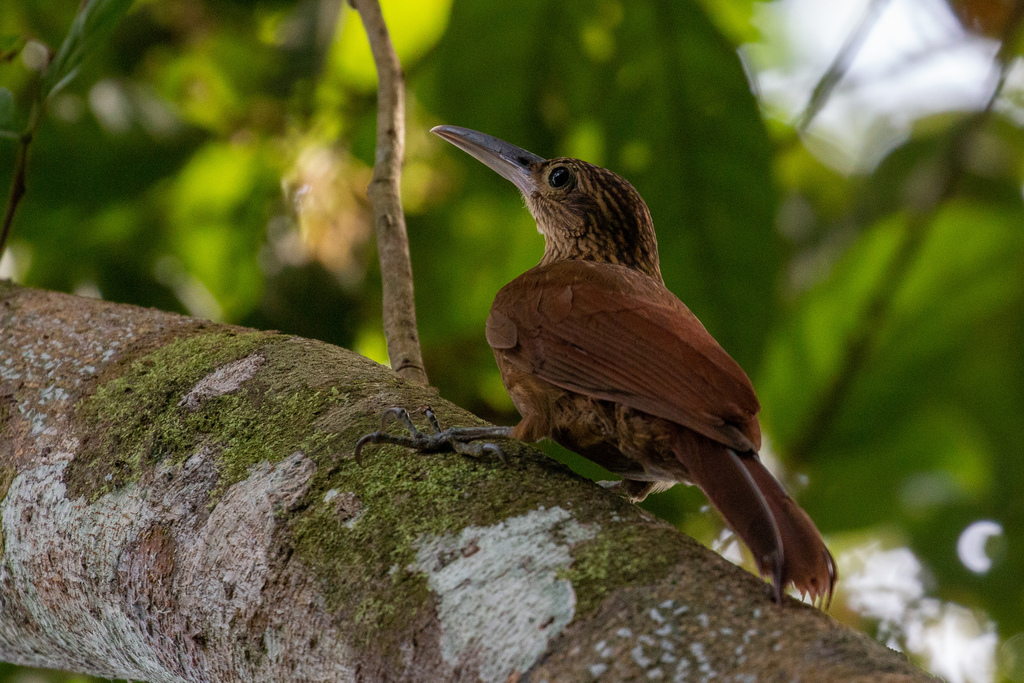
Buff-throated Woodcreeper
Photo © Thomaz de Carvalho Callado
Photo © Thomaz de Carvalho Callado — CC BY 4.0 — Source: iNaturalist photo #161505471Identification
The buff-throated woodcreeper is the largest member of its genus, measuring 22.5 to 29.5 cm in length with a distinctive heavy body and long, decurved bill. The nominate subspecies displays a dark brown face with narrow whitish buff streaks, a dark crown and nape with buff teardrop spots edged in black, and reddish olive-brown upperparts heavily streaked in buff. The lower back and rump are cinnamon-rufous, while the tail is rufous-chestnut. The throat is characteristically deep buff with a dusky lower edge, and the breast and sides show reddish-brown plumage with black-edged buff streaks. Dark brown iris, dark bill with paler culmen and mandible, and blue-gray legs distinguish this species. Subspecific variation is considerable, with some populations showing paler bills, more olive tones, or whiter streaking and throats.
Juveniles can be distinguished by their shorter, blacker bills, more rufous bellies, and wider, darker-edged streaks than adults.
Range & Habitat
The buff-throated woodcreeper is distributed across the Amazon Basin and adjacent regions, with different subspecies occupying distinct ranges from Venezuela and Colombia south through Ecuador, Peru, and Brazil, with populations also found in Bolivia, French Guiana, Guyana, and Suriname. The species inhabits humid forest environments throughout its range, favoring the interior and canopy levels of tall trees where it forages.
Behaviour & Diet
Like other woodcreepers, this species is a specialist forager that systematically searches tree bark and vegetation for invertebrate prey. It uses its long, heavy bill and stiff tail feathers to support itself as it moves along branches and trunks in its characteristic upward-spiraling manner, probing and gleaning insects and other small arthropods from crevices and lichen-covered bark.
Best Time & Places to See It
The buff-throated woodcreeper is a resident species throughout its range, present year-round. It is most readily encountered in humid lowland and foothill forests of the Amazon Basin. Birders should scan the trunks and branches of tall forest trees, particularly in areas with tall, mature growth. The species tends to forage at various heights from mid-story to canopy levels, often singly or in pairs.
Photography Tips
Photographing this species requires patience and attention to forest canopy height. Position yourself where tall trees can be backlit by morning or late afternoon light to reveal the subtle streaking and warm buff tones of the plumage. The bird's deliberate, methodical foraging behavior offers opportunities for sharp images, but the heavy streaking and dark coloration demand careful exposure metering to retain detail in both highlights and shadows. Focus on capturing the distinctive buff throat and the characteristic decurved bill profile, which are key identification features.
Amacayacu National Park
Anavilhanas National Park
Bahuaja Sonene National Park
Campos Amazónicos National Park
Cantão State Park
Chapada dos Guimarães National Park
Chapada dos Veadeiros National Park
Cordillera Azul National Park
Emas National Park
Nothing matches these filters.
No community photos yet. Log in to add the first one.
No community observations of this species yet.