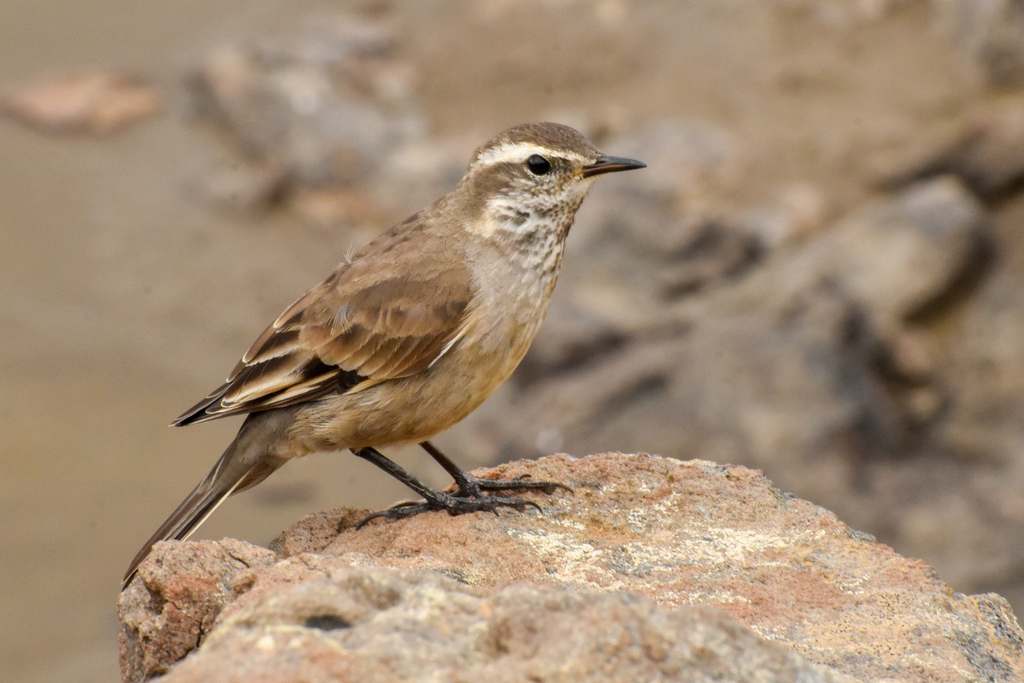
Buff-winged Cinclodes
Photo © Ezequiel Racker
Photo © Ezequiel Racker — CC BY 4.0 — Source: iNaturalist photo #201241680Identification
The buff-winged cinclodes is a small bird, measuring 15 to 19.4 cm long and weighing 29 to 33 g. It has a characteristic shortish bill and subtle but distinctive plumage markings. Look for a light buffish-white eyebrow stripe, dark gray-brown ear coverts with pale streaks, and a bright white malar area that flares toward the back of the head. The crown is dark gray-brown with a speckled forehead, and the upperparts are dark brown.
The wings are particularly diagnostic: dark brown wing coverts with wide buffish edges, and flight feathers with a narrow tawny-rufous band. The tail shows a graduated pattern, with the outer feathers progressively displaying more pale tawny tips. Underparts are predominantly whitish-buff on the belly with a white throat faintly scalloped in dark, dull pale-brown breast, and darker flanks. Both sexes share identical plumage, though juveniles appear more richly colored with dark edges on their underpart feathers.
Range & Habitat
This species inhabits a wide range across South America, with year-round populations in central and southern Chile and most of central and southern Argentina, including Tierra del Fuego. It migrates seasonally to northern Argentina, southern Brazil, southeastern Paraguay, and Uruguay, with occasional vagrant records from the Falkland Islands. The buff-winged cinclodes favors open habitats, particularly grassy environments such as páramo, puna, and temperate grasslands, though it also occurs in arid montane scrublands, Patagonian steppes, beaches, and open woodlands.
The species shows a strong preference for areas near water sources, especially bogs and streams. It is commonly encountered around human habitations and can be found from sea level to elevations of 3,000 meters. Much of the population moves northward after the breeding season, while others remain at their breeding latitude but descend to lower elevations during the austral winter.
Behaviour & Diet
The buff-winged cinclodes is partly migratory, with populations in Tierra del Fuego and Patagonia undertaking regular seasonal movements. It is a ground forager that feeds on a diverse diet of invertebrates, including many insects and molluscs, supplemented by seeds. When feeding, the bird hops and runs along the ground, probing and gleaning from both wet and dry substrates including rocks, beach debris, grass, dung, and shallow water. It typically forages singly or in pairs.
During breeding season—the austral summer from September through January or beyond—the species exhibits monogamous behavior. Males attract mates with a distinctive wing-flapping display performed from a perch. The buff-winged cinclodes excavates its own burrows at the end of tunnels dug into earth banks, or uses natural crevices among rocks and holes in human structures, occasionally occupying abandoned woodpecker holes. Both partners line the nesting chamber with a pad of grass and hair, and typically lay clutches of two to four eggs.
Best Time & Places to See It
The buff-winged cinclodes is widespread and common throughout most of its range, and in some areas represents the most abundant cinclodes species. Year-round residents in central and southern Chile and Argentina offer the most reliable viewing opportunities. During the austral winter months, populations expand into northern Argentina, Paraguay, Uruguay, and southern Brazil, making these regions productive for observation during the boreal summer.
Look for this species in open grasslands and near water sources such as streams and bogs. Human-modified landscapes including agricultural areas and settlements are equally productive, as the species benefits from habitats subject to only minimal disturbance and often profits from the effects of grazing. Early morning hours are optimal for observing singing males, particularly during the breeding season.
Photography Tips
The buff-winged cinclodes' small size and ground-dwelling habits require patience and a telephoto lens for effective photography. Position yourself near open grasslands and water sources where the bird forages on the ground, and use a longer focal length (400 mm or greater) to maintain distance while capturing frame-filling images. The bird's subtle plumage—buffish tones and fine streaking—demands careful exposure metering to avoid blown highlights on the white malar area and throat.
Dawn visits during breeding season offer the best opportunities to photograph singing males, which perform from visible perches and display with distinctive wing-flapping behavior. The open habitat where this species lives generally provides good lighting conditions, though the bird's dark upperparts and cryptic behavior mean that a fast shutter speed and high ISO may be necessary. Patient waiting near known feeding areas—particularly near streams, bogs, and grassy patches—will reward photographers with active foraging shots.
Peixe National Park Lagoon
Brazil
+293 birds+4 mammals
Where the coastal plains of Rio Grande do Sul meet the Atlantic, Peixe National Park Lagoon sprawls across nearly 2,200 square kilometres of shallow waters, reed…
VIEW NATIONAL PARKChiloé National Park
Dalcahue, Chile
+122 birds+6 mammals
Temperate rainforest cloaks the Chiloé archipelago's northwestern reaches, where granite ridges thrust through dense, moisture-laden canopy and freshwater streams carve ravines toward the Pacific. Across approximately…
VIEW NATIONAL PARKAlerce Costero National Park
Corral, Chile
+34 birds
Where temperate rainforest descends to the Pacific coast in southern Chile, Alerce Costero National Park protects one of the continent's rarest and most ancient ecosystems across…
VIEW NATIONAL PARKCabo de Hornos National Park
Cape Horn, Chile
+88 birds+9 mammals
Where the Andes plunge into the Southern Ocean and the Drake Passage churns between two continents, Cabo de Hornos National Park sprawls across one of Earth's…
VIEW NATIONAL PARKPan de Azúcar National Park
Chañaral, Chile
+74 birds+4 mammals
Where the Atacama Desert plunges toward the Pacific, Pan de Azúcar National Park sprawls across 727 square kilometres of one of Earth's most extreme transitions—a landscape…
VIEW NATIONAL PARKTorres del Paine National Park
Torres del Paine, Chile
+143 birds+10 mammals
Where granite spires pierce the Patagonian sky, Torres del Paine commands one of South America's most dramatic landscapes. Across 4,106 square kilometres of southern Chile, jagged…
VIEW NATIONAL PARKLaja National Park Lagoon
Antuco, Chile
+123 birds+1 mammals
Where the Andes descend into the Biobío Region's temperate forests, a vast lagoon fills the caldera of the extinct Antuco volcano, cradled by steep native woodland…
VIEW NATIONAL PARKPuyehue National Park
Puyehue, Chile
+110 birds+4 mammals
Across the volcanic spine of the Los Lagos Region, where the Andes descend toward temperate rainforest, Puyehue National Park encompasses nearly 2,600 square kilometers of one…
VIEW NATIONAL PARKLauca National Park
Putre, Chile
+139 birds+17 mammals
Where the Andes rise toward the altiplano in Chile's far north, Lauca National Park sprawls across more than 3,000 square kilometres of some of South America's…
VIEW NATIONAL PARKVicente Pérez Rosales National Park
Puerto Varas, Chile
+109 birds+8 mammals
Where the Andes descend toward the temperate rainforests of Chile's Lake District, nearly 4,641 square kilometers of pristine wilderness unfolds across Vicente Pérez Rosales National Park.…
VIEW NATIONAL PARKCerro Castillo National Park
Coyhaique, Chile
+89 birds+3 mammals
Granite peaks and windswept steppe converge across this vast Patagonian landscape, where the Andes' eastern flank drops into terrain sculpted by ice age glaciers and relentless…
VIEW NATIONAL PARKPatagonia National Park
Cochrane, Chile
+133 birds+8 mammals
Where the Andes meet the Patagonian steppe, vast grasslands and shrublands sweep across rolling terrain carved by ancient glaciation, their contours softened by distance and dramatic…
VIEW NATIONAL PARKReserva Nacional las Vicuñas
Putre, Chile
+87 birds+6 mammals
High desert plateaus interlace with volcanic ridges across this 4,204-square-kilometre expanse at the border between Chile and Bolivia, where altitudes exceed 3,500 metres and the climate…
VIEW NATIONAL PARKReserva Nacional Magallanes
Punta Arenas, Chile
+78 birds+2 mammals
Where windswept steppe meets sub-Antarctic forest near the southern tip of continental South America, Reserva Nacional Magallanes unfolds across roughly 352 square kilometres of profound ecological…
VIEW NATIONAL PARKParque Provincial Península de Magallanes
Argentina
+125 birds+4 mammals
Granite peaks and windswept steppe converge across this 415-square-kilometre peninsula jutting into the cold Atlantic waters of southern Patagonia, where the Magallanes landscape embodies the raw,…
VIEW NATIONAL PARKParque Municipal Llao Llao
San Carlos de Bariloche, Argentina
+73 birds+1 mammals
Where the Andes meet the Patagonian lakes, granite peaks rise above temperate rainforest in a landscape of startling contrasts. Parque Municipal Llao Llao, sprawling across 23…
VIEW NATIONAL PARKMonte León National Park
Argentina
+100 birds+4 mammals
Where the Patagonian steppe meets the Atlantic, Monte León National Park protects a landscape of windswept coastal cliffs, rocky outcrops, and semi-arid grassland spanning over 1,200…
VIEW NATIONAL PARKLos Glaciares National Park
Argentina
+121 birds+3 mammals
Where granite peaks and sprawling ice fields dominate the landscape, Los Glaciares National Park encompasses over ten thousand square kilometres of Patagonian wilderness in southern Argentina.…
VIEW NATIONAL PARKCampos del Tuyú National Park
Argentina
+169 birds+5 mammals
Subtropical forest graces the borderlands where Misiones Province meets Paraguay, a landscape shaped by the Paraná Plateau's weathered topography and the warm, humid climate of northeastern…
VIEW NATIONAL PARKPerito Moreno National Park
Argentina
+78 birds
Where the Patagonian steppe descends into a landscape carved by ancient ice, Perito Moreno National Park sprawls across nearly 1,590 square kilometres of some of South…
VIEW NATIONAL PARKNahuel Huapi National Park
Argentina
+124 birds+11 mammals
Where the Andes descend toward Patagonia, vast glacial lakes cut through a landscape of southern beech forest and granite peaks, creating one of South America's most…
VIEW NATIONAL PARKLanín National Park
Argentina
+128 birds+7 mammals
Where the volcanic spine of the Andes plunges into Patagonian steppe, Lanín National Park sprawls across nearly 4,700 square kilometers of one of Argentina's most visually…
VIEW NATIONAL PARKSierra de las Quijadas National Park
Argentina
+168 birds+5 mammals
Sandstone cliffs and deeply incised canyons define this 1,137-square-kilometre expanse in San Luis Province, where the dry Chacoan landscape of central Argentina reveals an unexpected ecological…
VIEW NATIONAL PARKLago Puelo National Park
Argentina
+109 birds+1 mammals
Where temperate forests descend to crystalline waters in the foothills of the Andes, Lago Puelo National Park sprawls across nearly 300 square kilometers of pristine wilderness…
VIEW NATIONAL PARKLos Alerces National Park
Argentina
+84 birds+3 mammals
Where the temperate rainforests of southern Patagonia sweep down towards crystalline lakes, Los Alerces National Park unfolds across nearly 3,000 square kilometres of one of South…
VIEW NATIONAL PARKNo community photos yet. Log in to add the first one.
No community observations of this species yet.