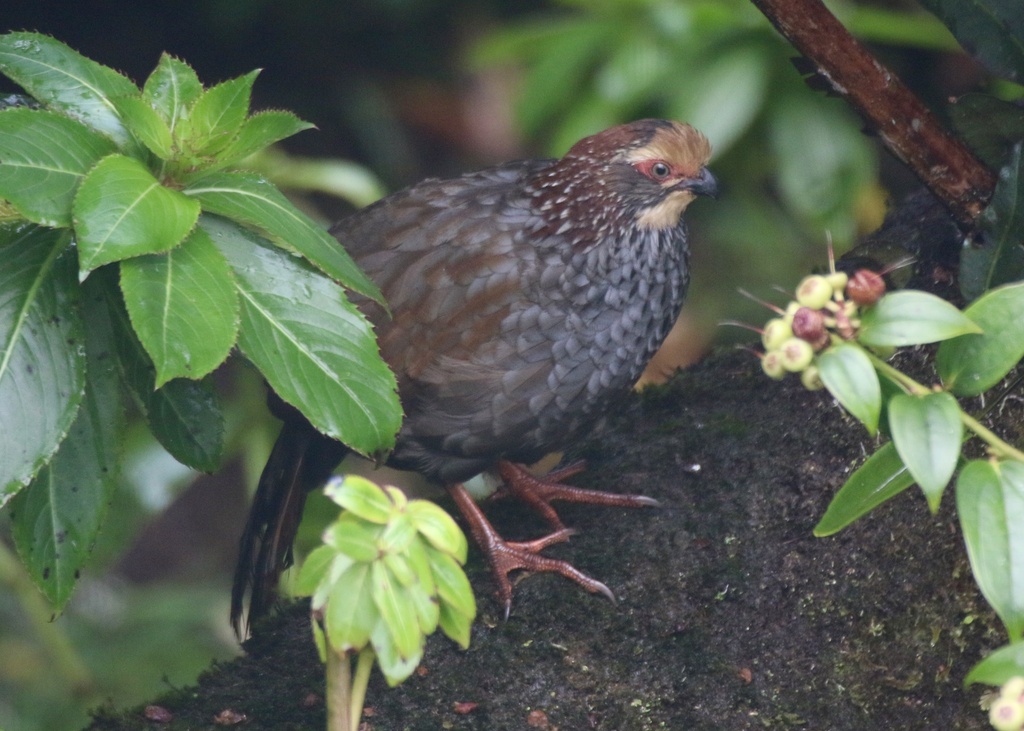
Buffy-crowned Wood Partridge
Photo © Cricket Raspet
Photo © Cricket Raspet — CC BY 4.0 — Source: iNaturalist photo #599918480Identification
The buffy-crowned wood partridge is a compact quail measuring 28 to 35.5 cm in length, with males weighing around 397 g and females approximately 340 g. The nominate subspecies displays distinctive white markings on the forehead, supercilium, chin, and throat, contrasting with a chestnut crown, short crest, and nape. A patch of bare red skin encircles the eye, a striking field mark. The back, wings, and tail combine chestnut and gray tones, while the belly is blue-gray with chestnut streaks. The darker subspecies D. l. hypospodius, found in central Costa Rica, is noticeably larger and grayer overall, with much narrower and darker breast stripes.
Range & Habitat
This species inhabits three separate ranges across Central America and southern Mexico. The nominate subspecies occurs from Chiapas in southern Mexico through western Guatemala, Honduras, El Salvador, and northwestern Nicaragua, with populations also in far eastern Guatemala. The subspecies D. l. hypospodius is restricted to central Costa Rica. The buffy-crowned wood partridge favours humid to semi-humid montane forests, including oak-pine, evergreen, and cloudforest types. Notably, the species demonstrates adaptability, occurring not only in primary forest but also in secondary growth, partially logged areas, and even coffee plantations.
Behaviour & Diet
These partridges forage by scratching through leaf litter, searching for seeds, buds, small fruits, and invertebrates, though their diet remains incompletely studied. They are social birds, moving in family groups of four to six during breeding season and forming larger coveys of up to 12 in the non-breeding season. Breeding occurs from February through June, with pairs typically nesting on the ground, either constructing domed structures or creating hollow scrapes in dense grasses. Clutches usually contain six to seven eggs.
Best Time & Places to See It
The buffy-crowned wood partridge is most vocal and active at dawn and into daylight hours, with activity resuming at dusk—these are prime times for detection. The species' primary vocalization, a rapid series of loud hoarse whistles rendered as "kee-orr-KWA" or "whew, Whit-cha, cha-waWHAT-cha," often preceded by softer notes, is often the first clue to its presence. The breeding season from February to June may offer enhanced opportunities for observation. Montane forest regions throughout its range, including coffee plantation margins, offer the best prospects.
Photography Tips
The buffy-crowned wood partridge's preference for dense forest understory and leaf-litter foraging makes photography challenging. Early morning visits to montane cloudforests during the breeding season increase encounter likelihood. The bird's striking facial pattern—white throat and supercilium contrasting with the chestnut crown and red eye-patch—rewards patient photographers with distinctive images. Ground-level positioning may be necessary to capture this species at natural height. Listen carefully for its distinctive calls to locate birds, then approach slowly and quietly through forest edges and secondary growth where visibility is better than in primary forest interior.
Chirripó National Park
Rivas, Costa Rica
+274 birds+6 mammals
Where the volcanic spine of Costa Rica's Central Cordillera reaches its apex, Chirripó National Park encompasses a landscape that shifts dramatically with elevation, from montane cloud…
VIEW NATIONAL PARKBraulio Carrillo National Park
Las Horquetas, Costa Rica
+547 birds+18 mammals
Where the Caribbean slope descends from the central volcanic cordillera toward the humid lowlands of Heredia, Braulio Carrillo National Park preserves one of Costa Rica's most…
VIEW NATIONAL PARKVolcán Poás National Park
Toro Amarillo, Costa Rica
+237 birds+4 mammals
Where volcanic slopes rise sharply from the Central Valley floor, Volcán Poás National Park protects one of Costa Rica's most active and accessible volcanic systems. The…
VIEW NATIONAL PARKLagunas de Montebello National Park
Laguna de Montebello, Mexico
+360 birds+2 mammals
Where turquoise lagoons pierce the limestone plateau of southeastern Chiapas, the Lagunas de Montebello National Park unfolds across roughly 174 square kilometers of spectral water and…
VIEW NATIONAL PARKLos Quetzales National Park
Copey, Costa Rica
+232 birds+3 mammals
Cloud forest sweeps across the upper slopes of the Central Valley watershed, where elevation and persistent moisture forge an ecosystem unlike any other in Costa Rica.…
VIEW NATIONAL PARKTapantí Macizo de la Muerte National Park
Orosi, Costa Rica
+503 birds+18 mammals
Where montane cloud forest rises steeply from the Orosi Valley, Tapantí Macizo de la Muerte National Park enfolds a landscape of perpetual moisture and emerald complexity.…
VIEW NATIONAL PARKLa Amistad International Park
Crorina, Costa Rica
+532 birds+20 mammals
Where the Caribbean slopes of Costa Rica's Talamanca Mountains rise steeply inland from Limón, the boundary between two nations dissolves into an unbroken expanse of rainforest.…
VIEW NATIONAL PARKNo community photos yet. Log in to add the first one.
No community observations of this species yet.