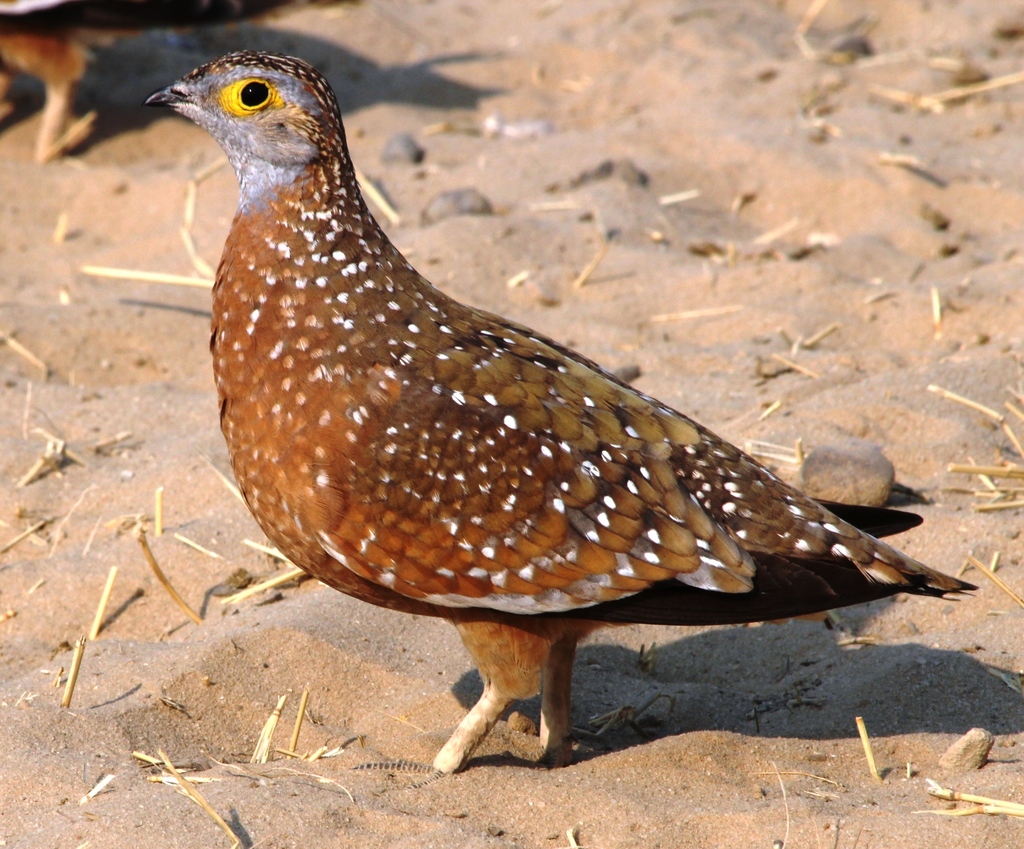
Burchell’s Sandgrouse
Photo © Tony Rebelo
Photo © Tony Rebelo — CC BY-SA 4.0 — Source: iNaturalist #10848363Identification
Burchell's sandgrouse is a plump, pigeon-sized bird with a small head and short legs. The overall plumage is light brown, intricately mottled with darker shades and white speckles that provide excellent camouflage in arid landscapes. Males are noticeably larger than females, reaching about 25 cm (10 in) in length, and display distinctive features including bare yellow skin surrounding the eye and pale grey cheeks and throat. Females are somewhat smaller and lack these facial markings, making them slightly more subdued in appearance.
Range & Habitat
This species is endemic to southern Africa, with its range spanning Angola, Namibia, Botswana, Zambia, Zimbabwe, and South Africa, where it is widespread and common throughout much of its distribution. Burchell's sandgrouse favours arid and semi-arid regions, typically frequenting areas of rough grass and scrub, particularly on the distinctive red sands of the Kalahari. The bird's range has actually expanded in recent decades, aided by the creation of water sources through the sinking of boreholes by farmers, demonstrating its adaptability to human-modified landscapes.
Behaviour & Diet
Like all sandgrouse, Burchell's is intimately tied to water availability in its harsh desert environment. The species primarily feeds on seeds, and moves about to a limited extent depending on water and food availability. Adult birds have evolved a remarkable adaptation for surviving in extremely hot conditions: when temperatures approach their critical thermal limit of around 43.8°C, they employ gular fluttering and panting for evaporative cooling. Most remarkably, Burchell's sandgrouse has developed an extraordinary water-transport system unique among birds. Adults prepare themselves by rubbing their bellies on dry ground to ruffle their feathers, then wade into water and bob up and down to saturate specially adapted breast feathers. Males typically carry an average of 22 ml of water in this manner, while females carry approximately 9 ml, which they transport back to their chicks at the nest.
Best Time & Places to See It
Burchell's sandgrouse is normally resident year-round, though local movements occur in response to water and seed availability. The species breeds during the dry season between April and October, a period when breeding birds are particularly active visiting water sources. As a widespread and common species across its range, it can be encountered throughout southern African countries including Botswana, Namibia, and South Africa, particularly in Kalahari regions. Early morning or late afternoon visits to waterholes and water sources offer the best chances of observation.
Photography Tips
Photographing Burchell's sandgrouse requires patience and positioning near water sources where birds congregate, particularly during the breeding season. The bird's cryptic colouration blends remarkably well with arid scrubland, so scanning areas of rough grass and Kalahari sand carefully is essential. Early morning or late afternoon light is ideal for capturing the subtle mottled patterns and distinctive yellow eye-patches of males. A telephoto lens is recommended, as the birds' wariness and preference for open, exposed habitats mean maintaining distance while still achieving frame-filling compositions.
Mapungubwe National Park
Musina Local Municipality, South Africa
+358 birds+29 mammals
Where the Limpopo River cuts through sandstone ridges at the convergence of South Africa, Botswana, and Zimbabwe, Mapungubwe National Park preserves a landscape of profound ecological…
VIEW NATIONAL PARKChobe National Park
Botswana
+446 birds+45 mammals
Where the Chobe River cuts a sinuous path through northern Botswana, the landscape transforms into one of Africa's most dynamic wetland-savanna mosaics. This national park encompasses…
VIEW NATIONAL PARKNxai Pan National Park
Botswana
+226 birds+16 mammals
Across the northwestern reaches of Botswana stretches a landscape of profound seasonal transformation—a sprawling pan system where shallow depressions fill and empty with the rains, creating…
VIEW NATIONAL PARKKhaudum National Park
Botswana
+213 birds+13 mammals
Where the Okavango's northern tributaries meander through miombo woodland and riverine forest, Khaudum National Park unfolds across a landscape of profound ecological richness and isolation. This…
VIEW NATIONAL PARKMokala National Park
Siyancuma Local Municipality, South Africa
+246 birds+35 mammals
Across the semi-arid savanna of the Northern Cape, where red earth meets sparse acacia woodland and open grassland punctuated by rocky outcrops, lies a landscape shaped…
VIEW NATIONAL PARKKhaudum National Park
Namibia
+221 birds+13 mammals
Where the Kavango River flows through northeastern Namibia, vast miombo woodlands and riverine forests create one of southern Africa's most remote and biodiverse wilderness corridors. Khaudum…
VIEW NATIONAL PARKNkasa Rupara National Park
Namibia
+283 birds+17 mammals
Where the Zambezi's floodplains spill across the border between Namibia and Botswana, Nkasa Rupara National Park unfolds across 518 square kilometers of wetland and woodland mosaic.…
VIEW NATIONAL PARKBwabwata National Park
Namibia
+377 birds+35 mammals
Where the Kavango River winds through northeastern Namibia, vast floodplains and dense riparian woodland create one of southern Africa's most ecologically dynamic protected landscapes. Spanning 14,249…
VIEW NATIONAL PARKEtosha National Park
Namibia
+356 birds+58 mammals
Across northern Namibia's stark semi-arid plateau, a vast shallow depression transforms seasonally into one of Africa's most dramatic wildlife theaters. Etosha National Park, encompassing more than…
VIEW NATIONAL PARKWaterberg Plateau National Park
Okambukonde, Namibia
+198 birds+27 mammals
Where ancient sandstone cliffs rise 200 metres above the surrounding bushveld, a fortress of geology creates one of southern Africa's most compelling ecosystems. The plateau's steep…
VIEW NATIONAL PARKMakgadikgadi Pans National Park
Gucta, Botswana
+272 birds+27 mammals
Where salt-crusted flatlands stretch endlessly toward a shimmering horizon, one of Africa's most extraordinary ecosystems awakens with the rains. The Makgadikgadi Pans comprise vast mineral-rich basins…
VIEW NATIONAL PARKNo community photos yet. Log in to add the first one.
No community observations of this species yet.