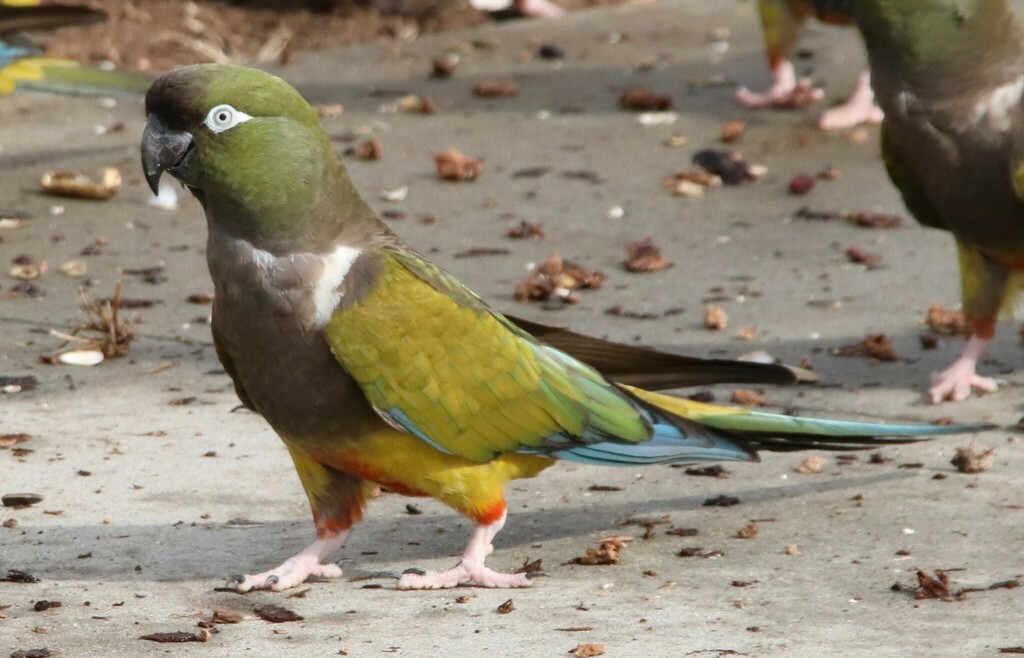
Burrowing Parrot
Photo © Millie Basden
Photo © Millie Basden — CC BY 4.0 — Source: iNaturalist photo #250640893The burrowing parrot (Cyanoliseus patagonus), also known as the burrowing parakeet or the Patagonian conure, is a species of parrot native to Argentina and Chile. It belongs to the monotypic genus Cyanoliseus, with four subspecies that are currently recognized. The burrowing parrot is unmistakable with a distinctive white eye ring, white breast marking, olive green body colour, and brightly coloured underparts. Named for their nesting habits, burrowing parrots excavate elaborate burrows in cliff faces and ravines in order to rear their chicks. They inhabit dry, open country up to 2000 m in elevation. Once abundant across Argentina and Chile, burrowing parrot populations have been in decline due to exploitation and persecution. == Taxonomy, phylogeny and systematics == The burrowing parrot was first described in 1818 by Louis Pierre Vieillot as Psittacus patagonus. The genus was later renamed Cyanoliseus by Charles Lucien Bonaparte in 1854. The burrowing parrot is the only member of the genus Cyanoliseus, making it monotypic. Together with other genera of long-tailed New World parrots, Cyanoliseus is a part of the Tribe Arini, which in turn is a part of the subfamily Arinae, or Neotropical parrots, in the family of true parrots, Psittacidae. The closest relative of the…
Lanín National Park
Argentina
+128 birds+7 mammals
Where the volcanic spine of the Andes plunges into Patagonian steppe, Lanín National Park sprawls across nearly 4,700 square kilometers of one of Argentina's most visually…
VIEW NATIONAL PARKSierra de las Quijadas National Park
Argentina
+168 birds+5 mammals
Sandstone cliffs and deeply incised canyons define this 1,137-square-kilometre expanse in San Luis Province, where the dry Chacoan landscape of central Argentina reveals an unexpected ecological…
VIEW NATIONAL PARKNo community photos yet. Log in to add the first one.
No community observations of this species yet.