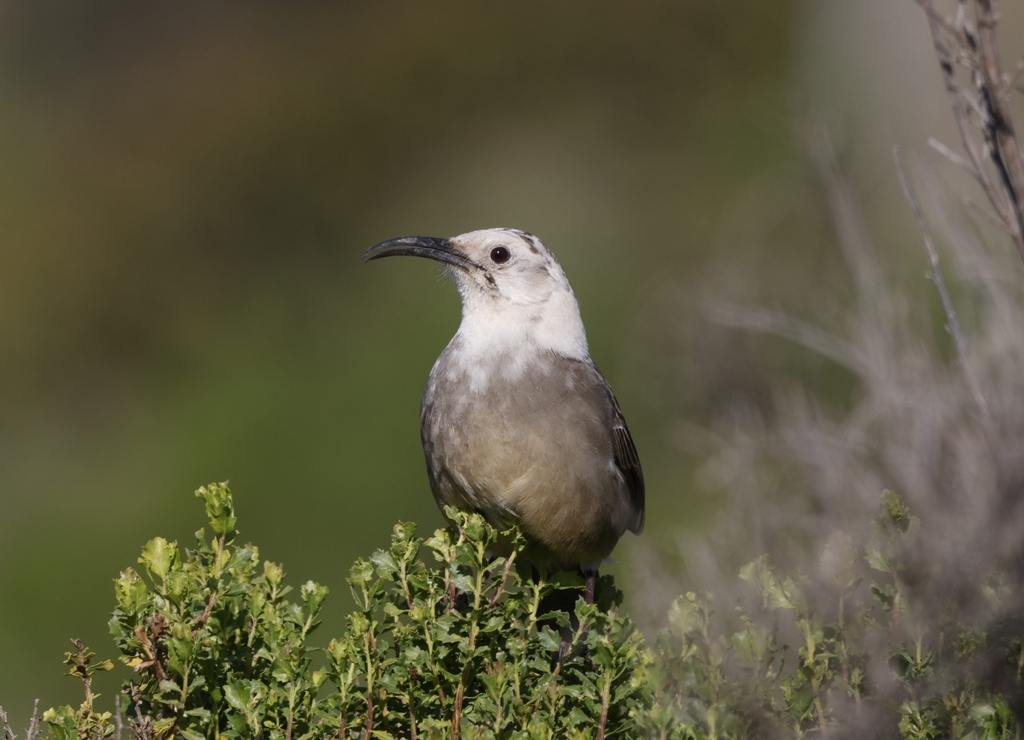
California Thrasher
Photo © Zack Abbey
Photo © Zack Abbey — CC BY 4.0 — Source: iNaturalist photo #619323405Identification
The California Thrasher is the largest member of the thrasher family, measuring about 32 cm (13 in) long and weighing up to 90 g (3.2 oz). It is unmistakable in the field: a deep grayish-brown bird with olive tones on the tail, featuring a distinctive long, decurved (downward-curved) bill and elongated tail. Look for a grayish-buff eyebrow stripe, dark cheek and eye line, and notably dark eyes—unusual among thrashers. The underparts are buffy to tawny brown, with a smoky gray upper breast and flanks.
Range & Habitat
This California endemic ranges year-round from Santa Cruz and Placer counties south through the coastal ranges and western Sierra Nevada slopes into northwestern Baja California, Mexico. Two subspecies exist with slight overlap allowing gene flow. The bird is a permanent resident of chaparral habitat, its primary home, and also inhabits sagebrush, juniper bushland, and oak woodlands with dense understory. It occasionally appears in suburban parks and gardens with heavy cover. Elevation ranges from sea level to 2,000 m (6,600 ft) in southern California mountains, though it is rarely found in open valleys.
Behaviour & Diet
The California Thrasher is cryptic and difficult to observe, preferring to remain hidden in dense brush. When exposed, it runs swiftly with its tail raised. About two-thirds of its foraging occurs on the ground, where it digs and sweeps leaf litter and soil with its bill. Spring diet consists almost exclusively of insects and small invertebrates; it adds soft fruits year-round. Males vigorously defend territories by chasing rivals and driving off their own young before breeding season. Both males and females sing, and the species is recognized as a striking, exuberant songster known for mimicking other species in its habitat. When threatened by large predators, the bird escapes by running into cover rather than flying, relying on its strong legs and tail.
Best Time & Places to See It
The breeding season, spanning February to July (sometimes starting in January), offers the best chance to locate this species by listening for its distinctive song. Search chaparral-covered slopes of the California Coast Ranges and western Sierra Nevada foothills. Early morning visits to dense shrubby areas are most productive. The bird's secretive nature means patience and careful observation are essential; scan the understory and listen for its mimetic vocalizations, which often reveal its presence before the bird is seen.
Photography Tips
This species presents a challenging photography subject due to its preference for dense cover. Position yourself near known territories during early morning hours when birds are most vocal and active. Use a telephoto lens (at least 400 mm) to capture distant perches and fleeting glimpses. The bird's dark plumage and shadowy habitat demand fast film speeds and careful exposure metering. When the thrasher forages on open ground beneath shrubs, use that opportunity for closer shots. Focus on its distinctive curved bill and dark eye, key identification features that make striking frame-fillers.
Lassen Volcanic National Park
Shasta County, United States
+239 birds+18 mammals
Volcanic peaks and geothermal upheaval have sculpted 545 square kilometers of Northern California into a landscape where fire and water engage in perpetual dialogue. Lassen Peak…
VIEW NATIONAL PARKPinnacles National Park
San Benito County, United States
+197 birds+33 mammals
Jagged volcanic spires thrust from chaparral-covered ridges across 222 square kilometers of central California's inner Coast Ranges, their pale stone crowns catching the afternoon light like…
VIEW NATIONAL PARKJoshua Tree National Park
Riverside County, United States
+221 birds+23 mammals
Across 5,610 square kilometers of Riverside County's high desert, a landscape of geological drama unfolds where granite monoliths pierce through bajadas of creosote scrub and Joshua…
VIEW NATIONAL PARKYosemite National Park
Mariposa County, United States
+224 birds+28 mammals
Granite cliffs soar nearly a kilometer above the valley floor in this expanse of high Sierra wilderness, where glacial U-shaped valleys sculpt a landscape of dramatic…
VIEW NATIONAL PARKSequoia National Park
Tulare County, United States
+187 birds+27 mammals
Granite peaks rising above 3,600 meters dominate the southern Sierra Nevada, where Sequoia National Park sprawls across one of North America's most vertically compressed wilderness zones.…
VIEW NATIONAL PARKKings Canyon National Park
Fresno County, United States
+186 birds+20 mammals
Where granite peaks fracture the Sierra Nevada skyline and the Kings River has carved one of North America's most dramatic canyons, a landscape of extreme relief…
VIEW NATIONAL PARKSacramento National Wildlife Refuge
Glenn County, United States
+247 birds+13 mammals
Across the flat expanse of Glenn County's Sacramento Valley, shallow pools and seasonal marshes create one of California's most vital wetland sanctuaries—a landscape shaped by water…
VIEW WILDLIFE SANCTUARYSan Luis National Wildlife Refuge
Merced County, United States
+219 birds+14 mammals
Across the floor of California's San Joaquin Valley, where semi-arid grasslands meet shallow seasonal wetlands, San Luis National Wildlife Sanctuary preserves a critical mosaic of habitats…
VIEW WILDLIFE SANCTUARYDon Edwards San Francisco Bay National Wildlife Refuge
Fremont, United States
+286 birds+20 mammals
Where the San Francisco Bay's shallow margins dissolve into tidal salt marshes and mudflats, this wildlife sanctuary preserves one of California's most ecologically vital estuarine systems.…
VIEW WILDLIFE SANCTUARYNo community photos yet. Log in to add the first one.
No community observations of this species yet.