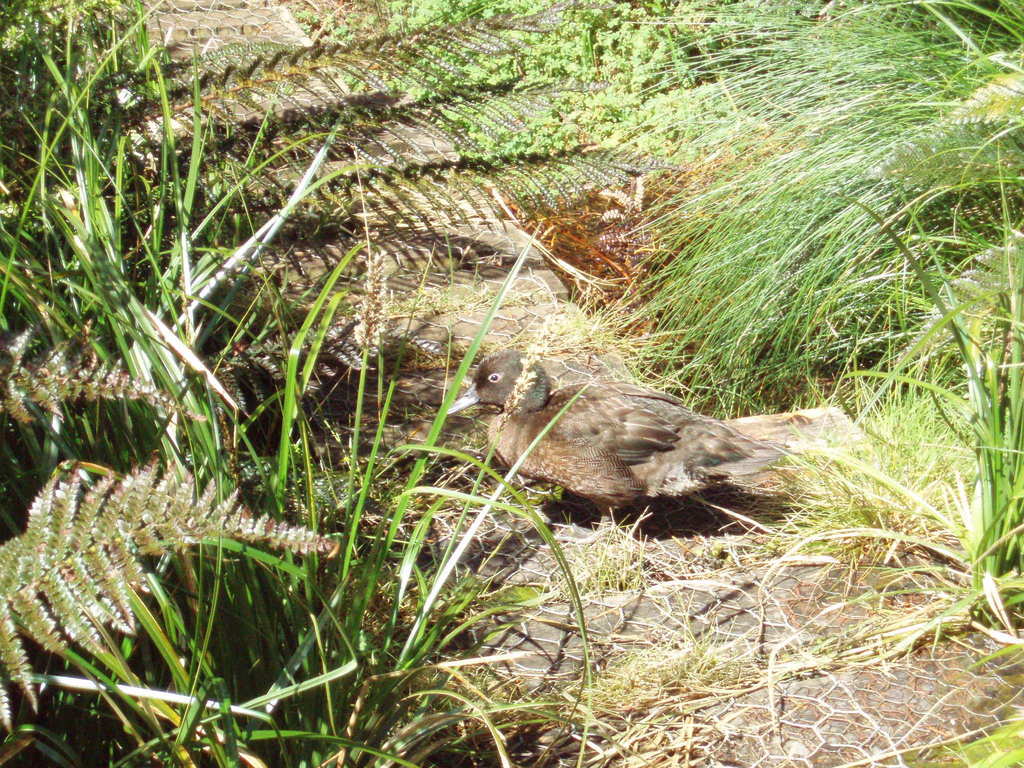
Campbell Teal
Photo © Colin Meurk
Photo © Colin Meurk — CC BY-SA 4.0 — Source: iNaturalist #940878Identification
The Campbell teal is a small, flightless dabbling duck with distinctly dark plumage. Males display dark sepia coloring with green iridescence on the head and back, complemented by a chestnut breast. Females are uniformly dark brown throughout. The species bears similarity to the Auckland teal, and was once considered conspecific with the brown teal, though it is now recognized as a distinct species endemic to New Zealand's Campbell Island group.
Range & Habitat
This species is found only in the Campbell Island group of New Zealand, where it inhabits tussock grassland dominated by Poa tussock grass, ferns, and megaherbs. The Campbell teal also utilizes the burrows and pathways created by petrel species that nest on these islands, making these seabird colonies integral to its habitat requirements. Historically found on Campbell Island itself, the species now occurs on multiple islands within the group following conservation efforts.
Behaviour & Diet
The Campbell teal is a nocturnal species, making it a challenging subject for observation. It is apparently territorial in the wild and feeds primarily on amphipods and insects, foraging within its preferred grassland habitat. As a flightless duck, it is entirely dependent on the island ecosystem for survival and cannot disperse to other locations.
Best Time & Places to See It
Campbell teal are nocturnal, making daytime sightings uncommon and requiring dedicated night-time observation efforts. The species is found on Campbell Island and the Campbell Island group. Following successful reintroduction efforts that began in 2004, populations have become re-established on Campbell Island itself. Access to these remote New Zealand islands is restricted and requires special permission, making encounters with this species feasible only for organized conservation trips or research expeditions.
Photography Tips
Photographing the Campbell teal presents significant challenges due to its nocturnal habits and remote island habitat. Night-time photography equipment and techniques will be essential for capturing images of this elusive species. The dark plumage of both sexes requires careful exposure management to reveal detail, particularly the subtle green iridescence on males' heads and backs. Given the species' small population and restricted range, photography opportunities are limited to authorized visits to the Campbell Island group, and photographers should prioritize the welfare of these vulnerable birds during any encounters.
Nothing matches these filters.
No community photos yet. Log in to add the first one.
No community observations of this species yet.