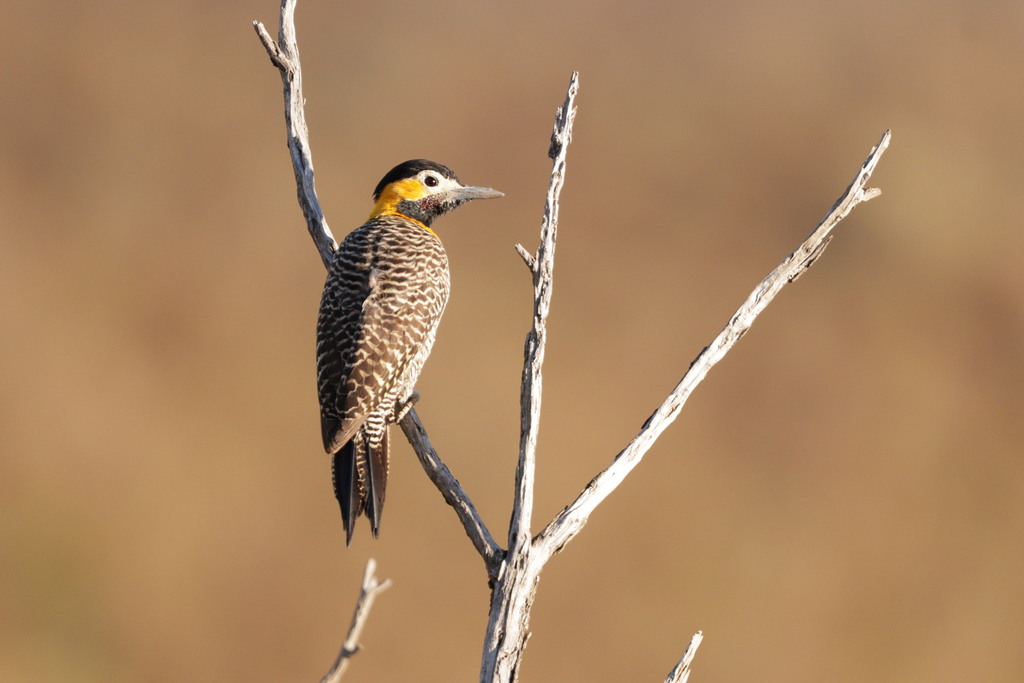
Campo Flicker
Photo © Conrado Pável de Oliveira
Photo © Conrado Pável de Oliveira — CC BY 4.0 — Source: iNaturalist photo #318334302Identification
The campo flicker is a medium-sized woodpecker, approximately 30 cm long and weighing about 150 g. Both sexes share distinctive plumage featuring a black crown, yellow face with white eye-rings, and brown upperparts barred with dull white. The most obvious sexual dimorphism appears on the face: males display a red malar stripe, while females show a black one. The rump is white with narrow dark bars, and the underparts are white with brown barring. The long bill is gray, and the iris reddish-brown. Juveniles resemble adults but display lighter yellow plumage. Two subspecies exist: the nominate campestris has a black throat, while campestroides has a white throat—their only structural difference.
Range & Habitat
The campo flicker is found across much of central and eastern South America, including Argentina, Bolivia, Brazil, Paraguay, Suriname, and Uruguay. The nominate subspecies inhabits disjunct populations in southern Suriname and northern Brazilian states, with a larger range extending from Maranhão south through Mato Grosso do Sul, central Paraguay, and northern Bolivia. Subspecies campestroides occurs from central Paraguay through Rio Grande do Sul and Uruguay into northeastern Argentina. The species inhabits diverse semi-open to open landscapes including savannas, the Pampas, scrubland, gallery forest edges, Pantanal grasslands, cerrado, parks, farmland, and heavily grazed pastures, from 80 m to 1,700 m elevation.
Behaviour & Diet
The campo flicker is a year-round resident throughout its range, foraging almost exclusively on the ground. It typically feeds in pairs or loose social groups, sometimes gathering up to seven individuals. The bird pecks, digs, and gleans for prey in ant and termite mounds, soil, stones, and fallen wood. Ants and termites—including adults, larvae, and pupae—form the bulk of its diet, with fruits comprising only a negligible portion. The species exhibits a complex social breeding system with predominantly monogamous pairs, though some cooperative groups include auxiliary females contributing eggs. Breeding peaks during the dry season in August and September, with nest cavities excavated in termite mounds, earthen banks, trees, or fence posts. Clutch size typically consists of four or five eggs. The campo flicker possesses a large vocal repertoire, including a rapid 'wicwicwic' song repeated 10 to 12 times, along with high, sharp, nasal calls like 'tih', 'tir', or 'wur'. Pairs duet with contrasting high and low calls.
Best Time & Places to See It
The campo flicker is considered common throughout its range and present year-round. The breeding season, peaking in August and September during the dry season, may offer increased activity and vocal engagement, particularly in Argentina and central Brazil. Suitable open and semi-open habitats such as savannas, grasslands, scrubland, and farmland provide the best viewing opportunities. The species' predominantly ground-feeding behavior makes it relatively accessible to patient observers in appropriate habitat.
Photography Tips
The campo flicker's terrestrial foraging habits and relatively open habitat preferences make it a rewarding subject for wildlife photography. Position yourself in open grassland or savanna habitats during early morning or late afternoon when feeding activity peaks. The bird's striking facial pattern—particularly the sexual dimorphism of the malar stripe—and barred plumage provide excellent detail for close-up shots. The species' tendency to feed in pairs or small groups offers opportunities for behavioral photography. Use a fast shutter speed to capture the pecking and digging motions characteristic of ground foraging. Listening for the distinctive rapid 'wicwicwic' call and the birds' duets can help locate them before visual searching.
Tijuca National Park
Brazil
+317 birds+13 mammals
Where the Atlantic forest rises steeply from Rio de Janeiro's urban edge, Tijuca National Park encompasses a landscape of dramatic granite peaks, cascading waterfalls, and closed-canopy…
VIEW NATIONAL PARKEmas National Park
Brazil
+333 birds+23 mammals
Across the high plateaux of central Brazil, where the cerrado grasslands roll toward distant horizons under an immense sky, Emas National Park anchors one of South…
VIEW NATIONAL PARKSerra do Cipó National Park
Brazil
+379 birds+5 mammals
Where granite escarpments rise above the Atlantic Forest transition zone in southeastern Brazil, Serra do Cipó National Park unfolds across a landscape of dramatic ridges, cascading…
VIEW NATIONAL PARKItatiaia National Park
Brazil
+519 birds+12 mammals
Where granite peaks pierce the Atlantic rainforest canopy in southeastern Brazil, Itatiaia National Park rises as one of the country's oldest and most ecologically vital protected…
VIEW NATIONAL PARKSaint-Hilaire/Lange National Park
Brazil
+225 birds
Subtropical Atlantic forests rise and fall across the plateaus of inland Paraná, where Saint-Hilaire/Lange National Park protects nearly 578 square kilometres of Brazil's most biodiverse woodland…
VIEW NATIONAL PARKSerra do Itajaí National Park
Brazil
+227 birds+2 mammals
Where the Atlantic rainforest rises steeply from the coastal plains of Santa Catarina, Serra do Itajaí National Park spreads across 1,136 square kilometres of montane wilderness…
VIEW NATIONAL PARKSerra da Bocaina National Park
Brazil
+441 birds+5 mammals
Where the escarpment of the Serra da Bocaina rises sharply from the Atlantic coastal plain, tropical rainforest cloaks steep mountainsides that climb toward peaks exceeding 2,000…
VIEW NATIONAL PARKIguaçu National Park
Brazil
+387 birds+17 mammals
Where the Paraná Plateau plunges toward the Atlantic watershed, six thousand square kilometers of subtropical rainforest cling to steep gorges and river valleys in this corner…
VIEW NATIONAL PARKIlha Grande National Park
Brazil
+233 birds
Across the subtropical plateaus and Atlantic forest remnants of southern Brazil, a vast protected landscape spanning nearly 4,600 square kilometers safeguards one of the continent's most…
VIEW NATIONAL PARKSão Joaquim National Park
Brazil
+222 birds+9 mammals
Where the southern Brazilian highlands rise above the Atlantic Forest, São Joaquim National Park protects nearly 1,000 square kilometers of montane terrain that shifts between temperate…
VIEW NATIONAL PARKPau Brasil National Park
Brazil
+211 birds
Tropical Atlantic forest cloaks the rolling terrain of northeastern Bahia, where Pau Brasil National Park protects nearly 390 square kilometers of one of Brazil's most biodiverse…
VIEW NATIONAL PARKSerra dos Órgãos National Park
Brazil
+446 birds+13 mammals
Granite peaks thrust skyward through the Atlantic Forest canopy in the mountains immediately north of Rio de Janeiro, their bare rock faces rising above a landscape…
VIEW NATIONAL PARKChapada dos Guimarães National Park
Brazil
+450 birds+1 mammals
Where weathered sandstone plateaus rise above the cerrado grasslands of central Brazil, Chapada dos Guimarães National Park protects 624 square kilometres of ecological transition zone that…
VIEW NATIONAL PARKChapada dos Veadeiros National Park
Brazil
+324 birds+6 mammals
Where granite plateaus rise above the cerrado savanna in central Brazil, Chapada dos Veadeiros National Park unfolds across 6,665 square kilometres of some of the world's…
VIEW NATIONAL PARKPantanal Matogrossense National Park
Brazil
+322 birds+17 mammals
Where the flooded forests of central Brazil meet vast seasonally inundated grasslands, Pantanal Matogrossense National Park sprawls across nearly 2,900 square kilometers of one of the…
VIEW NATIONAL PARKChapada Diamantina National Park
Brazil
+346 birds+5 mammals
Where granite peaks and sandstone cliffs rise abruptly from the Brazilian interior, Chapada Diamantina National Park sprawls across 4,215 square kilometers of some of Brazil's most…
VIEW NATIONAL PARKSerra do Gandarela National Park
Brazil
+333 birds+3 mammals
Where granite massifs rise through Atlantic Forest in southeastern Brazil's highlands, Serra do Gandarela National Park protects nearly 1,000 square kilometres of montane terrain that few…
VIEW NATIONAL PARKBrasília National Park
Plano Piloto, Brazil
+338 birds+15 mammals
Cerrado grassland and scattered woodland sweep across the central Brazilian plateau where this national park sprawls across more than a thousand square kilometres of the Federal…
VIEW NATIONAL PARKAraucárias National Park
Brazil
+231 birds+3 mammals
Where the southern Brazilian highlands rise into cool temperate forest, Araucárias National Park protects one of the Atlantic Forest's most distinctive ecosystems across 506 square kilometres…
VIEW NATIONAL PARKSerra Geral National Park
Brazil
+211 birds+2 mammals
Where basalt cliffs and sandstone escarpments rise above the subtropical forests of southern Brazil, Serra Geral National Park preserves one of the Atlantic region's most dramatic…
VIEW NATIONAL PARKCampos Gerais National Park
Brazil
+143 birds
Where rolling plateaus rise above the Atlantic forest escarpment in Paraná's interior, Campos Gerais National Park unfolds across 539 square kilometers of highland grassland and forest…
VIEW NATIONAL PARKEl Palmar National Park
Distrito Sexto, Argentina
+244 birds+14 mammals
Across the Paraná River floodplain in northeastern Argentina, palms rise from wetland and grassland in a landscape shaped by water and time. El Palmar National Park…
VIEW NATIONAL PARKRío Pilcomayo National Park
Argentina
+271 birds+13 mammals
Where the Río Pilcomayo cuts through northeastern Argentina's subtropical lowlands, a sprawling mosaic of wetlands, grasslands, and seasonally flooded forests creates one of South America's most…
VIEW NATIONAL PARKIguazú National Park
Puerto Iguazú, Argentina
+346 birds+15 mammals
Where the Paraná Plateau plunges toward the Atlantic watershed, nearly 800 square kilometers of subtropical rainforest drape across Misiones Province in a landscape carved by millennia…
VIEW NATIONAL PARKSierra de las Quijadas National Park
Argentina
+168 birds+5 mammals
Sandstone cliffs and deeply incised canyons define this 1,137-square-kilometre expanse in San Luis Province, where the dry Chacoan landscape of central Argentina reveals an unexpected ecological…
VIEW NATIONAL PARKParque Provincial Pampa del Indio
Laguna Limpia, Argentina
+231 birds+4 mammals
Across the flat horizons of Chaco Province, where the Paraná River system spills into vast wetlands and grasslands, Parque Provincial Pampa del Indio protects one of…
VIEW NATURE RESERVEChaco National Park
Municipio de Presidencia de la Plaza, Argentina
+258 birds+7 mammals
Across the humid subtropical lowlands of northeastern Argentina, where the Paraná River basin feeds vast seasonal wetlands and gallery forests, Chaco National Park protects one of…
VIEW NATIONAL PARKNo community photos yet. Log in to add the first one.
No community observations of this species yet.